Category
page 11945 in Japan

Atomic bombings of Hiroshima and Nagasaki
On 6 and 9 August 1945, the United States detonated two atomic bombs over the Japanese cities of Hiroshima and Nagasaki, respectively, during the final days of World War II. The aerial bombings killed 150,000 to 246,000 people, most of whom were civilians, and remain the first and only uses of nuclear weapons in an armed conflict.
In the final year of World War II, the Allies prepared for a costly invasion of the Japanese mainland. This undertaking was preceded by a conventional bombing and firebombing campaign that devastated 64 Japanese cities, including an operation on Tokyo. The war in Europe concluded when Germany surrendered on 8 May 1945, and the Allies turned their full attention to the Pacific War. By July 1945, the Allies' Manhattan Project had produced two types of atomic bombs: "Little Boy", an enriched uranium gun-type fission weapon, and "Fat Man", a plutonium implosion-type nuclear weapon. The 509th Composite Group of the U.S. Army Air Forces was trained and equipped with the specialized Silverplate version of the Boeing B-29 Superfortress, and deployed to Tinian in the Mariana Islands. The Allies called for the unconditional surrender of the Imperial Japanese Armed Forces in the Potsdam Declaration on 26 July 1945, the alternative being "prompt and utter destruction". The Japanese government ignored the ultimatum. Japan announced its surrender to the Allies on 15 August, six days after the bombing of Nagasaki and the Soviet Union's declaration of war against Japan and invasion of Manchuria. The Japanese government signed an instrument of surrender on 2 September, ending the war.

Kamikaze
thumb|254x254px|A kamikaze attack aircraft crashes into a US naval warship, May 1945.
, officially , were a part of the Japanese Special Attack Units of military aviators who flew suicide attacks for the Empire of Japan against Allied naval vessels in the closing stages of the Pacific campaign of World War II, intending to destroy warships more effectively than with conventional air attacks. About 3,800 kamikaze pilots died during the war in attacks that killed more than 7,000 Allied naval personnel, sank several dozen warships, and damaged scores more. The term is used generically in modern w

Battle of Iwo Jima
1945 major battle in which US Forces captured the island of Iwo Jima from Japan during World War II

Battle of Okinawa
1945 major battle of the Pacific War
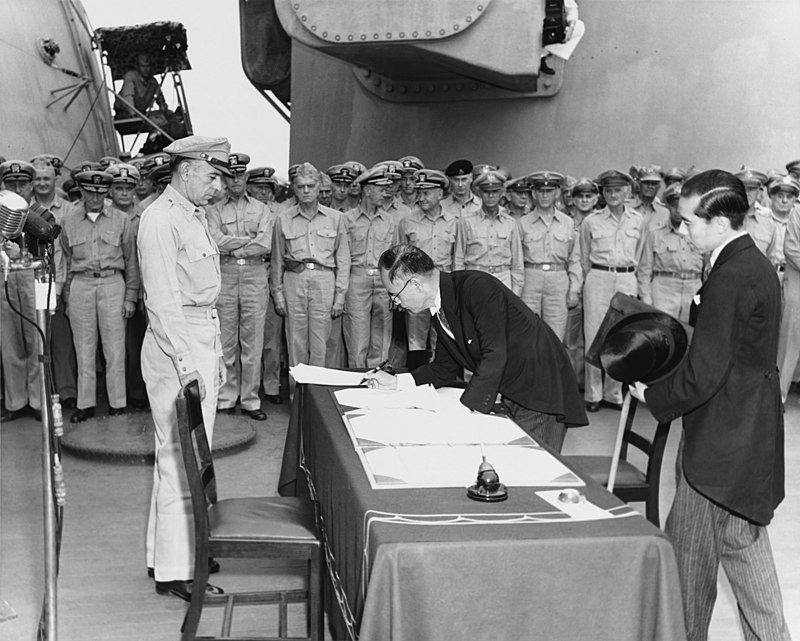
surrender of Japan
end of World War II, 2 September 1945

occupation of Japan
1945 Allied occupation of Japan following WWII
Soviet invasion of Manchuria
1945 invasion; part of the Soviet–Japanese War of World War II
Operation Ten-Go
1945 Japanese naval operation in World War II
Japanese Instrument of Surrender
1945 agreement ending hostilities in WWII
Bombing of Tokyo
1940s air raids by the United States Air Force in WWII
Hirohito surrender broadcast
radio broadcast in which Emperor Hirohito announced the Japanese surrender in World War II
Victory over Japan Day
day on which Japan surrendered, effectively ending World War II
Kuril Islands landing operation
part of the 1945 Soviet–Japanese War
Kyūjō Incident
coup d'état
Volcano and Ryukyu Islands campaign
1945 campaign
Bombing of Tokyo (10 March 1945)
1945 Firebombing raid on Tokyo (WWII)
Invasion of Lingayen Gulf
1945 invasion, part of World War II
Battle of Shumshu
1945 Russian-Japanese WWII battle
bombing of Kobe in World War II
aerial bombing of Kobe, Japan during World War II
Japan campaign
1942–45 campaign in Japan during the Second World War
Soviet invasion of South Sakhalin
1945 Soviet invasion of the Japanese portion of Sakhalin Island
Battle of Sagami Bay
1945 naval battle of the Japanese coast in WWII
Allied naval bombardments of Japan during World War II
1945 Simultaneous bombings of Japan by the Allies during World War II
Operation Starvation
World War II naval mining operation

Battle of West Hunan
1945 battle
Volunteer Fighting Corps
Defunct militia of Imperial Japan.
Battle of Corregidor
1945 WWII battle in the Pacific Theater
1945 Mikawa earthquake
earthquake offshore near Aichi prefecture, Japan
Battle of Bataan
1945 battle during World War II
bombing of Nagoya
bombing of Nagoya in World War II

Attack on Yokosuka
part of Pacific War, World War II
proposed Soviet invasion of Hokkaido
plans made to invade Hokkaido in August 1945
Second Guangxi campaign
1945 Chinese counter offensive
Operation PX
planned Japanese biological attack on the United States in World War II
Typhoon Ida
Pacific typhoon in 1945
Bombing of Osaka
1945 strategic bombing during World War II
Bombing of Nagaoka in World War II
1945 aerial bombing of a city
1945 in Japan
overview of Japan-related events during the year of 1945
Shinto Directive
order by Supreme Commander for the Allied Powers
Kalagong massacre
Mass killing of civilians by Japanese troops in Burma on 7 July 1945

Bombing of Okazaki in World War II
1945 aerial bombing of a city
Battle of West Henan–North Hubei
1945 battle
Bombing of Akita in World War II
1945 last bombing mission in World War II
Seishin Operation
1945 amphibious assault in northern Korea