Category
page 11st-century Roman emperors

Augustus
Augustus (born Gaius Octavius; 23 September 63 BC – 19 August AD 14), also known as Octavian (), was the founder of the Roman Empire and the first Roman emperor from 27 BC until his death in AD 14. The reign of Augustus initiated an imperial cult and an era of imperial peace (the or ) in which the Roman world was largely free of armed conflict. The principate, a style of government where the emperor showed nominal deference to the Senate, was established during his reign and lasted until the Crisis of the Third Century.

Nero
Nero Claudius Caesar Augustus Germanicus ( ; born Lucius Domitius Ahenobarbus; 15 December AD 37 – 9 June AD 68) was a Roman emperor and the final emperor of the Julio-Claudian dynasty, reigning from AD 54 until his suicide in AD 68.
Caligula
Gaius Julius Caesar Augustus Germanicus (31 August AD 12 – 24 January AD 41), also called Gaius and Caligula (), was Roman emperor from AD 37 until his assassination in AD 41. He was the son of the Roman general Germanicus and Augustus' granddaughter Agrippina the Elder, members of the first ruling family of the Roman Empire. He was born two years before Tiberius became emperor. Gaius accompanied his father, mother and siblings on campaign in Germania, at little more than four or five years old. He had been named after Gaius Julius Caesar, but his father's soldiers affectionately nicknamed him

Tiberius
Tiberius Julius Caesar Augustus ( ; 16 November 42 BC – 16 March AD 37) was Roman emperor from AD 14 until 37. He succeeded his stepfather Augustus, the first Roman emperor. Tiberius was born in Rome in 42 BC to politician Tiberius Claudius Nero and his wife, Livia Drusilla. In 38 BC, Livia divorced Nero and married Augustus. Following the untimely deaths of Augustus's two grandsons and adopted heirs, Gaius and Lucius Caesar, Tiberius was designated Augustus's successor. Prior to this, Tiberius had proved himself an able diplomat and one of the most successful Roman generals. His conquests of
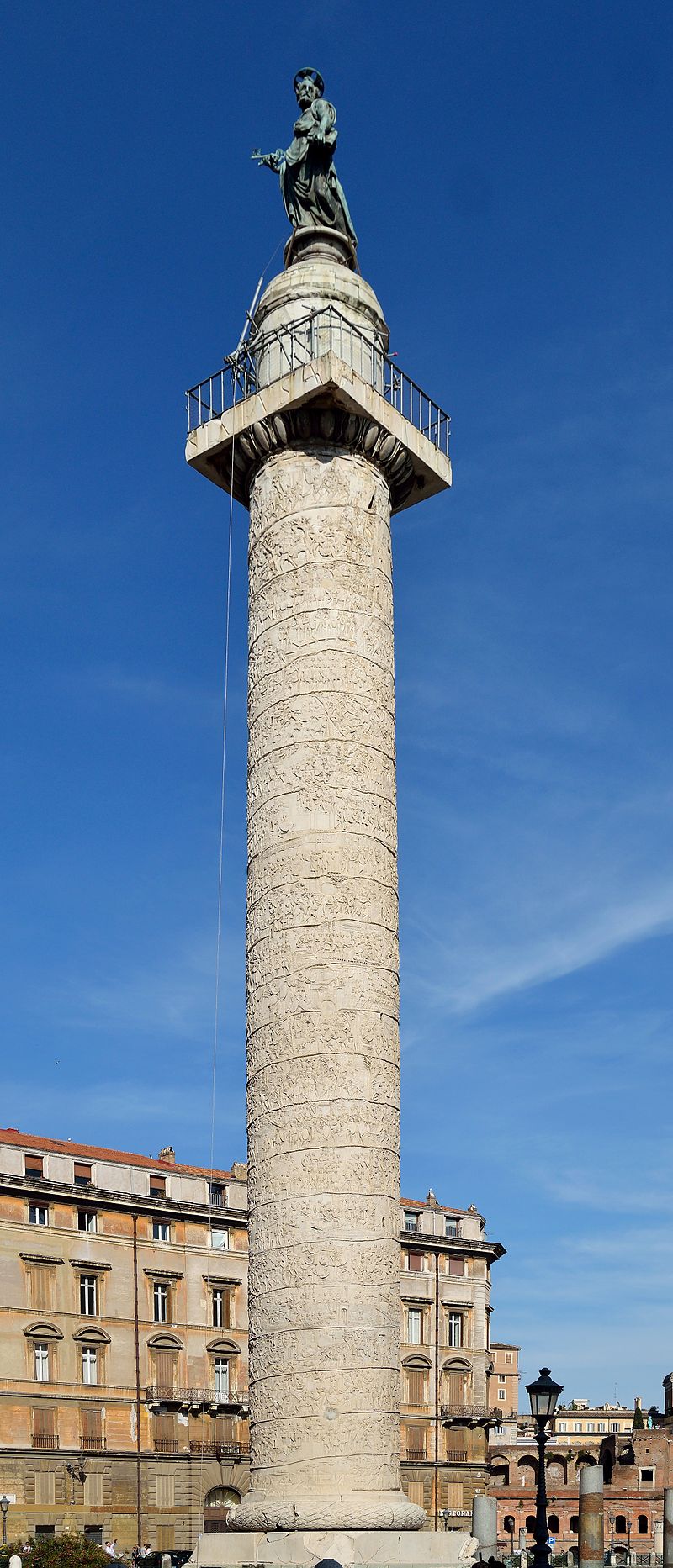
Trajan
Trajan ( ; born Marcus Ulpius Traianus, 18 September 53) was a Roman emperor from AD 98 to 117, remembered as the second of the Five Good Emperors of the Nerva–Antonine dynasty. He was a philanthropic ruler and a successful soldier-emperor who presided over one of the greatest military expansions in Roman history, during which, by the time of his death, the Roman Empire reached its maximum territorial extent. He was given the title of optimus princeps ('the best ruler') by the Roman Senate.

Vespasian
Vespasian (; ; 17 November 9 AD – 23 June 79) was Roman emperor from 69 to 79. The last emperor to reign in the Year of the Four Emperors, he founded the Flavian dynasty, which ruled the empire for 27 years. His fiscal reforms and consolidation of the empire brought political stability and an extensive building program.
Claudius
Tiberius Claudius Caesar Augustus Germanicus ( ; ; 1 August 10 BC – 13 October AD 54), or Claudius, was a Roman emperor, ruling from AD 41 to 54. A member of the Julio-Claudian dynasty, Claudius was born to Drusus and Antonia Minor at Lugdunum in Roman Gaul, where his father was stationed as a military legate. He was the first Roman emperor to be born outside Italy.
.png)
Titus
Titus Flavius Vespasianus (; 30 December 39 – 13 September 81 AD) was Roman emperor from 79 to 81 AD. A member of the Flavian dynasty, Titus succeeded his father Vespasian upon his death, becoming the first Roman emperor ever to succeed his biological father.

Domitian
Domitian ( ; (24 October 51 – 18 September 96) was Roman emperor from 81 to 96. The son of Vespasian and the younger brother of Titus, his two predecessors on the throne, he was the last member of the Flavian dynasty. Described by the historian Brian W. Jones as "a ruthless but efficient autocrat", his authoritarian style of ruling put him at sharp odds with the Senate, whose powers he drastically curtailed.
%20(35867773310)%20edited.jpg)
Galba
Galba ( ; born Servius Sulpicius Galba; 24 December 3 BC – 15 January AD 69) was Roman emperor, ruling for 7 months from 8 June AD 68 to 15 January 69. He was the first emperor in the Year of the Four Emperors and assumed the throne following Emperor Nero's suicide.

Otho
Otho (; born Marcus Salvius Otho; 28 April 32 – 16 April 69) was Roman emperor, ruling for three months from 15 January to 16 April 69. He was the second emperor of the Year of the Four Emperors.

Vitellius
Aulus Vitellius ( ; 24 September 1520 December 69) was Roman emperor, ruling for eight months from 19 April to 20 December AD 69. Vitellius became emperor following the quick succession of the previous emperors Galba and Otho, in a year of civil war known as the Year of the Four Emperors. Vitellius added the honorific title Germanicus to his name instead of Caesar upon his accession. Like his predecessor, Otho, Vitellius attempted to rally public support to his cause by honoring and imitating Nero who remained popular in the empire.

Nerva
Nerva (; born Marcus Cocceius Nerva; 8 November 30 – 27 January 98) was a Roman emperor from AD 96 to 98. Nerva became emperor when aged almost 66, after a lifetime of imperial service under Nero and the succeeding rulers of the Flavian dynasty.

Year of the Four Emperors
battles for succession to rule the Roman Empire (AD 69)