Category
page 120th century in philosophy

positivism
thumb|right|upright=1|Auguste Comte, the founder of modern positivism

analytic philosophy
20th-century tradition of Western philosophy
continental philosophy
set of 19th- and 20th-century philosophical traditions from mainland Europe
Tractatus Logico-Philosophicus
philosophical work by Wittgenstein
scientism
Scientism is the belief that science and the scientific method are the best or only way to render truth about the world and reality.

Narodniks
The Narodniks were members of a movement of the Russian Empire intelligentsia in the 1860s and 1870s, some of whom became involved in revolutionary agitation against tsarism. Their ideology, known as Narodism, Narodnism, or '''''', was a form of agrarian socialism, though it is often misunderstood as populism.
Dasein
'''''' ( ; ) is a term in the philosophy of Martin Heidegger. Adopted from the ordinary German word meaning 'existence', Heidegger used it to refer to the mode of being that he believed is particular to human beings, who are aware of and must confront such issues as personhood, mortality, and the dilemma or paradox of living in relationship with other humans while being ultimately alone with oneself.
Traditionalist School
perennial philosophy
Russian cosmism
philosophical and cultural movement that emerged in Russia in the turn of the 19th and 20th centuries
Doxa
Doxa (; from verb ) is a common belief or popular opinion. In classical rhetoric, doxa is contrasted with episteme ('knowledge').

The Society of the Spectacle
essay by Guy Debord
Islamic Declaration
book by Alija Izetbegović

cultural turn
1970s movement in the humanities and social sciences
philosophy in the Soviet Union
Heidegger and Nazism
philosopher's relations to the politics of his time

The World Forum for Proximity of Islamic Schools of Thought
organization

Language, Truth, and Logic
philosophical book by A. J. Ayer
Black Notebooks
work by Martin Heidegger

Law, Legislation and Liberty
book by Friedrich von Hayek
indeterminacy of translation
philosophical concept by W. V. Quine

The Origin of the Work of Art
book
Roerichism
thumb|300px|
Heideggerian terminology
terminology
Nonexistent objects
concept in metaphysics
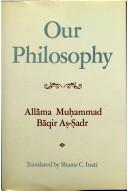
Falsafatuna
Falsafatuna is a book by Muhammad Baqir al-Sadr, published in 1959, which has been translated into English as Our Philosophy. It is a critique of European philosophy, especially of capitalism and socialism, from an Islamic viewpoint. It was aimed at secular youth in Iraq, and was written in response to the growth of communist ideas.
fundamental ontology
analytic of Dasein’s ontological constitution or being as a grounding of metaphysics