Category
page 12nd-century writers
%20-%20Veloso%20Salgado.png)
Galen
Aelius Galenus or Claudius Galenus (; September 129 – CE), often anglicized as Galen () or Galen of Pergamon, was a Roman and Greek physician, surgeon, and philosopher. Considered to be one of the most accomplished of all medical researchers of antiquity, Galen influenced the development of various scientific disciplines, including anatomy, physiology, pathology, pharmacology, and neurology, as well as philosophy and logic.

Lucian of Samosata
Lucian of Samosata (Λουκιανὸς ὁ Σαμοσατεύς, 125 – after 180) was a Hellenized Syrian satirist, rhetorician and pamphleteer who is best known for his characteristic tongue-in-cheek style, with which he frequently ridiculed philosophers and priests, speculative beliefs about the nature of the universe, religious practices, and superstitions. Although his native language was probably Syriac, all of his extant works are written entirely in ancient Greek (mostly in the Attic Greek dialect popular during the Second Sophistic period).

Apuleius
Apuleius ( ), also called Lucius Apuleius Madaurensis (c. 124 – after 170), was a Numidian Latin-language prose writer, Platonist philosopher and rhetorician. He was born in the Roman province of Numidia, in the Berber city of Madauros, modern-day M'Daourouch, Algeria. He studied Platonism in Athens, travelled to Italy, Asia Minor, and Egypt, and was an initiate in several cults or mysteries. The most famous incident in his life was when he was accused of using magic to gain the attentions (and fortune) of a wealthy widow. He declaimed his own defense before the proconsul and a court of magist
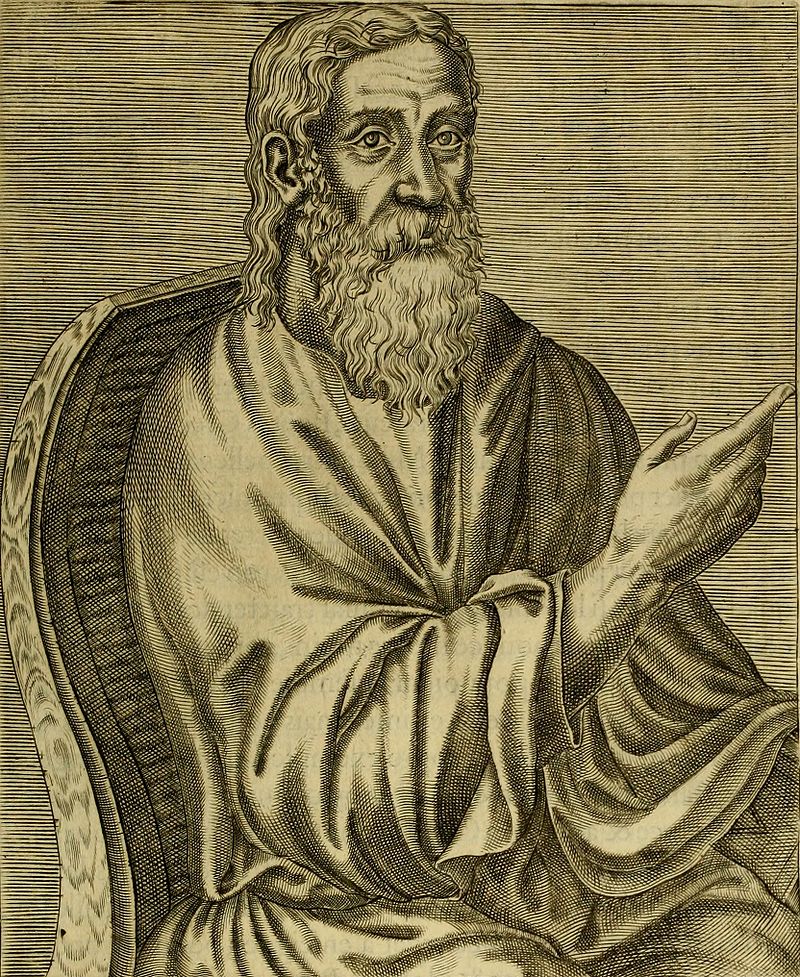
Clement of Alexandria
Christian theologian (c.150 – c.215)

Ignatius of Antioch
late 1st/early 2nd century Christian author and Patriarch of Antioch

Justin Martyr
2nd century CE Christian apologist and martyr

Pausanias
ancient Greek geographer, travel writer and mythographer

Polycarp
Polycarp (; , Polýkarpos; ; AD 69 155) was a Christian bishop of Smyrna. According to the Martyrdom of Polycarp, he died a martyr, bound and burned at the stake, then stabbed when the fire failed to consume his body. Polycarp is regarded as a saint and Church Father in the Eastern Orthodox Church, the Catholic Church, Oriental Orthodox Churches, Lutheranism, and Anglicanism.

Ulpian
Ulpian (; ; 223 or 228) was a Roman jurist born in Tyre in Roman Syria (modern Lebanon). He moved to Rome and rose to become considered one of the great legal authorities of his time. He was one of the five jurists upon whom decisions were to be based according to the Law of Citations of Valentinian III, and supplied the Justinian Digest about a third of its contents.

Marcion of Sinope
Anatolian Christian theologian (c.85–c.160)

Tatian
Tatian of Adiabene, or Tatian the Syrian or Tatian the Assyrian, (; ; ; ; – ) was an Assyrian Christian writer and theologian of the 2nd century.

Longus
right|thumb|Daphnis and Chloe by Jean-Pierre Cortot
Longus, sometimes Longos (), was the author of an ancient Greek novel or romance, Daphnis and Chloe. Nothing is known of his life; it is assumed that he lived on the isle of Lesbos (setting for Daphnis and Chloe) during the 2nd century AD.

Papinian
Aemilius Papinianus (; ; 142 CE–212 CE), simply rendered as Papinian () in English, was a celebrated Roman jurist, magister libellorum, attorney general (advocatus fisci) and, after the death of Gaius Fulvius Plautianus in 205 CE, praetorian prefect.

Marcus Cornelius Fronto
2nd century Roman rhetorician and advocate

Nicomachus
Nicomachus of Gerasa (; ) was an Ancient Greek Neopythagorean philosopher from Gerasa, in the Arabia Petraea (now Jerash, Jordan). He is perhaps Hellenized of Arab origin from Jerash. Like many Pythagoreans, Nicomachus wrote about the mystical properties of numbers, best known for his works Introduction to Arithmetic and Manual of Harmonics, which are an important resource on Ancient Greek mathematics and Ancient Greek music in the Roman period. Nicomachus' work on arithmetic became a standard text for Neoplatonic education in Late antiquity, with philosophers such as Iamblichus and John Philo

Polyaenus
thumb|Polyaenus, Stratagems in War, 1821
Polyaenus or Polyenus ( ; see ae (æ) vs. e; , "much-praised") was a 2nd-century Roman Macedonian author and rhetorician, known best for his Stratagems in War (), which has been preserved. He was born in Bithynia, Asia Minor. The Suda calls him a rhetorician, and Polyaenus himself writes that he was accustomed to plead causes before the Roman emperor. Polyaenus dedicated Stratagems in War to the two emperors Marcus Aurelius () and Lucius Verus (), while they were engaged in the Roman–Parthian War of 161–166, about 163, at which time he was too old to acc
Bardaisan
Bardaisan (11 July 154 – 222 AD; , Bar Dayṣān; also Bardaiṣan), known in Arabic as ibn Dayṣān () and in Latin as Bardesanes, was a Syriac-speaking Christian writer and teacher with a Gnostic background, and founder of the Bardaisanites.
Sextus Pompeius Festus
2nd century AD Roman grammarian
Aelianus Tacticus
2nd-century Greek military writer
Julia Balbilla
Roman noble woman and poet
Hermas
2nd century Roman freedman and writer
Publius Juventius Celsus
Roman jurist and politician (AD 67–130)
Hermogenes of Tarsus
2nd century Greek rhetorician
Symmachus
2nd century translator of biblical texts

Marcus Valerius Probus
1st century Roman grammarian and critic
Jamblichus
2nd century Syrian Greek novelist
Antonius Diogenes
2nd-century BC Greek writer
Apollinaris Claudius
2nd century Christian writer and bishop
Dionysius of Byzantium
ancient Greek geographer
Aristo of Pella
2nd century Christian apologist and chronicler

Sulpicius Apollinaris
Roman grammarian
Diogenianus
Diogenianus () was a Greek grammarian from Heraclea in Pontus (or in Caria) who flourished during the reign of Hadrian (117–138). He was the author of an alphabetical lexicon, chiefly of poetical words, abridged from the great lexicon () of Pamphilus of Alexandria (AD 50) and other similar works. It was also known by the title (“Manual for those without means”). It formed the basis of the lexicon, or rather glossary, of Hesychius of Alexandria, which is described in the preface as a new edition of the work of Diogenianus. A collection of 776 proverbs under his name is still extant bearing the
Eutychius Proclus
2nd-century Greek grammarian and writer
Quintus Terentius Scaurus
Latin grammarian in the reign of Hadrian
Flavius Caper
2nd-century Roman grammarian

Arcadius of Antioch
ancient Greek grammarian
Sextus Caecilius Africanus
2nd century Roman jurist
Aelius Moeris
ancient Greek atticist grammarian
Titius Aristo
2nd century Roman jurist

Aelius Dionysius
ancient Greek musicologist
Rhodo
Rhodo was a Christian writer who flourished in the time of the Roman emperor Commodus (180-92); he was a native of the province of Asia Minor who came to Rome where he was a pupil of Tatian.
Lucius Aemilius Juncus
suffect consul, philosopher of the 2nd century AD