Category
page 13rd-century Roman consuls

Diocletian
Diocletian ( ; ; ; 242/245 – 311/312), nicknamed Jovius, was Roman emperor from 284 until his abdication in 305. He was born Diocles to a family of low status in the Roman province of Dalmatia. As with other Illyrian soldiers of the period, Diocles rose through the ranks of the military early in his career, serving under Aurelian and Probus, and eventually becoming a cavalry commander for the army of Emperor Carus. After the deaths of Carus and his son Numerian on a campaign in Persia, Diocles was proclaimed emperor by the troops, taking the name "Diocletianus". The title was also claimed by C

Septimius Severus
Roman emperor from 193 to 211

Caracalla
Marcus Aurelius Antoninus (born Lucius Septimius Bassianus, 4 April 188 – 8 April 217), better known by his nickname Caracalla (; ), was Roman emperor from 198 to 217 AD, first serving as nominal co-emperor under his father and then ruling alone after 211 AD. He was a member of the Severan dynasty, the elder son of Emperor Septimius Severus and Empress Julia Domna. Severus proclaimed Caracalla co-ruler in 198, doing the same with his other son Geta in 209. The two brothers briefly shared power after their father's death in 211, but Caracalla soon had Geta murdered by the Praetorian Guard

Aurelian
Aurelian (; ; 9 September ) was a Roman emperor from 270 to 275 during the Crisis of the Third Century. During his reign, he won an unprecedented series of military victories which reunited the Roman Empire after it had nearly disintegrated under the pressure of barbarian invasions and internal revolts. For his success in restoring the Empire's territorial integrity, Aurelian was honored with the title ("Restorer of the World").
.png)
Elagabalus
Marcus Aurelius Antoninus (born Sextus Varius Avitus Bassianus, 204 – 13 March 222), better known by his posthumous nicknames Elagabalus ( ) and Heliogabalus ( ), was Roman emperor from 218 to 222, while he was still a teenager. His short reign was notorious for religious controversy and alleged sexual debauchery. A close relative to the Severan dynasty, he came from a prominent Syrian Arab family in Emesa (Homs), Syria, where he served as the head priest of the sun god Elagabal from a young age. After the death of his cousin, the emperor Caracalla, Elagabalus was raised to the Principate at 1

Severus Alexander
Roman Emperor (208-235)

Macrinus
Marcus Opellius Macrinus (; – June 218) was a Roman emperor who reigned from April 217 to June 218, jointly with his young son Diadumenianus. Born in Caesarea (now called Cherchell, in modern Algeria), in the Roman province of Mauretania Caesariensis to an equestrian family of Berber origins, he became the first emperor who did not hail from the senatorial class and also the first emperor who never visited Rome during his reign. Before becoming emperor, Macrinus served under Emperor Caracalla as a praetorian prefect and dealt with Rome's civil affairs. He later conspired against Caracalla and

Decius
Gaius Messius Quintus Trajanus Decius ( 201June 251), known as Trajan Decius or simply Decius (), was Roman emperor from 249 to 251.

Cassius Dio
Greco-Roman statesman and historian (c. 155–c. 235)

Constantius Chlorus
Roman emperor (250-306)

Philip the Arab
Roman Emperor (204-249)

Valerian
Roman emperor
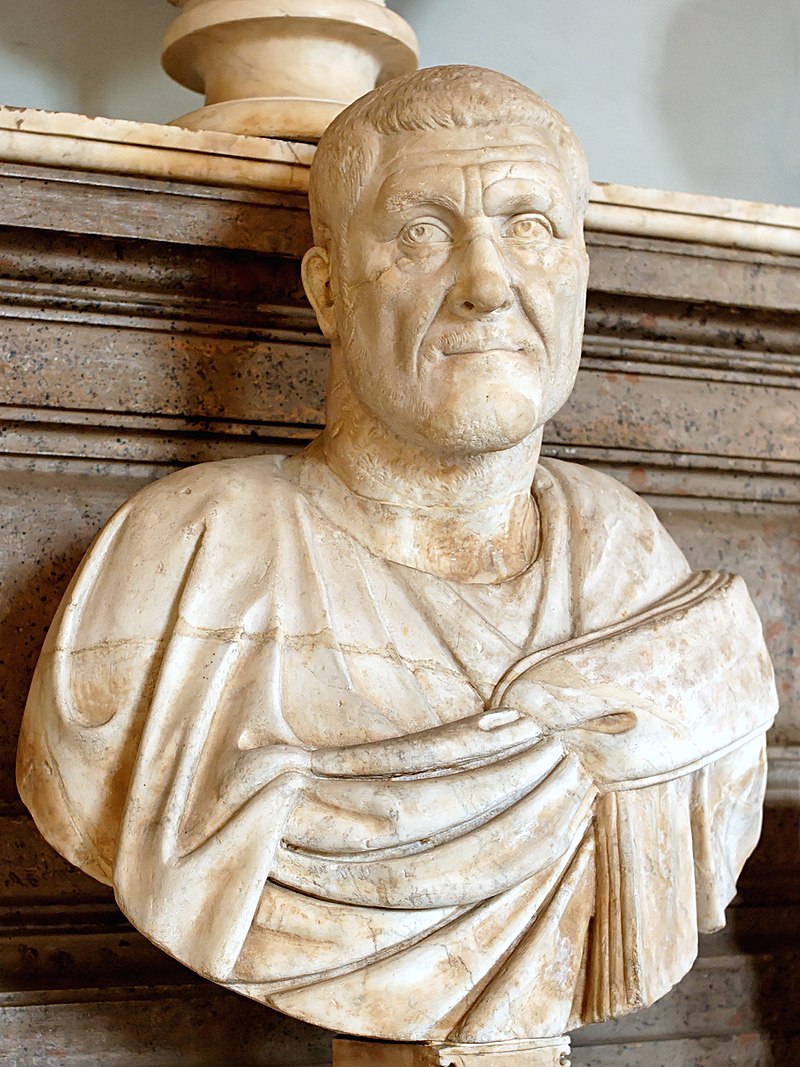
Maximinus Thrax
Roman Emperor (173-238)

Claudius Gothicus
Roman Emperor from 268 to 270 (213–270)

Gordian III
Roman emperor (225-244)
.jpg)
Gallienus
Publius Licinius Egnatius Gallienus (, ; – September 268) was Roman emperor with his father Valerian from 253 to 260 and alone from 260 to 268. He ruled during the Crisis of the Third Century that nearly caused the collapse of the empire. He won numerous military victories against usurpers and Germanic tribes, but was unable to prevent the secession of important provinces. His 15-year reign was the longest in half a century.

Geta
Roman emperor from 209 to 211

Maximian
Maximian (; ), nicknamed Herculius, was Roman emperor from 286 to 305. He was Caesar from 285 to 286, then Augustus from 286 to 305. He shared the latter title with his co-emperor and superior, Diocletian, whose political brain complemented Maximian's military brawn. Maximian established his residence at Trier but spent most of his time on campaign. In late 285, he suppressed rebels in Gaul known as the Bagaudae. From 285 to 288, he fought against Germanic tribes along the Rhine frontier. Together with Diocletian, he launched a scorched earth campaign deep into Alamannic territory in 288, refo

Probus
3rd-century Roman Emperor (232-282)
%20-%20Foto%20G.%20Dall'Orto%2028-5-2006.jpg)
Galerius
Galerius Valerius Maximianus (; Greek: Γαλέριος; 258 – May 311) was Roman emperor from 305 to 311. He participated in the system of government later known as the Tetrarchy, first acting as caesar under Emperor Diocletian. In this period Galerius obtained victory warring against the Persian Sasanian Empire, defeating Narseh at the battle of Satala in 298 and possibly sacking the Sasanian capital of Ctesiphon in 299. He also campaigned across the Danube against the Carpi, defeating them in 297 and 300. Galerius was promoted to augustus upon the abdication of Diocletian in 305, but had to contend

Pupienus
Marcus Clodius Pupienus Maximus ( 164–238) was Roman emperor with Balbinus for 99 days in 238, during the Year of the Six Emperors. The sources for this period are scant, and thus knowledge of the emperor is limited. In most contemporary texts he is referred to by his cognomen "Maximus" rather than by his second nomen (family name) Pupienus ().

Trebonianus Gallus
Roman Emperor from 251 to 253 (206-253)

Balbinus
Decimus Caelius Calvinus Balbinus (July/August 238 AD) was Roman emperor with Pupienus for three months in 238, the Year of the Six Emperors.

Tacitus
Roman emperor from 275 to 276

Carus
Marcus Aurelius Carus ( – July or August 283) was Roman emperor from 282 to 283. During his short reign, Carus fought the Germanic tribes and Sarmatians along the Danube frontier with success.
%20obverse.jpg)
Carinus
thumb|A Roman Antoninianus|radiate produced in 283 depicting Emperor Carinus. From the collection of [[York Museums Trust. Legend: M. AVR. CARINVS NOB. CAES.]]
.jpg)
Volusian
Gaius Vibius Volusianus (Latin: Gaius Vibius Afinius Gallus Veldumnianus Volusianus; died August 253), commonly called Volusian, was a Roman emperor from 251 to 253, ruling with his father Trebonianus Gallus.
%2002.jpg)
Numerian
Numerian (; died November 284) was Roman emperor from 283 to 284 with his older brother Carinus. They were sons of Carus, a general raised to the office of praetorian prefect under Emperor Probus in 282.

Herennius Etruscus
Roman emperor (220-251)

Tetricus I
Gallic emperor from 271 to 274 AD

Philippus II
consul of the Roman Empire (237-249)

Victorinus
Marcus Piavonius Victorinus was emperor in the Gallic provinces from 268 to 270 or 269 to 271, following the brief reign of Marius. He was murdered by a jealous husband whose wife he had tried to seduce.
Tetricus II
Roman usurper
Quietus
Titus Fulvius Junius Quietus (died 261) was a Roman usurper against Roman Emperor Gallienus.
Macrianus Minor
Usurper of throne of Roman Empire (died 261)
Valerius Romulus
son of Roman Emperor Maxentius (died 309)
Marius Maximus
Roman consul and historian (c.160 – c.230)
Gaius Fulvius Plautianus
prefect of the Praetorian Guard, senator and consul (c.150-205)
Licinius Valerianus Minor
brother of Roman emperor Gallienus (died 268)
Julius Asclepiodotus
Late 3rd-century Roman politician
Afranius Hannibalianus
Roman consul 292 AD
Publius Valerius Comazon
3rd century Roman general and praetorian prefect
Marinianus
Roman consul 268 AD
Lucius Fabius Cilo
confidant of Roman emperor Septimius Severus
Publius Septimius Geta
brother of emperor Septimus Severus (c.143-c.204)
Seleucus
3rd century Roman imperial usurper
Pomponius Bassus
3rd century Roman senator and consul
Pomponius Bassus
Roman senator and consul (175–221)
Apsines
Apsines of Gadara (; fl. 3rd century AD) was a Greek rhetorician. He was a native of the Hellenised city of Gadara, whose ruins stand today at the border of Jordan with Syria and Israel. Apsines went on to study at Smyrna and taught at Athens, gaining such a reputation that he was raised to the consulship by the emperor Maximinus. He was a rival of Fronto of Emesa, and a friend of Philostratus, the author of the Lives of the Sophists, who praises his wonderful memory and accuracy.

Lucius Aurellius Commodus Pompeianus
grandson of Roman emperor Marcus Aurelius
Nummius Tuscus
Roman consul

Lucius Valerius Claudius Poplicola Balbinus Maximus
Roman senator appointed consul in 253
Publius Catius Sabinus
Roman consul
Marcus Pupienus Africanus
consul of the Roman Empire
Gaius Septimius Severus Aper
Roman aristocrat and consul (c.175-c.212)

Lucius Caesonius Ovinius Manilius Rufinianus Bassus
consul of the Roman Empire
Titus Claudius Aurelius Aristobulus
Roman consul in 285 AD
Vettius Gratus
Roman senator and consul in 250
Quintus Tineius Sacerdos
Roman consul in 219 AD
Marcus Annius Flavius Libo
Roman consul 204 AD