Category
page 14th-century philosophers

Augustine of Hippo
Christian theologian, philosopher, and saint (354–430)

Hypatia
Hypatia (born 350–370 – March 415 AD) was a Neoplatonist philosopher, astronomer, and mathematician who lived in Alexandria, at that time in the province of Egypt and a major city of the Roman Empire. In Alexandria, Hypatia was a prominent thinker who taught subjects including philosophy and astronomy, and in her lifetime was renowned as a great teacher and a wise counselor. Not the only fourth century Alexandrian female mathematician, Hypatia was preceded by Pandrosion. However, Hypatia is the first female mathematician whose life is reasonably well recorded. She wrote a commentary on Di
.jpg)
Ambrose
Ambrose of Milan (; 4 April 397), canonized as Saint Ambrose, was a theologian and statesman who served as Bishop of Milan from 374 to 397.

Julian
last Pagan Roman emperor, reigned 361 to 363

Athanasius of Alexandria
Pope of Alexandria from 328 to 373 (296–373)
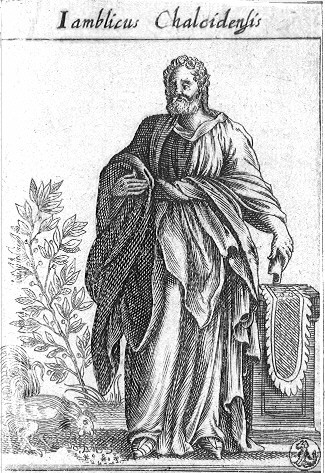
Iamblichus
Iamblichus ( ; ; ; ) was a Syrian Arab Neoplatonist philosopher who determined a direction later taken by Neoplatonism. Iamblichus was also the biographer of the Greek mystic, philosopher, and mathematician Pythagoras. In addition to his philosophical contributions, his is important for the study of the sophists because it preserved about ten pages of an otherwise unknown sophist known as the Anonymus Iamblichi.
Gaius Marius Victorinus
Roman philosopher, theologian and writer

Calcidius
right|thumb|Tenth-century manuscript of Calcidius' Timaeus translation and commentary now in the Vatican Library.
Calcidius (or Chalcidius) was a 4th-century philosopher who translated the first part (to 53c) of Plato's Timaeus from Greek into Latin around the year 321 and provided with it an extensive commentary. This was likely done for Bishop Hosius of Córdoba. Very little is otherwise known of him.
Nemesius
Nemesius of Emesa (; ; fl. c. AD 390) was a Christian philosopher, and the author of a treatise Περὶ φύσεως ἀνθρώπου or De natura hominis ("On Human Nature"). According to the title of his book, he was the bishop of Emesa (modern-day Homs, Syria). His book is an attempt to compile a system of anthropology from the standpoint of Christian philosophy; it was very influential in later Greek, Arabic and Christian thought.
Adurbad-i Mahrspandan
Iranian philosopher
Mardonio
goth-Roman rhetorician, philosopher and educator