Category
page 16th-century establishments in Europe

Benedictines
The Benedictines, officially the Order of Saint Benedict (, abbreviated as O.S.B. or OSB), are a mainly contemplative monastic order of the Catholic Church for men and for women who follow the Rule of Saint Benedict. Initiated in 529, they are the oldest of all the religious orders in the Latin Church. The male religious are also sometimes called the Black Monks, especially in English speaking countries, after the colour of their habits, although some, like the Olivetans, wear white. They were founded by Benedict of Nursia, a 6th-century Italian monk who laid the foundations of Benedictine mon

Pannonian Avars
alliance of various Eurasian nomads – 6th to 9th centuries

Early Middle Ages
period of European history lasting from the 5th century to the 10th century

Austrasia
Austrasia was a historical region and the northeastern realm within the core of the Frankish State during the Early Middle Ages, centering on the regions between Meuse, Moselle, Middle Rhine and the Main rivers. It included the original Frankish-ruled territories within what had been the northernmost part of Roman Gaul and parts of Roman Germania. It also stretched beyond the old Roman borders on the Rhine into Frankish areas which had never been formally under Roman rule. It came into being as a part of the Frankish Kingdom, founded by the Merovingian king Clovis I (r. 481–511), who expanded
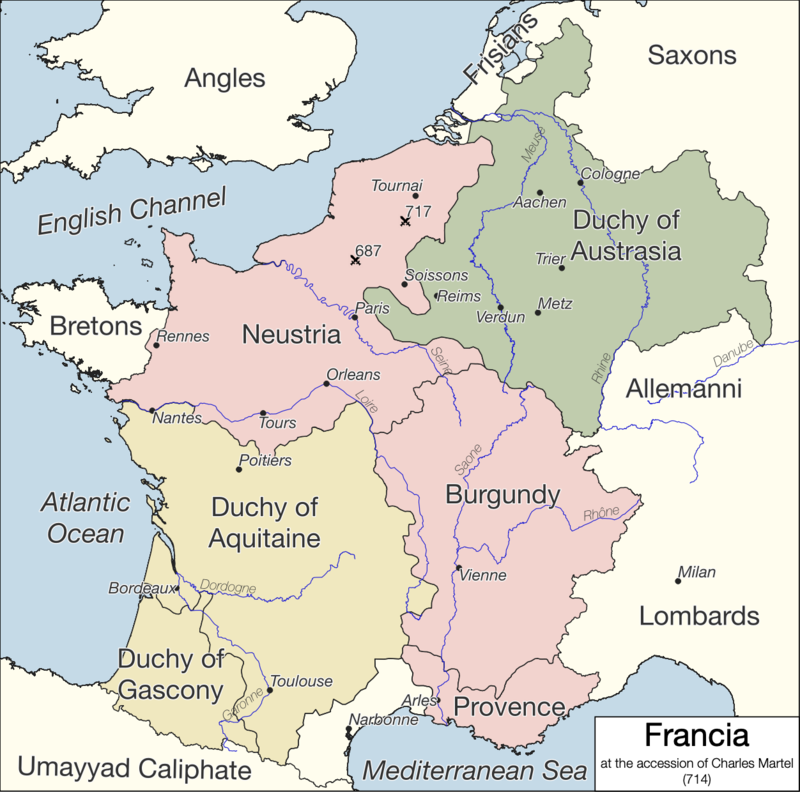
Neustria
Neustria was the western part of the Kingdom of the Franks during the Early Middle Ages, in contrast to the eastern Frankish sub-kingdom, Austrasia. It initially included land between the Loire and the Silva Carbonaria, in the north of present-day France, with Paris, Orléans, Tours, Soissons as its main cities.