Category
page 1Abdomen

stomach
The stomach is a muscular, hollow organ in the upper gastrointestinal tract of humans and many other animals, including several invertebrates. The Ancient Greek name for the stomach is gaster which is used as gastric in medical terms related to the stomach. The stomach has a dilated structure and functions as a vital organ in the digestive system. The stomach is involved in the gastric phase of digestion, following the cephalic phase in which the sight and smell of food and the act of chewing are stimuli. In the stomach a chemical breakdown of food takes place by means of secreted digestive en

abdomen
An abdomen (also belly or stomach in vertebrates, or metasoma in arthropods) is the front part of the torso between the thorax (chest) and pelvis in humans and in other vertebrates. The area occupied by the abdomen is called the abdominal cavity. In arthropods, it is the posterior tagma of the body; it follows the thorax or cephalothorax.

navel
The navel (clinically known as the umbilicus; : umbilici or umbilicuses; also known as the belly button or tummy button) is a protruding, flat, or hollowed area on the abdomen at the attachment site of the umbilical cord.

small intestine
part of the digestive tract, following the stomach and followed by the large intestine fake

spleen
alt=3D medical animation still showing structure of as well as location of the spleen in human body|thumb|A 3D medical animation still of spleen structure and exact location

esophagus
The esophagus (American English) or oesophagus (British English) () is an organ in vertebrates through which food passes, aided by peristaltic contractions, from the pharynx to the stomach. The esophagus is a fibromuscular tube, about long in adult humans, that travels behind the trachea and heart, passes through the diaphragm, and empties into the uppermost region of the stomach. During swallowing, the epiglottis tilts backwards to prevent food from going down the larynx and lungs. The word esophagus is from Ancient Greek οἰσοφάγος (oisophágos), from οἴσω (oísō), future form of φέρω (phérō, "

gallbladder
In vertebrates, the gallbladder, also known as the cholecyst, is a small hollow organ where bile is stored and concentrated before it is released into the small intestine. In humans, the pear-shaped gallbladder lies beneath the liver, although the structure and position of the gallbladder can vary significantly among animal species. It receives bile, produced by the liver, via the common hepatic duct, and stores it. The bile is then released via the common bile duct into the duodenum, where the bile helps in the digestion of fats.

stomach cancer
gastrointestinal system cancer that is located in the stomach

ureter
The ureters are tubes composed of smooth muscle that transport urine from the kidneys to the urinary bladder. In adult humans, the ureters are typically 20–30 centimeters long and 3–4 millimeters in diameter. They are lined with urothelial cells, a form of transitional epithelium, and feature an extra layer of smooth muscle in the lower third to aid peristalsis.
The ureters can be affected by diseases including urinary tract infections and kidney stones. is the narrowing of a ureter, often caused by chronic inflammation. Congenital abnormalities can cause development of two ureters on the same

waist
thumb|Waist-to-hip ratios
The waist is the part of the abdomen between the rib cage and hips. Normally, it is the narrowest part of the torso.

peritoneum
The peritoneum is the serous membrane forming the lining of the abdominal cavity or coelom in amniotes and some invertebrates, such as annelids. It covers most of the intra-abdominal (or coelomic) organs, and is composed of a layer of mesothelium supported by a thin layer of connective tissue. This peritoneal lining of the cavity supports many of the abdominal organs and serves as a conduit for their blood vessels, lymphatic vessels, and nerves.

gastrointestinal tract
set of organs ensuring the ingestion and digestion of food

vagus nerve
tenth cranial nerve
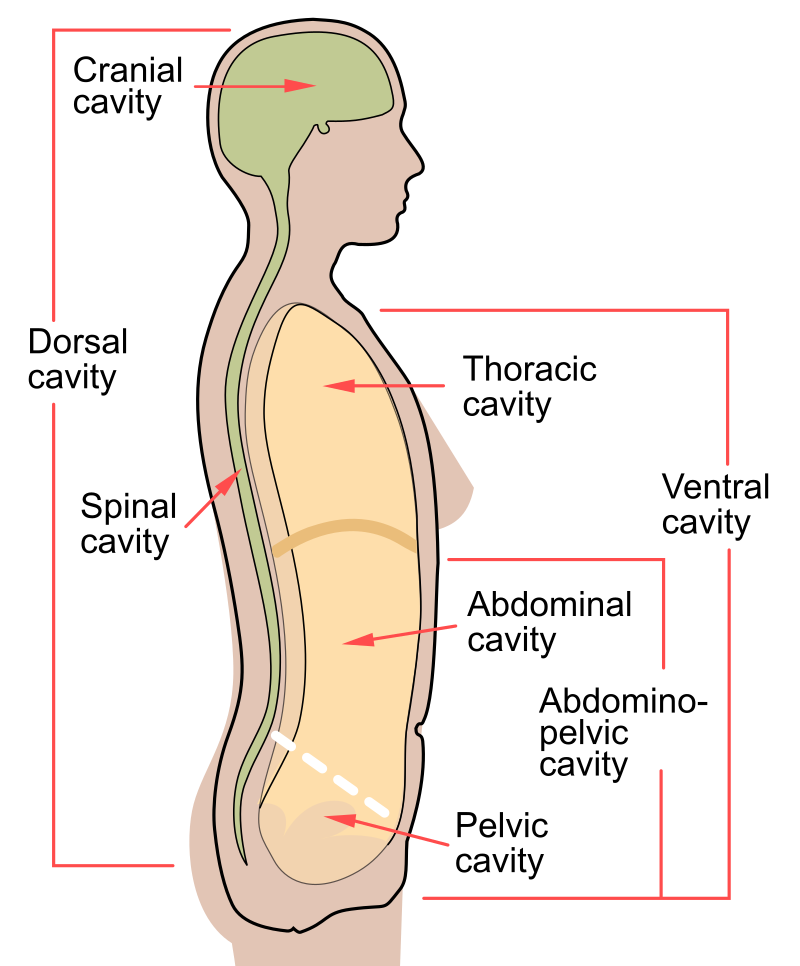
abdominal cavity
body cavity in the abdominal area

mesentery
In human anatomy, the mesentery is an organ that attaches the intestines to the posterior abdominal wall, consisting of a double fold of the peritoneum. It helps (among other functions) in storing fat and allowing blood vessels, lymphatics, and nerves to supply the intestines.
abdominal external oblique muscle
muscle
abdominal obesity
excess fat around the stomach and abdomen
crop top
any top or t-shirt cut shorter than the waist
inguinal canal
human abdominal anatomical feature
linea alba
fibrous structure of the abdomen
retroperitoneal space
anatomical space in the abdominal cavity behind the peritoneum
epigastrium
In anatomy, the epigastrium (or epigastric region) is the upper central region of the abdomen. It is located between the costal margins and the subcostal plane. Pain may be referred to the epigastrium from damage to structures derived from the foregut.
greater omentum
the fat sheath under abdominal wall
borborygmus
rumbling, growling or gurgling noise produced by movement of the contents of the gastro-intestinal tract
lesser omentum
double layer of peritoneum that extends from the liver to the lesser curvature of the stomach, and to the first part of the duodenum
Dantian
Dantian (丹田; Pinyin: dāntián, Romaji: tanden) in traditional Chinese medicine is a center of qi, the vital life force.
abdominal wall
represents the boundaries of the abdominal cavity
abdominal hair
hair that grows on the abdomen
flank
side of the body between the rib cage and the iliac bone of the hip
Cystohepatic triangle
hepatic portal system
anatomical feature
gastric mucosa
lining of the stomach
hypogastrium
The hypogastrium (also called the hypogastric region or suprapubic region) is a region of the abdomen located below the umbilical region.
lesser sac
abdominal cavity

Inguinal triangle
region of the abdominal wall, also known by the eponym Hesselbach's triangle
transversalis fascia
aponeurosis between the transverse abdominal muscle and the parietal peritoneum
peritoneal cavity
space between the parietal peritoneum (the peritoneum that surrounds the abdominal wall) and visceral peritoneum (the peritoneum that surrounds the internal organs)
abdominal exercise
exercise strengthening the abdominal muscles
Beijing bikini
act of rolling up a shirt to expose the stomach
abdominopelvic cavity
omental foramen
part of the human abdomen
hypochondrium
In anatomy, the division of the abdomen into regions can employ a nine-region scheme. The hypochondrium refers to the two hypochondriac regions in the upper third of the abdomen; the left hypochondrium and right hypochondrium. They are located on the lateral sides of the abdominal wall respectively, inferior to (below) the thoracic cage, being separated by the epigastrium.
hepatoduodenal ligament
Ligament of the liver and duodenum
Rectus sheath
laminas around abdominal muscles
gubernaculum
The paired gubernacula (from Ancient Greek κυβερνάω = pilot, steer), also called the caudal genital ligament, are embryonic structures which begin as undifferentiated mesenchyme attaching to the caudal end of the gonads (testicles in males and ovaries in females).
median plane
anatomical plane, bisects the body vertically through the midline marked by the navel
quadrants and regions of abdomen
divisions of the abdominal cavity
hepatorenal recess of subhepatic space
Area between liver and right kidney
umbilical region
region of the abdomen
retroperitoneal hemorrhage
medical condition
ligamentum venosum
part of the fetal circulation in humans
arcuate line of rectus sheath
Line of demarcation in the human abdomen
midriff
thumb|American singer-songwriter Caroline Polachek performing with her midriff exposed in 2023.In fashion, the midriff is the human abdomen. The midriff is exposed when wearing a crop top or some forms of swimwear or underwear.
Aortic bifurcation
the point at which the abdominal aorta bifurcates into the left and right common iliac arteries
situs solitus
normal arrangement (position) of internal (thoracic and abdominal) organs: heart is on the left with the pulmonary atrium on the right and the systemic atrium on the left along with the cardiac apex
hepatogastric ligament
Ligament of the liver and stomach
Inferior epigastric vessels
Linea semilunaris
curved tendinous line placed one on either side of the rectus abdominis
gastrointestinal hormone
hormone secreted by the gastrointestinal mucosa
Phrygian cap
normal anatomical variant of the gallbladder