Category
page 1Acceleration
.jpg)
gravity
thumb|upright=1.35|The shapes of two massive galaxies in this image evolved under the effects of gravity.

acceleration
{dt} = \frac{d^2\mathbf{x{dt^2}
| dimension = wikidata
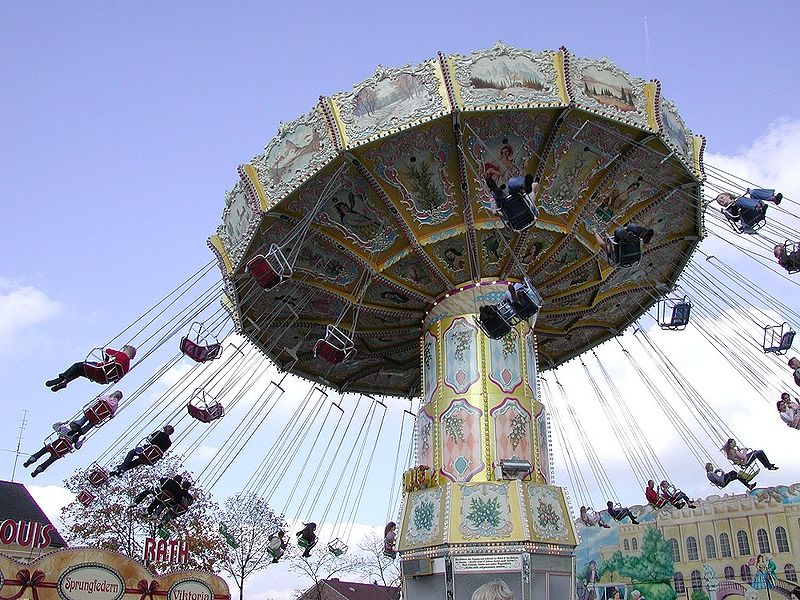
centrifugal force
type of inertial force

centripetal force
force that makes a moving body follow a curved path
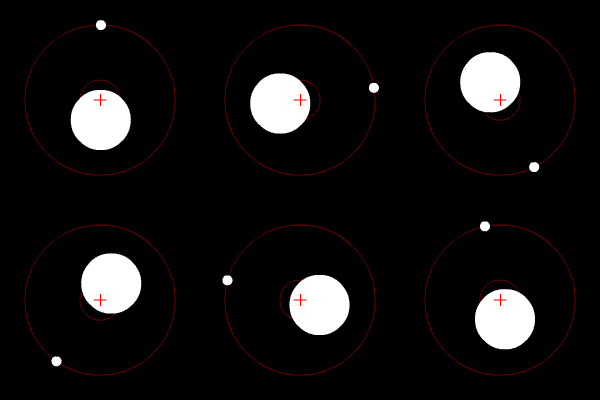
gravitational acceleration
acceleration of an object caused by gravity
angular acceleration
rate of change of angular velocity

accelerometer
thumb|A typical accelerometer

equivalence principle
hypothesis that inertial and gravitational masses are equivalent

jerk
rate of change of acceleration

g-force
thumb|In straight and level flight, lift (L) equals weight (W). In a steady level banked turn of 60°, lift equals double the weight (L = 2W). The pilot experiences 2 g and a doubled weight. The steeper the bank, the greater the g-forces.
thumb|This Top Fuel dragster can accelerate from zero to in 0.86 seconds. This is a horizontal acceleration of 5.3 g. Combining this with the vertical g-force in the stationary case using the [[Pythagorean theorem yields a g-force of 5.4 g.]]
accelerating expansion of the universe
increase in the expansion rate of the universe, attributed to dark energy

G-suit
thumb|MSF830 anti-g suit trousers and cummerbund fitted over a flying suit
Unruh effect
prediction that an accelerating observer will observe blackbody radiation where an inertial observer would observe none
Peak ground acceleration
maximum ground acceleration during an earthquake at a location
Rindler coordinates
coordinate system on a subset of Minkowski space adapted to a uniformly accelerating observer undergoing hyperbolic motion
four-acceleration
In the theory of relativity, four-acceleration is a four-vector (vector in four-dimensional spacetime) that is analogous to classical acceleration (a three-dimensional vector, see three-acceleration in special relativity). Four-acceleration has applications in areas such as the annihilation of antiprotons, resonance of strange particles and radiation of an accelerated charge.
G-LOC
G-force induced loss of consciousness (abbreviated as G-LOC, pronounced "JEE-lock") is a term generally used in aerospace physiology to describe a loss of consciousness occurring from excessive and sustained g-forces draining blood away from the brain causing cerebral hypoxia. The condition is most likely to affect pilots of high performance fighter and aerobatic aircraft or astronauts, but is possible on some extreme amusement park rides. G-LOC incidents have caused fatal accidents in high performance aircraft capable of sustaining high g for extended periods. High-g training for pilots of hi
proper acceleration
physical acceleration experienced by an object
greyout
thumb|right|300px|Simulated stages of a greyout.
A greyout is a transient loss of vision characterized by a perceived dimming of light and color, sometimes accompanied by a loss of peripheral vision. It is a precursor to fainting or a blackout and is caused by hypoxia (low brain oxygen level), often due to a loss of blood pressure.
mechanical shock
term in mechanics
hyperbolic motion
motion of an object with constant proper acceleration in special relativity
Fermi acceleration
acceleration phenomenon of oft-reflected charged particles
Fourth, fifth, and sixth derivatives of position
higher derivatives of the position vector with respect to time
high-G training
training done by aviators and astronauts
hypergravity
thumb|Michael Collins (astronaut)|Michael Collins during centrifuge training
Hypergravity is defined as the condition where the force of gravity (real or perceived) exceeds that on the surface of the Earth. This is expressed as being greater than 1 g. Hypergravity conditions are created on Earth for research on human physiology in aerial combat and space flight, as well as testing of materials and equipment for space missions. Manufacturing of titanium aluminide turbine blades in 20 g is being explored by researchers at the European Space Agency (ESA) via an 8-meter wide Large Diamet
acceleration
follow by differentiation of velocity with respect to time in the context of special relativity