Category
page 1Achaean Leaders

Achilles
In Greek mythology, Achilles ( ) or Achilleus () was a hero of the Trojan War who was known as being the greatest of all the Greek warriors. The central character in Homer's Iliad, he was the son of the Nereid Thetis and Peleus, king of Phthia and famous Argonaut. Achilles was raised in Phthia along with his childhood companion Patroclus and received his education by the centaur Chiron. In the Iliad, he is presented as the commander of the mythical tribe of the Myrmidons.

Odysseus
In Greek and Roman mythology, Odysseus (; , ), also known by the Latin variant Ulysses (, ; ), is a legendary Greek king of Ithaca and the hero of Homer's epic poem, the Odyssey. Odysseus also plays a key role in Homer's Iliad and other works in that same epic cycle.

Agamemnon
In Greek mythology, Agamemnon (; Agamémnōn) was a king of Mycenae who commanded the Achaeans during the Trojan War. He was the son (or grandson) of King Atreus and Queen Aerope, the brother of Menelaus, the husband of Clytemnestra, and the father of Iphigenia, Iphianassa, Electra, Laodike, Orestes and Chrysothemis. Legends make him the king of Mycenae or Argos, thought to be different names for the same area. Agamemnon was killed upon his return from Troy by Clytemnestra, or in an older version of the story, by Clytemnestra's lover Aegisthus.
.jpg)
Menelaus
In Greek mythology, Menelaus (; , Menélaos) was a Greek king of Mycenaean (pre-Dorian) Sparta. According to the Iliad, the Trojan War began as a result of Menelaus's wife, Helen, fleeing to Troy with the Trojan prince Paris. Menelaus was a central figure in the Trojan War, leading the Spartan contingent of the Greek army, under his elder brother Agamemnon, king of Mycenae. Prominent in both the Iliad and Odyssey, Menelaus was also popular in Greek vase painting and Greek tragedy, the latter more as a hero of the Trojan War than as a member of the doomed House of Atreus.

Ajax the Great
son of Telamon in Greek mythology
%20-%20Napoli%20MAN%209105%20-%2003%20(cropped).jpg)
Patroclus
thumb|upright=1.2|Patroclus on an antique fresco from the House of the Tragic Poet in [[Pompeii, 1st century AD (Naples National Archaeological Museum)]]
Patroclus (generally pronounced ; ) was a Greek hero of the Trojan War and close companion of the hero Achilles in Greek mythology. Patroclus is an important character in Homer's Iliad. Although Homer does not explicitly describe Patroclus and Achilles as lovers, later ancient authors often interpreted their relationship in this manner.
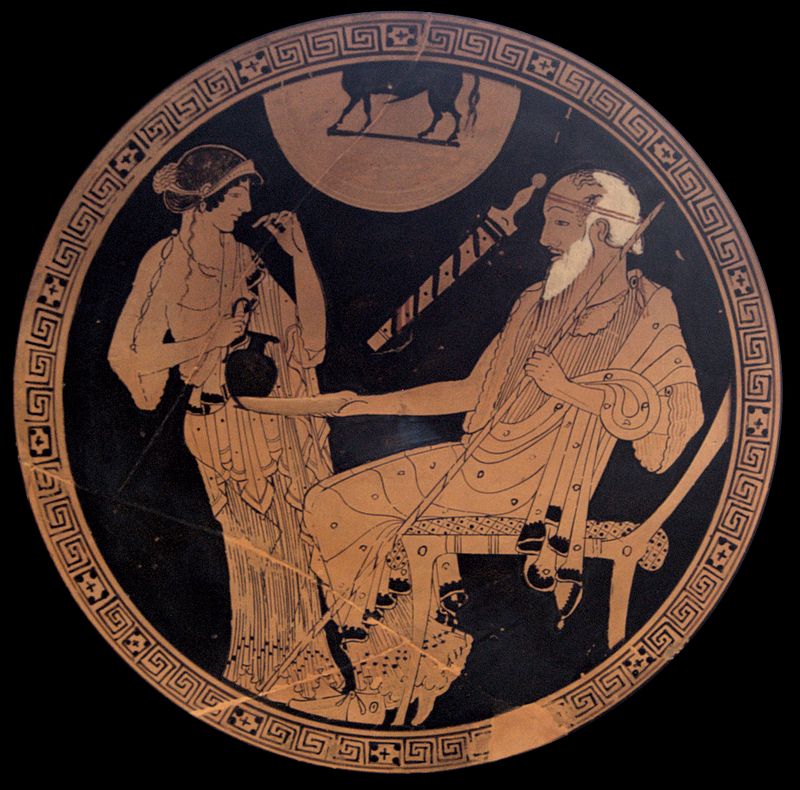
Nestor
wise ruler of Pylos in Greek mythology, son of Neleus

Philoctetes
thumb|Philoctetes at Lemnos, on an Attic red-figure [[lekythos, ca. 420 BC (Metropolitan Museum of Art)]]
Philoctetes ( Philoktētēs; , ), or Philocthetes, according to Greek mythology, was the son of Poeas, king of Meliboea in Thessaly, and Demonassa or Methone. He was a Greek hero, famed as an archer, and a participant in the Trojan War.

Neoptolemus
thumb|Scene from the tragedy Andromache (play)|Andromache by [[Euripides: Orestes kills Neoptolemus at the altar of Apollo in Delphi. Despairing Hermione, wife of Neoptolemus but previously promised to Orestes, kneels at the foot of the altar. Roman fresco in Pompeii]]
thumb|Neoptolemus's Kingdom, Epirus

Ajax the Lesser
mythological Greek character, son of Oileus
Calchas
Calchas (; ) is an Argive mantis, or seer, in Greek mythology. Calchas appears in the opening scenes of the Iliad, and also has a long literary history after Homer.
Palamedes
mythical son of Nauplius
Idomeneus
Greek mythical character, King of Crete

Protesilaus
thumb|upright=1.3|Coinage of Skione. Head of Protesilaos, wearing Attic helmet / Stern of galley left within incuse square. Circa 480-470 BC
thumb|upright=1.3|Coinage of Phthiotic Thebes|Thebai, [[Thessaly. Veiled head of Demeter, wearing wreath of grain ears / ΘHBAIΩИ, Protesilaos, wearing armor and short chiton, holding sword in right hand and shield in left, stepping off the prow of a galley; waves visible to the lower right. Early 3rd century BC]]
In Greek mythology, Protesilaus (; ) was a hero in the Iliad who was venerated at cult sites in Thessaly and Thrace. Protesilaus was the son of

Antilochus
thumb|Antilochus on an Red-figure pottery|Attic red-figure [[amphora ca. 470 BC from the Louvre]]
In Greek mythology, Antilochus (; Ancient Greek: Ἀντίλοχος Antílokhos) was a prince of Pylos and one of the Achaeans in the Trojan War. He was the youngest prince to command troops.
Agapenor
In Greek mythology, Agapenor () was a leader of the Arcadians in the Trojan War.
Machaon
character of Greek mythology: son of Asclepius and Coronis, lover of Anticlea; healing hero of the Trojan War; killed by Eurypylus
Demophon of Athens
Athenian king in Greek mythology, son of Theseus and Phaedra
Acamas
son of Theseus
Phoenix
Greek mythology character, son of Amyntor, accompanied Achilles to the Trojan War

Podalirius
thumb|right|150px|Statue of Podalirius - Archaeological Museum of Dion
In Greek mythology, Podalirius or Podaleirius or Podaleirios () was a son of Asclepius.
Menestheus
In Greek mythology, Menestheus (; Ancient Greek: Μενεσθεύς) was a legendary king of Athens during the Trojan War. He was set up as king by the twins Castor and Pollux when Theseus travelled to the Underworld after abducting their sister, Helen, and exiled Theseus from the city after his return.

Teucer
thumb|Statue of an archer, traditionally called "Teucer," from the Temple of Aphaia, ca. 505–500 BC.
thumb|right|Statue of Teucer by Sir William Hamo Thornycroft
Peneleus
In Greek mythology, Peneleos ( Pēneléōs) or, less commonly, Peneleus ( Pēnéleos), son of Hippalcimus (Hippalmus) and Asterope, was an Achaean soldier in the Trojan War.
.jpg)
Automedon
thumb|right|Henri Regnault: Automedon with the Horses of Achilles (1868)
In Greek mythology, Automedon (; Ancient Greek: Αὐτομέδων), son of Diores, was Achilles' charioteer, who drove the immortal horses Balius and Xanthos. He was born on the island of Skyros.
Thersander
mythological king of Thebes
Tlepolemus
In Greek mythology, Tlepolemus (; ) was the leader of the Rhodian forces in the Trojan War.
Meriones
mythical son of Molus of Crete
Amphilochus
mythical son of Amphiaraus
Sthenelus son of Capaneus
king of Argos in Greek mythology
Nireus
In Greek mythology, Nireus (Ancient Greek: Νιρεύς) was a king of the island Syme (according to Diodorus Siculus, also of a part of Cnidia) and one of the Homeric Greeks in the Trojan War. He was the second most handsome man in the Greek camp after Achilles and was physically weak.
Ascalaphus
son of Ares in Greek mythology
Podarces
In Greek mythology, Podarces () was a son of Iphiclus (son of Phylacus, founder of Phylace) by Diomedeia and the brother of Protesilaus. In some accounts, he and his brother were called the sons of Phylacus and Astyoche instead.
Amarynceus
Amarynceus (Ancient Greek: Ἀμαρυγκεύς) was in Greek mythology, a chief of the Eleans.
Elephenor
In Greek mythology, Elephenor ( Elephḗnōr, -oros) was the king of the Abantes of Euboea.
Epeius
mythical character, Achean soldier who built the Trojan Horse
Medon
list of mythical and historical people

Meges
In Greek mythology, Mégês Phyleïdês (Ancient Greek: Μέγης Φυλεΐδης) was the commander of Epeans and/or Dulichians during the Trojan War.
Mopsus
Greek mythological seer. son of Manto,
Thoas
son of Andraemon and Gorge
Prothoenor
In Greek mythology, Prothoenor (Ancient Greek: Προθοήνωρ) was one of the Greek leaders in the Trojan War, from Thespiae in Boeotia, son of Areilycus (Archilycus) and Theobule, brother of Arcesilaus; he commanded eight ships. In one account, Prothoenor was the son of Alector and Arteis, and thus a half-brother of Leitus and Clonius. According to the Iliad, he was killed by Polydamas, who immediately began to boast about it.
Ialmenus
In Greek mythology, Ialmenus or Ialmenos (; Ancient Greek: Ἰάλμενος) was a son of Ares and Astyoche, and twin brother of Ascalaphus. Together with his brother he sailed with the Argonauts, among the suitors of Helen, and led the Orchomenian contingent in the Trojan War.
Arcesilaus
son of Archilycus in Greek mythology
Leitus
In Greek mythology, Leitus (; Ancient Greek: Λήϊτος Leϊtos) was a leader of the Boeotians and admiral of 12 ships which sailed against Troy.
Eurytus
Eurytus, Eurytos (; Ancient Greek: Εὔρυτος) or Erytus (Ἔρυτος) is the name of several characters in Greek mythology, and of at least one historical figure.
Achilles and Patroclus
relationship in classical culture
Antiphus
In Greek mythology, Antiphus or Ántiphos (/ˈæntəfəs/; Ancient Greek: Ἄντιφος) is a name attributed to multiple individuals:
Epistrophus
set of mythological Greek characters
Eurypylus
mythical son of Euaemon
Amphimachus
Greek mythical character, son of Cteatus, suitor of Helen
Euryalus
thumb | right | Nisus and Euryalus at the 1827 Salon
Euryalus (; ) refers to the Euryalus fortress, the main citadel of Ancient Syracuse, and to several different characters from Greek mythology and classical literature:
Schedius
Schedius (Ancient Greek: Σχεδίος Skhedíos means 'near') was a name attributed to four individuals in Greek mythology.
Polypoetes
In Greek mythology, Polypoetes (; , Polupoitēs) was a name attributed to the following individuals:
Prothous
In Greek mythology, Prothous (Ancient Greek: Πρόθοος Prothoös) may refer to:
Diores
In Greek mythology, Diores () referred to four different people.
Eumelus
Eumelus ( Eúmēlos means "rich in sheep") was the name of:
Adrastus
set of mythological Greek characters