Category
page 1Adygea
Adygea
Adygea ( ), officially the Republic of Adygea or the Adygean Republic, is a republic of Russia. It is situated in the North Caucasus of Eastern Europe. The republic is a part of the Southern Federal District, and covers an area of , with a population of roughly 500,731 residents as at 2025. It is an enclave within Krasnodar Krai and is the fifth-smallest Russian federal subject by area. Maykop is the capital and the largest city of Adygea, home to one-third of the republic's population.

Adyghe
one of the official languages of the Republic of Adygea in Russia
.png)
Kabarday
thumb|The percentage of the Circassian population in every district in Kabardino-Balkaria Republic
thumb|Yinal speaking Adyghe and Kabardian.
thumb|right|Kabardian dancers in traditional dress
thumb|right|Kabardian men in traditional dress
The Kabardians (Kabardian: Къэбэрдей адыгэхэр; Adyghe: Къэбэртай адыгэхэр; ) or Kabardinians are one of the twelve major Circassian tribes, representing one of the twelve stars on the green-and-gold Circassian flag. They are also commonly known by the plural terms Kabardin, Kebertei, or Kabarday. Along with the Besleney tribe, they speak a distinctive dialec
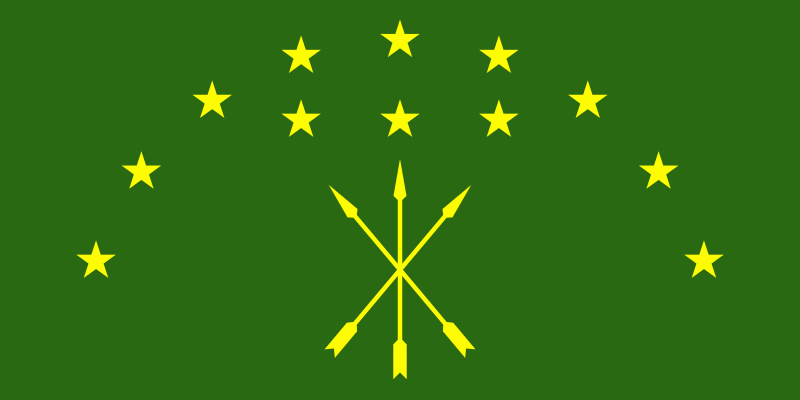
flag of the Republic of Adygea
green and gold flag
Ubykh people
Ethnic group

Shapsugs
thumb|263px|Adyghe (Circassian) knight
Confederation of Mountain Peoples of the Caucasus
former militarized political organization in the Caucasus
coat of arms of the Republic of Adygea

Abadzekh
The Abzakh (Circassian: Абдзах, Abdzakh; Russian: абадзехи) also known as Abdzakhs or Abadzekhs are one of the twelve major Circassian tribes, representing one of the twelve stars on the green-and-gold Circassian flag. Historically, they lived in the mountainous part of the modern Russian republics of Adygea and Krasnodar Krai. Major settlements or villages were located in the river valleys Kurdzhips, Psheha, Pshish, and Psekups.

Bzhedug
The Bzhedugh (, ; ; ) are one of the twelve major Circassian tribes.

Cherkesogai
Cherkesogai (), or Circassian Armenians ( ''cherk'ezahayer; Circassian: Адыгэ-ермэлы, Adyge-ermely''; ); sometimes referred to as Ermeli (Circassian: Ермэлы), Mountainous Armenians () or Transkuban Armenians (), are ethnic Armenians who have inhabited Russia's Krasnodar Krai and Republic of Adyghea since the end of the 15th century and spoke the Adyghe language (currently, most of them speak Russian as their first language), in contrast to other Armenians living in the region. They reside mostly in the cities of Armavir and Maykop. The total number of Cherkesogai is about 50,000 people (2008 e

Baslaney
The Besleney (Circassian: Беслъэней, ; ) are one of the twelve major Circassian tribes, representing one of the twelve stars on the green-and-gold Circassian flag. By character, culture and language, the Besleney are closest to Kabardians. The noble families of the Besleney were Kanoko and Shaloho, ancestors of Kabardian Prince Beslan, (the son of legendary Prince Inal), who established his own tribe of the same name.

Natukhai people
thumb|250px|A Natukhaj flag
The Natukhaj are one of the twelve major Circassian tribes, representing one of the twelve stars on the green-and-gold Circassian flag. Their areas historically extended along the Black Sea coast from Anapa in the north to Tsemes Bay (now Novorossiysk) in the south and from the north side of the mountains to the lower Kuban River.
Hatukhai people
The Hatuqay or Hatuqway are one of the twelve major Circassian tribes, representing one of the twelve stars on the green-and-gold Circassian flag. They speak the Hatuqay dialect of the Adyghe language. Most of them live in Turkey; a result of the Circassian genocide in the 19th century, the majority of the Hatuqay were killed or deported to the Ottoman Empire, resulting in their virtual extinction in their historical homeland. Historically, they lived in the Hatuqay Principality of Circassia and were known for their martial character, engaging in incessant wars. Hatuqay was marked on period ma
Temirgoy people
The Chemirgoy or Temirgoy are one of the twelve major Circassian tribes, representing one of the twelve stars on the green-and-gold Circassian flag. They lived between the lower flows of the Belaya and Laba Rivers and their lands extended north to the Kuban. After the end of the Caucasian War, most Temirgoys resettled in other Circassian villages (e.g. Bzhedugii, Kabarda, Urupskiy), as well as in Turkey and in other parts of the Middle East. In Turkey, the majority of the population of the village Hadzhimukohabl (now Dondukovskaya) are Temirgoy.
Mamkhegh
The Mamkhegh or Mamheg ( or ; ) were one of the twelve major Circassian tribes, representing one of the twelve stars on the green-and-gold Circassian flag.
Adyge mak'
newspaper
Mequash
The Makhosh () were one of the Circassian tribes. The tribe was mostly annihilated in the Circassian genocide following the Russo-Circassian War.
Yegeruqwai
The Yegeruqway (; Russian: Егерукаевцы, Yegerukaevtsy) were one of the twelve major Circassian tribes, representing one of the twelve stars on the green-and-gold Circassian flag. There is also a small town with a form of the same name Egerukhay (Russian: Егерухай, Yegerukhaj) in the Koshekhablsky District, Adygea, Russia. The Yegeruqway currently reside in said town, other places of habitation include Khatazhukay and Dzherokay.