Category
page 1Alphabets

alphabet
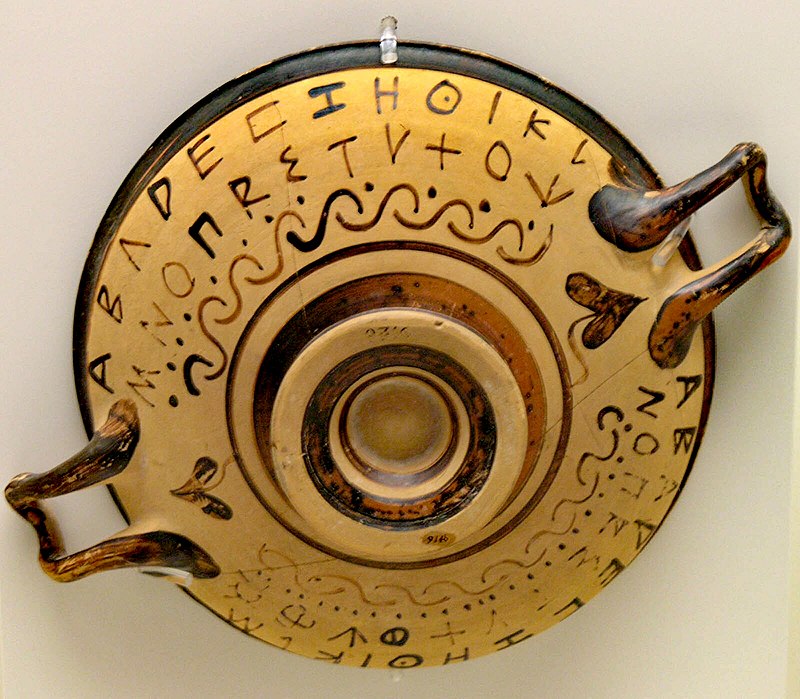
An alphabet is a writing system that uses a standard set of symbols, called letters, to more or less represent particular sounds in a spoken language. Specifically, letters largely correspond to phonemes as the smallest sound segments that can distinguish one word from another in a given language. Not all writing systems represent language in this way: a syllabary assigns symbols to spoken syllables, while logographies assign symbols to words, morphemes, or other semantic units.
letter
grapheme in an alphabetic system of writing

runic script

Glagolitic
oldest known Slavic alphabet
%20(14760479206).jpg)
Ogham
Ogham (also ogam and ogom, , Modern Irish: ; , later ) is an Early Medieval alphabet used primarily to write the early Irish language (in the "orthodox" inscriptions, 4th to 6th centuries AD), and later the Old Irish language (scholastic ogham, 6th to 9th centuries). There are roughly 400 surviving orthodox inscriptions on stone monuments throughout Ireland and western Britain, the bulk of which are in southern areas of the Irish province of Munster. The Munster counties of Cork and Kerry contain 60% of all Irish ogham stones. The largest number outside Ireland are in Pembrokeshire, Wales.

Mongolian
writing system used for the Mongolian language

Tifinagh
Tifinagh (Tuareg Berber language: ; Neo-Tifinagh: ; Berber Latin alphabet: ; ) is a script used to write the Berber languages. Tifinagh is descended from the ancient Libyco-Berber alphabet. The traditional Tifinagh, sometimes called Tuareg Tifinagh, is still favored by the Tuareg people of the Sahara desert in southern Algeria, northeastern Mali, northern Niger, and northern Burkina Faso for writing the Tuareg languages. Neo-Tifinagh is an alphabet developed by the Berber Academy by adopting Tuareg Tifinagh for use for Kabyle; it has been since modified for use across North Africa.

Gothic script
unicameral alphabet created in the 4th century by Ulfilas for the purpose of translating the Bible to the Gothic language

leet
thumb|An "eleet hacker" (31337 H4XØR) laptop sticker, along with a "Free Kevin Mitnick|Kevin" sticker
Etruscan alphabet
alphabet used by the Etruscans of central Italy

Kannada script
abugida writing system of the Brahmic family, used in India to write the Kannada and Tulu languages

Tengwar
The Tengwar () script is an artificial script, one of several scripts created by J. R. R. Tolkien, the author of The Lord of the Rings. Within the context of Tolkien's fictional world, the Tengwar were invented by the Elf Fëanor, and used first to write the Elvish languages Quenya and Telerin. Later a great number of Tolkien's constructed languages were written using the Tengwar, including Sindarin. Tolkien used Tengwar to write English: most of Tolkien's Tengwar samples are actually in English.

N’ko
alphabetic script initially created by Solomana Kante in 1949 as a transcription system for Manding languages in Western Africa, now designed and developed to become a pan-African script covering their phonology

alphabetical order
system whereby strings of characters are placed in order by alphabet
history of the alphabet
aspect of history
Template:Alphabet
Wikimedia template
Meroitic script
writing system
Avestan
alphabet mainly used in Zoroastrian scriptures to transcribe the old Avestan language
Old Permic alphabet
writing system
letter case
distinctive property of a letter in a bicameral alphabet (most notably the Latin, Greek, or Cyrillic ones); piece of information whether a letter grapheme is taller "upper case" or lower "lower case"
Manchu alphabet
alphabet based on Mongolian alphabet

acrophony
Acrophony (; + 'sound') is the naming of letters of an alphabetic writing system so that a letter's name begins with the letter itself. For example, Greek letter names are acrophonic: the names of the letters α, β, γ, δ, are spelled with the respective letters: (), (), (), ().
Ol Chiki
alphabetic script for Santal, invented in 1925 by Raghunath Murmu and publicized in 1939
Clear Script
alphabet created in 1648 by the Buddhist monk Zaya Pandita for the Oirat language
Deseret alphabet
19th-century phonetic writing system devised by the LDS Church

Enochian
Enochian ( ) is an occult constructed language—said by its originators to have been received from angels—recorded in the private journals of John Dee and his colleague Edward Kelley in late 16th-century England. Kelley was a scryer who worked with Dee in his magical investigations. The language is integral to the practice of Enochian magic.
Old Persian cuneiform
unicameral cuneiform semi-syllabary used to write the Old Persian language
Adlam
bicameral alphabet invented in Guinea to write the Fulah language from right to left

Cirth
The Cirth (, meaning "runes"; sg. certh ) is a semi‑artificial script, based on real‑life runic alphabets, one of several scripts invented by J. R. R. Tolkien for the constructed languages he devised and used in his works. Cirth is written with a capital letter when referring to the writing system; the letters themselves can be called cirth.
Libyc script
abjad writing system
Alphabet song
song
Warang Citi
Writing system for Ho language
Chakma script
abugida
Kadamba
historic abugida of South India
Vagindra
writing system
Lorm alphabet
hand-touch alphabet for tactile signing
Sorang Sompeng
writing script
New Tai Lue
abugida used to write Tai Lü
Beria Erfe
bicameral alphabetic script, also known with the name “Beria Giray Erfe” or “Zaghawa”, used since the 1950s for writing the Zaghawa (or Beria, Bera) language in Sudan and Chad
Phrygian alphabet
earliest writing script of the Phrygians
Name–letter effect
measure of self-esteem
Osage
alphabet invented for writing the Osage language
Kayah Li
alphabet
nyctography
thumb|right|Reconstructed nyctograph, with scale demonstrated by a 5 euro cent.
Nyctography (in Nyctography: ) is a form of substitution cipher writing created by Lewis Carroll (Charles Lutwidge Dodgson) in 1891. It is written with a nyctograph (a device invented by Carroll) and uses a system of dots and strokes all based on a dot placed in the upper left corner. Using the Nyctograph, one could quickly jot down ideas or notes without the aid of light. Carroll invented the Nyctograph and Nyctography as he was often awakened during the night with thoughts that needed to be written down at once,
Ol Onal
unicameral alphabet script for Bhumij language
Alphabets of Asia Minor
alphabets in use in Iron Age Anatolia
Udmurt alphabets
script used for writing words and texts in Udmurt language
De Landa alphabet
attempt to interpret Maya script as an alphabetic script
Dargin alphabets
orthography of Dargwa
Stokoe notation
phonemic script for sign languages
Unicode chart Old Turkic
Characters of Unicode block Old Turkic
Coelbren y Beirdd
constructed script
Saraiki alphabet
extension of the Punjabi Shahmukhi extended Urdu alphabet for Saraiki
Rma script
script for the Qiang language