Category
page 1Altiplano Cundiboyacense
Colombian Grebe
species of bird

Pterygotus
Pterygotus is an extinct genus of giant predatory eurypterid, a group of extinct aquatic arthropods. Fossils of Pterygotus have been discovered in deposits ranging in age from Middle Silurian to Late Devonian, and have been referred to several different species. Fossils have been recovered from five continents; Australia, Asia, Europe, North America and South America, which indicates that Pterygotus might have had a nearly cosmopolitan (worldwide) distribution. The type species, P. anglicus, was described by Swiss naturalist Louis Agassiz in 1839, who gave it the name Pterygotus, meaning "wing
Cordillera Oriental
mountain range in Colombia
Lake Guatavita
lake in Cundinamarca Department, Colombia
Lake Tota
lake in Colombia

Monserrate
Monserrate (; named after Catalan homonym mountain Montserrat) is a mountain over high that overlooks the city center of Bogotá, the capital city of Colombia. It rises to above the sea level, where there is a church (built in the 17th century) with a shrine, devoted to El Señor Caído ("The Fallen Lord").
Tequendama Falls
waterfall
Bogotá River
river in Colombia

Akodon bogotensis
species of mammal

Deconica montana
species of fungus

Atractus crassicaudatus
species of reptile

Bogotá yellow-shouldered bat
species of mammal
Suba
locality of the Capital District of Bogotá, Colombia
Bogota savanna
Wetland in Bogota, Colombia
Engativá
Engativá is the 10th locality (localidad) of Bogotá, the capital city of Colombia. located in the city’s west‑northwest sector, Originally an independent municipality of the Department of Cundinamarca, Engativá was annexed to Bogotá in 1954, forming part of the city’s expansion.

Usaquén
thumb|right|200px|Church of Santa Bárbara de Usaquén
thumb|right|200px|Cedritos
Usaquén is the 1st locality of Bogotá, capital of Colombia. It is located in the north of the city. This district is mostly inhabited by upper middle and upper class residents. It is designated as Bogotá's #1 locality, while being a separate municipality of Cundinamarca until 1954, when it was annexed into the city. Today, Usaquén is home to more than 480,000 inhabitants as projected by 2008. The Eastern Hills form the natural border to the east.
Atelopus muisca
species of amphibian
Altiplano Cundiboyacense
plateau in the Colombian Andes
Dendropsophus garagoensis
species of amphibian

Caecilia degenerata
species of amphibian

Equisetum bogotense
species of plant

Neochoerus
thumb|left|Paleoart of Neochoerus pinckneyi.
Sumapaz
Sumapaz is the 20th locality of Bogotá, capital of Colombia. It is the largest of Bogotá's 20 localities, starting in the north at the edge of the urban frontier with Usme and stretching to the south at the border of Cundinamarca with the departments of Meta and Huila. It is completely rural, with no city services.

Teusaquillo
Teusaquillo is the 13th locality of Bogotá, capital of Colombia. It is located in the geographic center of the city, to the northwest of downtown Bogotá. This district is inhabited by middle and upper class residents. It is an urbanized locality with several green zones as parks, avenues, and the campus of the National University of Colombia. Most of the heritage buildings and houses of Bogotá are in this locality. It is located on the former site of an indigenous resguardo known as Pueblo Viejo (Old Village), which existed until the main urbanization phase of the 20th century.
Bosa
locality of the Capital District of Bogotá, Colombia

Callawayasaurus
Callawayasaurus is a genus of plesiosaur from the family Elasmosauridae. When the holotype was first described by Samuel Paul Welles in 1962, it was described as Alzadasaurus colombiensis before being moved into its current genus by Kenneth Carpenter in 1999.
Lake Iguaque
lake in Colombia
Laguna de Fúquene
lake in Cundinamarca Department, Colombia
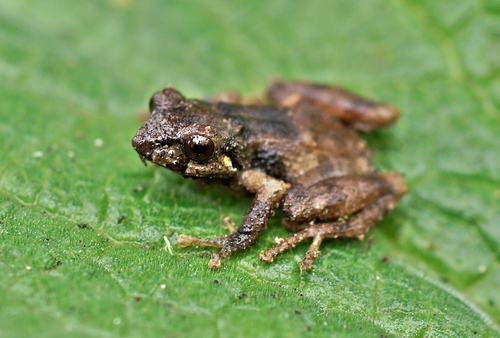
Pristimantis susaguae
species of amphibian
Usme
Usme is the 5th locality of the Capital District of Bogotá, capital city of Colombia. Usme is located in the south of Bogotá, bordering to the north the localities of San Cristóbal, Rafael Uribe Uribe and Tunjuelito, to the west the locality of Ciudad Bolívar, to the south the locality of Sumapaz, and to the east, behind the Eastern Hills, the municipalities of Ubaque, Chipaque and Une in the Department of Cundinamarca.
Chingaza National Natural Park
national park in Colombia
Guadalupe Hill
mountain
Muisca Confederations
loose confederations of different Muisca rulers (Bogota, Tunja, Duitama and Sogamoso) in the central Andean highlands of present-day Colombia before the Spanish conquest of northern South America

Stenorhynchosaurus
Stenorhynchosaurus is an extinct genus of pliosaurid plesiosaurs which lived in the Early Cretaceous of South America. The type species and only known is Stenorhynchosaurus munozi.
Laguna de Suesca
lake in Colombia
Muiscasaurus
Muiscasaurus is an extinct genus of ophthalmosaurid ichthyosaur that lived in modern Colombia during the Early Cretaceous. The only known species is the type Muiscasaurus catheti.
Sogamoso River
river in Colombia
Tunjuelo River
watercourse in Colombia
Monquirasaurus
Monquirasaurus ("Monquirá lizard") is an extinct genus of giant short-necked pliosaurs who lived during the Early Cretaceous (Aptian) in what is now Colombia. One species is known, M. boyacensis, described in 2021 from an almost complete fossil skeleton, discovered in 1977 in the town of Villa de Leyva, located in Boyacá. Published descriptions of the holotype specimen estimate that it should reach a total size approaching in length and weighing , making Monquirasaurus a large representative of the pliosaurids.
Chicamocha River
river in Colombia
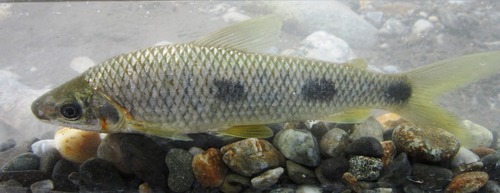
Leporinus muyscorum
species of fish
Fucha River
river in Colombia
Protandrena bachue
species of insect
Eastern Hills, Bogotá
chain of hills in Colombia
Neocorynura muiscae
species of insect
Leivanectes
Leivanectes is a genus of plesiosaurs of the family Elasmosauridae known from Late Aptian marine deposits in central Colombia. It contains a single species, L. bernadoi, which was described in 2019.
Crioceratites
thumb|250px|A rare heteromorph ammonite fossil from the south of France. The species is Crioceratites nolani and the spines have been partially restored to show how it might have appeared in life

Choconta
genus of insects
Ischnura chingaza
species of insect
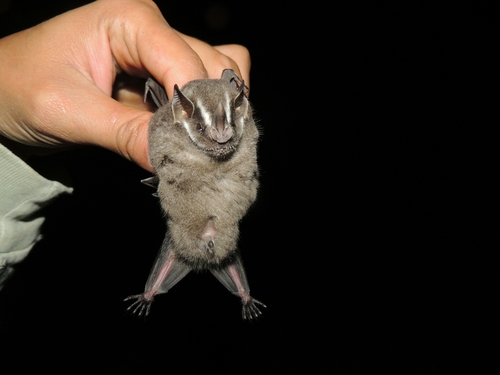
Bogota fruit-eating bat
species of bat
Tominé Reservoir
reservoir in Colombia
Alabagrus muisca
species of insect

Arzobispo River
River in Cundinamarca, Colombia

Bacata
Bacatá (Chibcha: or ) is the name given to the main settlement of one of the Muisca Confederations on the Bogotá savanna. It mostly refers to an area, rather than an individual village, although the name is also found in texts referring to the modern settlement of Funza, in the centre of the savanna. Bacatá was the main seat of the zipa, the ruler of the Bogotá savanna and adjacent areas. The name of the Colombian capital, Bogotá, is derived from Bacatá, but founded as Santafe de Bogotá in the western foothills of the Eastern Hills in a different location than the original settlement Bacatá, w
Suárez River
river in Santander, Colombia

Ageratina tinifolia
species of plant

Chicamocha Canyon
steep sided canyon carved by the Chicamocha River in Colombia
Teusacá River
river in Colombia
Soacha River
watercourse in Colombia
Siecha Lakes
body of water