Category
page 1Amorphous solids

glass
thumb|300px|A glass building facade|alt=Refer to caption

amber
thumb|An ant inside Baltic amber
thumb|right|Unpolished amber stones

caramel
Caramel (, or (US) ) is a range of food ingredients made by heating sugars to high temperatures. It is used as a flavoring in puddings and desserts, as a filling in bonbons or candy bars, as a topping for ice cream and custard, and as a colorant commonly used in drinks.

bitumen
thumb|Natural bitumen from the Dead Sea
thumb|Refined bitumen
thumb|upright|The University of Queensland [[pitch drop experiment, demonstrating the viscosity of bitumen]]

cotton candy
confectionery

amorphous solid
solid, in which atoms and/or molecules are disordered like in a liquid

tetrahydrocannabinol
Tetrahydrocannabinol (THC) is a cannabinoid found in cannabis. It is the principal psychoactive constituent of Cannabis and one of at least 113 total cannabinoids identified on the plant. Although the chemical formula for THC (C21H30O2) describes multiple isomers, the term THC usually refers to the delta-9-THC isomer with chemical name '(−)-trans-Δ9-tetrahydrocannabinol'. It is a colorless oil.

petroleum jelly
chemical substance used as lubricating agent

slag
thumb|upright=1.15|Molten slag is carried outside and poured into a dump. Caletones copper smelter in El Teniente mine, Chile.
Slag is a by-product or co-product of smelting (pyrometallurgical) ores and recycled metals depending on the type of material being produced. Slag is mainly a mixture of metal oxides and silicon dioxide. Broadly, it can be classified as ferrous (co-products of processing iron and steel), ferroalloy (a by-product of ferroalloy production) or non-ferrous/base metals (by-products of recovering non-ferrous materials like copper, nickel, zinc and phosphorus). Within these g

poly(methyl methacrylate)
transparent thermoplastic, commonly called acrylic
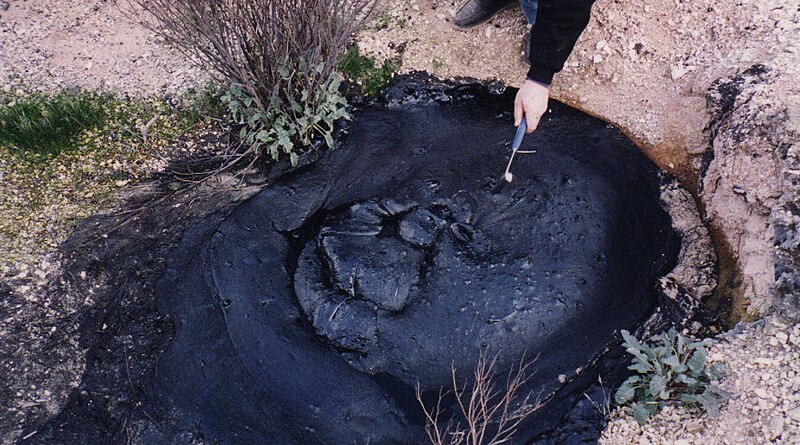
pitch
mixture of aromatic organic compounds, black, tar-like, super viscous liquid

tektite
thumb|250px|Two splash-form tektites, molten terrestrial ejecta from a [[meteorite impact]]
Soan papdi
Indian dessert
glassy carbon
allotrope of carbon
amorphous carbon
carbon that has no crystalline structure
dronabinol
Dronabinol (), sold under the brand names Marinol and Syndros, is the generic name for the molecule of (−)-trans-Δ9-tetrahydrocannabinol (THC) in the pharmaceutical context. It has indications as an appetite stimulant and antiemetic and is approved by the US Food and Drug Administration (FDA) as safe and effective for HIV/AIDS-induced anorexia and chemotherapy-induced nausea and vomiting.
nuclear pasta
degenerate matter within the crusts of neutron stars which forms complex structures said to resemble pasta
amorphous silicon
non-crystalline silicon
sugar glass
brittle transparent form of sugar

polycrase-(Y)
Polycrase or polycrase-(Y) is a black or brown metallic complex uranium yttrium oxide mineral with the chemical formula . It is amorphous. It has a Mohs hardness of 5 to 6 and a specific gravity of 5. It is radioactive due to its uranium content (around 6%). It occurs in granitic pegmatites.
ground granulated blast-furnace slag
Granular slag by-product of iron and steel-making used as supplementary cementitious material
Bioasphalt
Bioasphalt is an asphalt alternative made from non-petroleum based renewable resources.
allotrope of sulphur
class of simple substances consisting only of sulfur atoms
polyamorphism
300px|thumb|Pressure–temperature phase diagram, including an illustration of the liquid–liquid transition line proposed for several polyamorphous materials. This liquid–liquid [[phase transition would be a first order, discontinuous transition between low and high density liquids (labelled 1 and 2). This is analogous to polymorphism of crystalline materials, where different stable crystalline states (solid 1, 2 in diagram) of the same substance can exist (e.g. diamond and graphite are two polymorphs of carbon). Like the ordinary liquid–gas transition, the liquid–liquid transition is expected t
ilsemannite
Ilsemannite is an uncommon amorphous complex heterovalent molybdenum oxide, that was first published in 1871, and has been a valid species since pre-IMA. It is a grandfathered mineral, meaning the name ilsemannite is still believed to refer to a valid species. However, it is likely that specimens formed under different conditions, in different localities do not have the same composition, and may even be a mixture of compounds. Furthermore, it is hard to analyze the specimens due to them being a mixture, hence why adequate analyses are lacking of said mineral. Ilsemannite is believed to be iden