Category
page 1Ancient Egypt

Ancient Egypt
Egyptian civilization from the 4th millennium BC
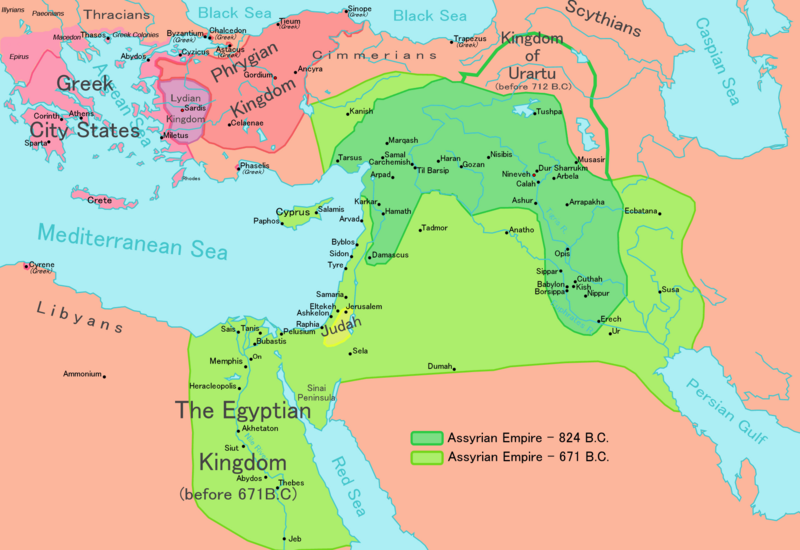
Neo-Assyrian Empire
historical state in Mesopotamia

Sea Peoples
purported historical ethnic group

mastaba
right|thumb|Example of a mastaba, the Mastabat al-Fir'aun of [[Shepseskaf]]
A mastaba ( , or ), also mastabah or mastabat) is a type of ancient Egyptian tomb in the form of a flat-roofed, rectangular structure with inward sloping sides, constructed out of mudbricks or limestone. These edifices marked the burial sites of many eminent Egyptians during Egypt's Early Dynastic Period and Old Kingdom. Non-royal use of mastabas continued for over a thousand years.
Portal:Egypt
Wikimedia portal
history of ancient Egypt
aspect of history
Portal:Ancient Egypt
Wikimedia portal
Egyptian blue
color
.jpg)
henna
thumb|An elderly Bengalis|Bengali man in [[Dhaka with a beard dyed in henna]]

Sherden
thumb|300px|The Sherden in battle as depicted at Medinet Habu (temple)|Medinet Habu
The Sherden (Egyptian: šrdn, šꜣrdꜣnꜣ or šꜣrdynꜣ; Ugaritic: šrdnn(m) and trtn(m); possibly Akkadian: šêrtânnu; also glossed "Shardana" or "Sherdanu") are one of the several ethnic groups the Sea Peoples were said to be composed of, appearing in fragmentary historical and iconographic records (ancient Egyptian and Ugaritic) from the Eastern Mediterranean in the late 2nd millennium BC.
Ancient Egyptian agriculture

Fanous
thumb|upright|Traditional Egyptian fanous lanterns in [[Cairo, Egypt, celebrating Ramadan]]
Tomb of Nebamun
The tomb-chapel of Nebamun, an ancient Egyptian scribe, located at Thebes
simsimiyya
The simsimiyya (Arabic: سمسمية or سنسمية simsimyya/sinsimiyya; pl. simsimiyyāt/sinsimiyyāt, سمسميات) is a box or bowl lyre used in Egypt. Models exist with both circular soundboxes as well as rectangular.
In the past, Egyptian models had 5 strings. The strings are held in place by pegs instead of tuning rings. Today, images of the instrument in Egypt may show 12 strings. It has been played since ancient times.

Ancient Egyptian units of measurement
system of measurement used in Ancient Egypt
shendyt
The shendyt (šnḏyt, Schenti, Schent, Shent, Skent) was a type of loincloth similar to a skirt. It was a kilt-like garment worn in ancient Egypt. It was made of cloth and was worn around the waist, typically extending to above the knees. Shendyts are depicted on pharaohs, deities, and commoners in a variety of situations in Egyptian artwork.
Uronarti
Uronarti is an island and archaeological site in the Nile just south of the Second Cataract in the north of Sudan. The site features a massive ancient fortress that still stands on its northern end. This fortress is one of many constructed along the Nile in Lower Nubia during the Middle Kingdom, beginning under the reign of Senusret I.
ancient Egyptian race controversy
question of the race of ancient Egyptians
Giza West Field
cemetery in Egypt
Annals of Thutmose III
18th-dynasty inscriptions at Karnak
history of Persian Egypt
aspect of history
asp
term in antiquity describing a venomous snake in the Nile region
bident
thumb|Pluto holding a bident in a woodcut from the Gods and Goddesses series of Hendrick Goltzius (1588–1589)
Giza East Field
cemetery in Egypt
regalia of the Pharaohs
symbolic objects of the royalty of Ancient Egypt
Mersa Gawasis
Egyptian harbour
sebakh
thumb|30th Dynasty mudbricks excavated in [[Luxor. Ancient mudbricks are a common source of sebakh.]]
Sebakh (, less commonly transliterated as sebbakh) is an Arabic word that translates to "fertilizer". In English, the term is primarily used to describe decomposed mudbricks from archaeological sites, which is an organic material that can be employed both as an agricultural fertilizer and as a fuel for fires.
International Campaign to Save the Monuments of Nubia
campaign coordinated by UNESCO to record and/or save archaeological sites and monuments in Nubia 1960-1980
Denkmäler aus Ägypten und Äthiopien
book by Karl Richard Lepsius; scientific documentation of the Prussian expedition of 1842-1845
periodization of ancient Egypt

Wah-Sut
Wah-Sut (, meaning Enduring are the places of Khakaure justified in Abydos) is a town located south of Abydos in Middle Egypt. The name of the town indicates that it was originally built as an outlying part of Abydos, set up by the Egyptian state as housing for the people working in and around the funerary complex of pharaoh Senusret III (fl. c. 1850 BCE) of the Twelfth Dynasty, at the peak of the Middle Kingdom.
clergy of ancient Egypt
Unfinished head of Nefertiti
Rope stretcher
Capritage Helwan
Euyun helwan
Ancient Egyptian corkscrew-horned sheep
a type of sheep in ancient southern Egypt and Nubia
Tell el-Maschuta
archaeological site in Egypt