Category
page 1Ancient Greek buildings and structures
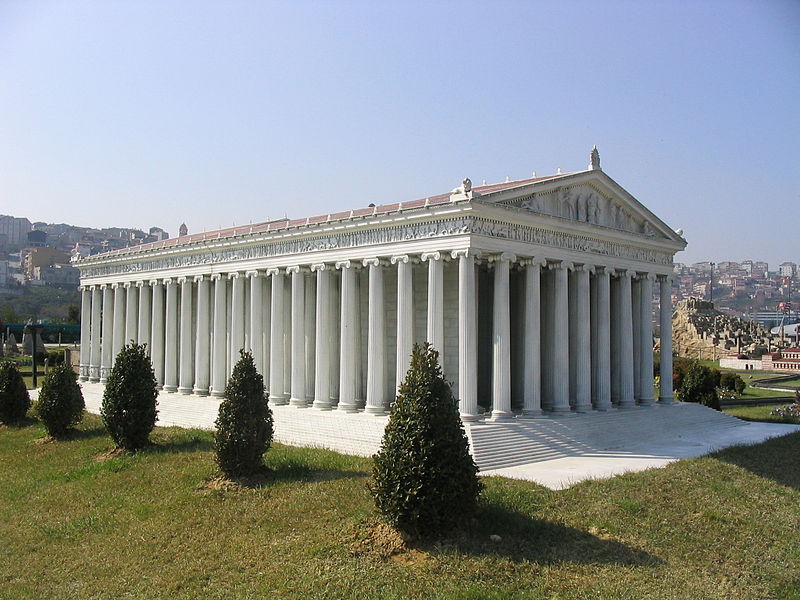
Temple of Ephesian Artemis
temple in Ephesus, one of the Seven Wonders of the Ancient World

agora
thumb|260px|View of the Ancient Agora of Athens in the foreground. The [[Temple of Hephaestus is to the left and the Stoa of Attalos to the right.]]

stoa
thumb|300px|The restored Stoa of Attalos in Athens, with busts of historical philosophers.
ancient Greek temple
structures built to house deity statues within Greek sanctuaries
odeon
ancient concert hall for performances and competitions

hippodrome
Hippodrome is a term sometimes used for public entertainment venues of various types. A modern example is the Hippodrome which opened in London in 1900 "combining circus, hippodrome, and stage performances".

bouleuterion
thumb|right|Bouleuterion of Priene
Bouleuterion (, bouleutērion), also translated as and was a building in ancient Greece which housed the council of citizens (, boulē) of a democratic city state. These representatives assembled at the bouleuterion to confer and decide about public affairs. There are several extant bouleuterion around Greece and its former colonies. It should not be confused with the Prytaneion, which housed the executive council of the assembly and often served as the boule's mess hall. The early bouleuterions were believed to have been originated from entertainment buildings
Temple of Apollo Epicurius in Bassae
ancient temple in Peloponnese, Greece
Pythagoreion
The Pythagoreion is the archaeological site of the ancient town of Samos in Samos, Greece. It is located in the area of the modern town of Pythagoreio, from which it got its modern name. The archaeological site contains ancient Greek and Roman monuments and a famous ancient tunnel, the Tunnel of Eupalinos or Eupalinian aqueduct. Along with the Heraion of Samos, the Pythagoreion was registered as a UNESCO World Heritage Site in 1992 because of its testimony to the cultural, military, and economic importance of Samos during Archaic and early Classical Greece.

prytaneion
thumb|260px|Prytaneion of Panticapaeum, II b.c. ([[Kerch, Crimea)]]
A prytaneion (, ) was the seat of the prytaneis (executive), and so the seat of government in ancient Greece. The term is used to describe any of a range of ancient structures where officials met (normally relating to the government of a city), but the term is also used to refer to the building where the officials and winners of the Olympic Games met at Olympia. The prytaneion normally stood in the centre of the city, in the agora.
tunnel of Eupalinos
ancient tunnel in the isle of Samos

Diolkos
thumb|upright=1.2|The Isthmus of Corinth|Isthmus with the Canal of Corinth close to where the diolkos ran.
thumb|upright=1.2|Strategic position of the Isthmus of Corinth between two seas.

Heroön
thumb|right|The northwest heroön at Sagalassos, Turkey

Cadmea of Thebes
thumb|275px|Ruins of the Cadmea.

Philippeion
The Philippeion () in the Altis of Olympia was a tholos made of in limestone and marble. Originally, it contained chryselephantine (ivory and gold) statues of the family of Philip II, including himself, his son Alexander the Great, one of his wives Olympias, his father Amyntas III, and his mother Eurydice I. It was made by the Athenian sculptor Leochares as a memorial celebrating Philip's victory at the battle of Chaeronea (338 BC). It was the only structure inside the Altis dedicated to human beings rather than gods.

Metroon
Coordinates:
Stadium at Olympia
ancient Olympic venue in Olympia, Greece
sanctuary of Artemis Orthia
sanctuary at Sparta

ekklesiasterion
thumb|The ekklesia in Athens convened on a hill called the Pnyx
In Ancient Greece, the ekklesiasterion (ἐκκλησιαστήριον) was the meeting place of the popular assembly (ekklesia) in a democratic Greek city-state (polis, plural poleis).

Pirene
fountain in ancient Corinth, Greece
Leonidaion
thumb|Leionidaion at southwest corner of Olympia sanctuary
thumb|The remains of the Leonidaion (2020)
thumb|Floor plan of the Leonidaion
Pelopion
thumb|Remains of the Pelopion in Olympia
The Pelopion was a structure at the ancient site of Olympia, Greece. It was the alleged tomb of Pelops, a figure in Greek mythology. It was a monument surrounded by a pentagonal structure. The tomb became an altar for animal sacrifices in Archaic Greece and continued to serve as an altar into the Roman era, until it fell into disuse with the advent of Christianity. It consisted of a mound of ashes and compacted earth, at the peak of which the sacrifice would take place – a black ram was sacrificed here every year in honor of Pelops. In order to get to t
tholos
circular temple
Stadium of Nemea
Ancient Greek stadium in Nemea, Corinthia
Treasuries at Olympia
ruined building complex in ancient Olympia, Greece
Belevi Mausoleum
Hellenistic tomb in Turkey
Greek baths of Olympia
ancient thermae of Olympia, Greece