Category
page 1Ancient Greek cities

polis
Polis (: poleis) means 'city' in Ancient Greek. The ancient word polis had socio-political connotations not possessed by modern usage. For example, Modern Greek πόλη (póli), "city", is located within a (chóra), "country", which is a πατρίδα (patrída) or "native land" for its citizens. In ancient Greece, the polis was the native land; there was no other. It had a constitution and demanded the supreme loyalty of its citizens. Χώρα was only the countryside, not a country. Ancient Greece was not a sovereign country; rather, it was territory occupied by Hellenes, people who claimed as their native

Thebes
modern city in Boeotia, Greece

Elefsina
thumb|250px|Plan of ancient Eleusis

Chalkída
Chalcis (; Ancient Greek and Katharevousa: , ), also called Chalkida or Halkida (Modern Greek: , ), is the chief city of the island of Euboea in Greece, situated on the Euripus Strait at its narrowest point. The name is preserved from antiquity and is derived from the Greek χαλκός (copper, bronze), though there is no trace of any mines in the area. In the Late Middle Ages, it was known as Negropont(e), an Italian name that has also been applied to the entire island of Euboea.
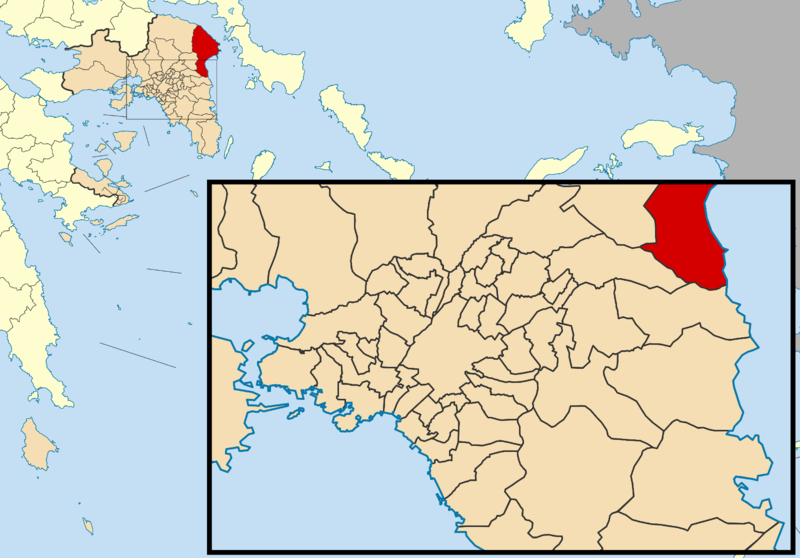
Marathon
modern town in Attica, Greece

Eretria
thumb|Neighbouring ancient cities
thumb|Plan of the site
.jpg)
Sicyon
thumb|260px|Ruins of Sicyon
Elis
ancient city-state, capital city of the district of Elis

Thespiae
Thespiae ( ; ) was an ancient Greek city (polis) in Boeotia. It sits at the foot of Mount Helicon and near right bank of the Thespius River (modern name Kanavari River).
Ancient Abdera
city in ancient Thrace and archaeological site
Abae
Abae (, '''') was an ancient town in the northeastern corner of ancient Phocis, in Greece, near the frontiers of the Opuntian Locrians, said to have been built by the Argive Abas, son of Lynceus and Hypermnestra, and grandson of Danaus. This bit of legend suggests an origin or at least an existence in the Bronze Age, and sites protohistory supports a continued existence in Iron-Age antiquity. It was famous for its oracle of Apollo Abaeus, one of those consulted by Croesus, king of Lydia, and Mardonius, among others. The site of the oracle was rediscovered at Kalapodi and excavated in modern ti
Orchomenus
ancient Greek city-state of Boeotia

Rhamnous
Rhamnous (; ), also Ramnous or Rhamnus, was an ancient Greek city in Attica situated on the coast, overlooking the Euboean Strait. Its ruins lie northwest of the modern town of Agia Marina in the municipality of Marathon.
Elateia
Elateia (; ) was an ancient Greek city of Phthiotis, and the most important place in that region after Delphi. It is also a modern-day town that is a former municipality in the southeastern part of Phthiotis. Since the 2011 local government reform, it is a municipal unit of the municipality Amfikleia-Elateia. Its population is 2,804 inhabitants (2021 census) and its land area is 154.361 km2. The municipal seat was the town of Eláteia (pop. 2,002); other communities are Zeli (466), Panagítsa (148), Lefkochóri (99) and Sfáka (89).

Cassandreia
thumb|Cassandreia
Cassandreia or Cassandrea (, Kassándreia) was once one of the most important cities in Ancient Macedonia, founded by and named after Cassander in 316 BC. It was located on the site of the earlier Ancient Greek city of Potidaea, at the isthmus of the Pallene peninsula. The fact that Cassander named it after himself suggests that he may have intended it to be his capital, and if the canal which cuts the peninsula at this point was dug or at least planned in his time, he may have intended to develop his naval forces using it as a base with a harbour on each of the east and west

Thoricus
260px|right|thumb|Archaeological site of Thorikos
Cleonae
ancient polis between Argos and Corinth
Opus
ancient city in Greece

list of ancient Greek cities
Wikimedia list article
Panopeus
Panopeus (), or Phanoteus (the name is given in a variety of forms in the ancient sources), was a Greek town of ancient Phocis, near the frontier of Boeotia, and on the road from Daulis to Chaeronea. Pausanias said that Panopeus was 20 stadia from Chaeronea and 7 from Daulis; but the latter number is almost certainly a mistake. The ruins at the village of Agios Vlasios (or Aio Vlasi) (), which are clearly those of Panopeus, are about 20 stadia distant from Chaeronea, but as much as 27 stadia distant from Daulis.
Aphidna
Aphidna () or Aphidnae or Aphidnai (Ἀφίδναι) was one of the twelve ancient towns of ancient Attica. It was celebrated in the mythical period as the place where Theseus deposited Helen of Troy, entrusting her to the care of his friend Aphidnus. When the Dioscuri invaded Attica in search of their sister, the inhabitants of Deceleia informed the Lacedaemonians where Helen was concealed, and showed them the way to Aphidna. The Dioscuri thereupon took the town, and carried off their sister. We learn, from a decree quoted by Demosthenes, that Aphidna was, in his time, a fortified town, and at a grea
Hyampolis
Hyampolis (Ὑάμπολις Iabolis) was a city in ancient Phocis, Greece. A native of this city was called a Hyampolites. Some ancient authors record that the city was also called simply Hya.

Akragas
ancient Greek city of Agrigento
Amphicleia
Amphicleia or Amphikleia () or Amphicaea or Amphikaia (Ἀμφίκαια) was a Greek town in the north of ancient Phocis, distant 60 stadia from Lilaea, and 15 stadia from Tithronium. It was destroyed by the Persian army of Xerxes in his invasion of Greece (480 BCE). Although Herodotus calls it Amphicaea, following the most ancient traditions, the Amphictyonic League gave it the name of Amphicleia in their decree respecting rebuilding the town (346 BCE). It also bore for some time the name of Ophiteia (Ὀφιτεία), in consequence of a legend, which Pausanias relates. The place was celebrated in
Anticyra
REDIRECT Antikyra#Ancient
Pindus
ancient city of Doris, Greece
Thronium
ancient city of Epirus
Oropus
Oropus or Oropos (, or rarely ἡ Ὠρωπός) was a town on the borders of ancient Attica and Boeotia, and the capital of a district, called after it Oropia (ἡ Ὠρωπία.) This district is a maritime plain, through which the Asopus flows into the sea, and extends for along the shore. It is separated from the inland plain of Tanagra by some hills, which are a continuation of the principal chain of the Diacrian mountains.
==History==
Oropus was originally a town of Boeotia; and, from its position in the maritime plain of the Asopus, it naturally belonged to that country. It was, however, a frequent subj
Kytheros
Cytherus or Kytheros ( or Κύθηρος), also known as Cytherum or Kytheron (Κύθηρον), was one of the twelve cities of ancient Attica, and afterwards a deme. Pausanias states that the nymphs of the river Cytherus in Elis were called Ionides from Ion, the son of Gargettus, when he migrated from Athens to Elis.
Cytinium
Cytinium or Kytinion ( or Κυτείνιον) was an ancient city and polis (city-state) of Greece, one of the towns of the tetrapolis of Doris. Its site is within the bounds of the modern village of .
Sollium
Sollium or Sollion (), was a town on the coast of ancient Acarnania, on the Ionian Sea. It was in the neighbourhood of Palaerus, which lay between Leucas and Alyzia. William Martin Leake, however, placed it south of Alyzia, at Stravolimióna (i.e., Port Stravo). Sollium was a Corinthian colony, and as such was taken by the Athenians in the first year of the Peloponnesian War (431 BCE). The Athenians gave both the place and its territory to Palaerus. It is again mentioned in 426 BCE, as the place at which Demosthenes landed when he resolved to invade Aetolia.