Category
page 1Ancient Greek educators

Callimachus
Callimachus (; ; ) was an ancient Greek poet, scholar, and librarian who was active in Alexandria during the 3rd century BC. A representative of Ancient Greek literature of the Hellenistic period, he wrote over 800 literary works, most of which do not survive, in a wide variety of genres. He espoused an aesthetic philosophy, known as Callimacheanism, which exerted a strong influence on poets of the Roman Empire and, through their reception, on later Western literature.
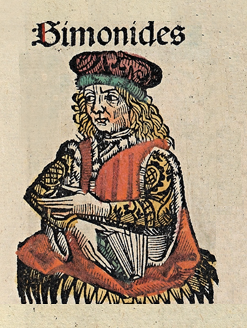
Simonides of Ceos
Greek lyric poet (c. 556–468 BC)

Dionysius of Halicarnassus
1st-century BC Greek historian and teacher

sophist
A sophist () was a professional travelling teacher in ancient Greece in the fifth and fourth centuries BC. Sophists specialized in one or more subject areas, such as philosophy, rhetoric, music, athletics, mathematics, and arete: "virtue" or "excellence". The sophists sold their tutoring expertise predominantly to young statesmen and nobility. Certain sophists are regarded as philosophers in their own right. The first credited sophist, Protagoras, argued that "man is the measure of all things", and he controversially would strive to "make the weaker argument the stronger".

Posidonius
Posidonius (; , "of Poseidon") "of Apameia" () or "of Rhodes" () (), was a Greek politician, astronomer, astrologer, geographer, historian, mathematician, and teacher native to Apamea, Syria. He was considered the most learned man of his time and, possibly, of the entire Stoic school. After a period learning Stoic philosophy from Panaetius in Athens, he spent many years in travel and scientific researches in Spain, Africa, Italy, Gaul, Liguria, Sicily and on the eastern shores of the Adriatic. He settled as a teacher at Rhodes where his fame attracted numerous scholars. Next to Panaetius he di
Libanius
Libanius (; ) was a teacher of rhetoric of the Sophist school in the Eastern Roman Empire. His prolific writings make him one of the best documented teachers of higher education in the ancient world and a critical source of history of the Greek East during the 4th century AD. During the rise of Christian hegemony in the later Roman Empire, he remained unconverted and in religious matters was a pagan Hellene.

Euclid of Megara
Greek philosopher (c. 435 – c. 365 BC)

Antiochus of Ascalon
ancient Greek philosopher
Zenodotus
Zenodotus () was a Greek grammarian, literary critic, Homeric scholar, and the first librarian of the Library of Alexandria. A native of Ephesus and a pupil of Philitas of Cos, he lived during the reigns of the first two Ptolemies, and was at the height of his reputation about 280 BC.
Philetas of Cos
ancient Greek scholar and poet
Alexandros Polyhistor
1st-century BC Greek scholar
Zenobius
Zenobius () was a Greek sophist, who taught rhetoric at Rome during the reign of Emperor Hadrian (AD 117–138).
Apollodorus the Epicurean
ancient Greek philosopher
Apsines
Apsines of Gadara (; fl. 3rd century AD) was a Greek rhetorician. He was a native of the Hellenised city of Gadara, whose ruins stand today at the border of Jordan with Syria and Israel. Apsines went on to study at Smyrna and taught at Athens, gaining such a reputation that he was raised to the consulship by the emperor Maximinus. He was a rival of Fronto of Emesa, and a friend of Philostratus, the author of the Lives of the Sophists, who praises his wonderful memory and accuracy.
Diophantus
ancient Greek rhetorician
Aristos of Ascalon
ancient Greek philosopher
Epiphanius of Petra
ancient Greek rhetorician