Category
page 1Ancient Greek physics

Timaeus
dialogue by Plato

De rerum natura
didactic poem by Lucretius
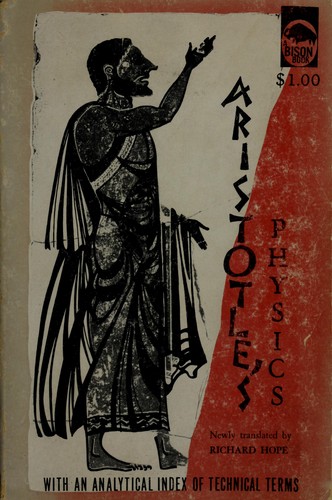
Physics
treatise by Aristotle

History of Animals
work by Aristotle
Aristotelian physics
natural sciences as described by Aristotle

On the Soul
Treatise by Aristotle
clinamen
Clinamen (; plural clinamina, derived from , to incline) is the unpredictable swerve of atoms in the atomistic doctrine of Epicurus. This swerving, according to Lucretius, provides the "free will which living things throughout the world have". Lucretius never gives the primary cause of the deflections.
Tetrabiblos
thumb|Quadripartitum, 1622

physis
Physis (; ; pl. physeis, φύσεις) is a Greek philosophical, theological, and scientific term, usually translated into English—according to its Latin translation "natura"—as "nature". The term originated in ancient Greek philosophy, and was later used in Christian theology and Western philosophy. In pre-Socratic usage, physis was contrasted with , , "law, human convention". Another opposition, particularly well-known from the works of Aristotle, is that of physis and techne – in this case, what is produced and what is artificial are distinguished from beings that arise spontaneously from their o
macrocosm and microcosm
a vision of cosmos where the part reflects the whole and vice versa
inherence
Inherence refers to Empedocles' idea that the qualities of matter come from the relative proportions of each of the four elements entering into a thing. The idea was further developed by Plato and Aristotle.
Stoic physics
natural philosophy of the Stoic philosophers