Category
page 1Ancient Levant

Assyrian Empire
Assyria was a major ancient Mesopotamian civilization that existed as a city-state from the 21st century BC to the 14th century BC and eventually expanded into an empire from the 14th century BC to the 7th century BC.

Phoenicia
Phoenicians were an ancient Semitic people who inhabited city-states in Canaan along the Levantine coast of the eastern Mediterranean, primarily in present-day Lebanon and parts of coastal Syria. Their maritime civilization expanded and contracted over time, with its cultural core stretching from Arwad to Mount Carmel. Through trade and colonization, the Phoenicians extended their influence across the Mediterranean, from Cyprus to the Iberian Peninsula, leaving behind thousands of inscriptions.

Babylonia
Babylonia (; , ) was an ancient Akkadian-speaking state and cultural area based on the city of Babylon in central-southern Mesopotamia (present-day Iraq and parts of Syria). It emerged as an Akkadian-populated but Amorite-ruled state . During the reign of Hammurabi and afterwards, Babylonia was retrospectively called "the country of Akkad" ( in Akkadian), a deliberate archaism in reference to the previous glory of the Akkadian Empire. It was often involved in rivalry with the linguistically related state of Assyria in Upper Mesopotamia, and with Elam to the east. Babylonia briefly became the m

Akkadian Empire
ancient empire in the Mesopotamia (2334–2154 BC)

Kingdom of Judah
Israelite Kingdom, whose capital was Jerusalem and Hebron, c. 930–586 BCE

Amorites
thumb|upright=1.5|Cuneiform clay tablets from the Amorite Kingdom of Mari, 1st half of the 2nd millennium BC
The Amorites () were an ancient Northwest Semitic-speaking Bronze Age people who emerged from western Mesopotamia. Initially appearing in Sumerian records , they expanded and ruled most of the Levant and Mesopotamia, and parts of Egypt, from the 21st century BC to the start of the 16th century BC.

Ugarit
Ugarit (; , ủgrt /ʾUgarītu/) was an ancient Levantine coastal city located in what is today northern Syria. The site, with its corpus of ancient cuneiform texts, was discovered in 1928. The texts were written in a previously unknown Northwest Semitic tongue—the Ugaritic language. Archaeological excavations of Ugarit show evidence of occupation since the 8th millennium BC. Research has focused on the late Bronze Age levels; relatively little is known about earlier occupation. The ongoing archaeological investigation of Ugarit has proven to be invaluable to the study of the Bronze Age in the eas
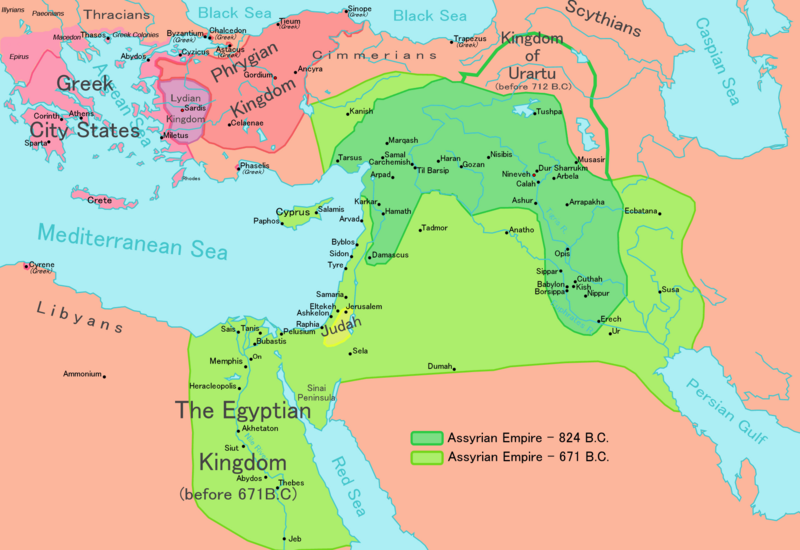
Neo-Assyrian Empire
historical state in Mesopotamia

Sea Peoples
purported historical ethnic group

Mari
ancient Sumerian and Amorite city

Ebla
Ebla (Sumerian: eb₂-la, , modern: , Tell Mardikh) was one of the earliest kingdoms in Syria. Its remains constitute a tell located about southwest of Aleppo near the village of Mardikh. Ebla was an important center throughout the and in the first half of the Its discovery proved the Levant was a center of ancient, centralized civilization equal to Egypt and Mesopotamia and ruled out the view that the latter two were the only important centers in the Near East during the Early Bronze Age.

Roman Syria
Roman province (64 BC - 198 AD)

Arabia Petraea
Roman province (106–630s)

Arameans
The Arameans, or Aramaeans (; ; , ), were a tribal Semitic people in the ancient Near East, first documented in historical sources from the late 12th century BCE. Their homeland, often referred to as the land of Aram, originally covered central regions of what is now Syria.

Palmyrene Empire
breakaway state from the Roman Empire (270–273)

Osroene
Osroene or Osrhoene (; ) was an ancient kingdom and region in Upper Mesopotamia. The Kingdom of Osroene, also known as the "Kingdom of Edessa" ( / "Kingdom of Urhay"), according to the name of its capital city (now Şanlıurfa, Turkey), existed from the 2nd century BC up to the 3rd century AD, and was ruled by the Nabataean Arab Abgarid dynasty. They were generally allied with the Parthians.
Syrian Wars
series of wars between Egypt and the Seleucid Empire in Syria (274-168 BCE)

Alalakh
Alalakh (Tell Atchana; Hittite: Alalaḫ) is an ancient archaeological site approximately northeast of Antakya (historic Antioch) in what is now Turkey's Hatay Province. It flourished as an urban settlement in the Middle and Late Bronze Age, c. 2000–1200 BC. The city contained palaces, temples, private houses and fortifications. The remains of Alalakh have formed an extensive mound covering around 22 hectares. In the Late Bronze Age, Alalakh was the capital of the local kingdom of Mukiš.
King's Highway
ancient trade route

Qatna
Qatna (modern: , Tell al-Mishrifeh; also Tell Misrife or Tell Mishrifeh) was an ancient city located in Homs Governorate, Syria. Its remains constitute a tell situated about northeast of Homs near the village of al-Mishrifeh. The city was an important center through most of the second millennium BC and in the first half of the first millennium BC. It contained one of the largest royal palaces of Bronze Age in Syria and has an intact royal tomb that has provided a great amount of archaeological evidence on the funerary habits of that period.
Neo-Hittite states
successor states of the Hittite empire in the ancient Near East

Habiru
thumb|alt= Cuneiform SA.KAS and KU6.KAŠ.RU| Cuneiform of Sumerian language|Sumerian and corresponding West Semitic ha-bi-ru

Shasu
thumb|right|200px|Shasu prisoner as depicted in Ramesses III's [[reliefs at Medinet Habu.]]
The Shasu (, possibly pronounced šaswə) were Semitic-speaking pastoral nomads in the Southern Levant from the late Bronze Age to the Early Iron Age or the Third Intermediate Period of Egypt. They were tent dwellers, organized in clans ruled by a tribal chieftain and were described as brigands active from the Jezreel Valley to Ashkelon, in the Transjordan and in the Sinai. Some of them also worked as mercenaries for Asiatic and Egyptian armies.
Aram
historical region including several Aramean kingdoms covering much of the present-day Syria, southeastern Turkey, and parts of Lebanon and Iraq.
En Esur
large Chalcolithic village and Early Bronze Age city, Israel
Execration texts
ancient Egyptian ritual writing

Suteans
thumb|Map of Mesopotamia during the kingdom of Shamshi-Adad I showing the location of Suhum, the homeland of Suteans
The Suteans (Akkadian: Sutī’ū, possibly from Amorite: Šetī’u) were a nomadic Semitic people who lived throughout the Levant, Canaan, and Mesopotamia, specifically in the region of Suhum, during the Old Babylonian period. They were famous in Semitic epic poetry for being fierce nomadic warriors, and like the ʿApiru, traditionally worked as mercenaries. The Suteans spoke the Sutean language, an unattested language proposed to be related to either Aramaic or Arabic. They may have b
.jpg)
Ghassulian
thumb|Copper sceptre from the [[Nahal Mishmar hoard (at Hecht Museum, Haifa)]]
thumb|Ghassulian ossuary, ca. 3500 BC, [[Canaan (at the British Museum)]]
thumb|The Ghassulian star
Ahlamu
thumb|Syrian Desert, where Ahlamu nomads were active
The Ahlamu, or Aḫlamū, were a group or designation of Semitic semi-nomads. Their habitat was west of the Euphrates between the mouth of the Khabur and Palmyra.
history of the ancient Levant
aspect of history
Pompeian era
calendar era used by Hellenistic cities in Roman Palestine
Phoenician settlement of North Africa
phoenician colonization in North Africa