Category
page 1Ancient Olympic Games

wrestling
Wrestling is a martial art, combat sport, and form of entertainment that involves grappling with an opponent and striving to obtain a position of advantage through different throws or techniques, within a given ruleset. Wrestling involves different grappling-type techniques, such as clinch fighting, throws and takedowns, joint locks, pins, and other grappling holds. Many different wrestling techniques have been incorporated into martial arts, combat sports, and military systems.

Olympia
town on the Peloponnese peninsula in Greece, site of the ancient Olympic Games
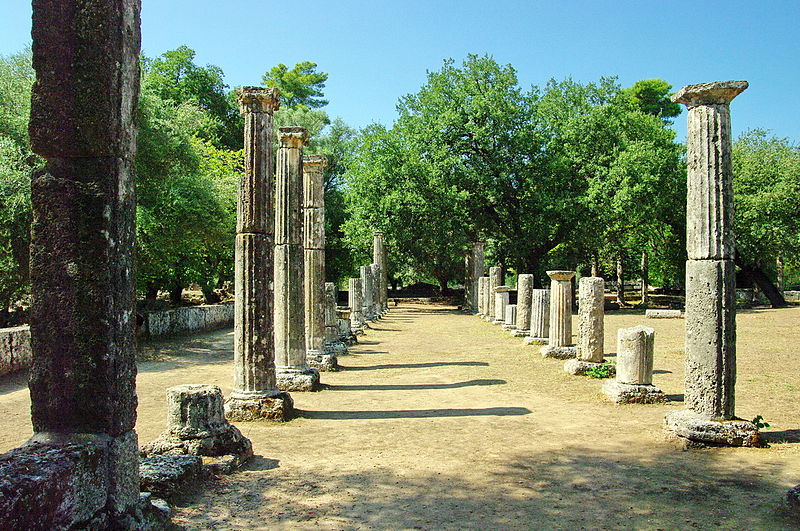
ancient Olympic Games
athletic competitions in ancient Greece
.jpg)
olympiad
thumb | 300px |Stadium at ancient Olympia, Greece|Olympia
.jpg)
Pelops
thumb|Roman mosaic with Pelops and Hippodamia, kept in the D. Diogo de Sousa Museum in Braga, Portugal.
Phlegon of Tralles
2nd-century AD Greek writer

pentathlon
thumb|right|The pentathlon was first documented in Ancient Greece, and included the discus and [[javelin throw.]]
A pentathlon is a contest featuring five events. The name is derived from Greek: combining the words pente (five) and -athlon (competition) (). The first pentathlon was documented in Ancient Greece and was part of the Ancient Olympic Games. Five events were contested over one day for the Ancient Olympic pentathlon, starting with the long jump, javelin throwing, and discus throwing, followed by the stadion (a short foot race) and wrestling. Pentathletes were considered to be among t

epinikion
thumb|150px|In addition to epinikia, a victorious athlete might be honored with a statue, as with this charioteer found at Delphi, probably a champion driver at the [[Pythian Games]]
The epinikion or epinicion (: epinikia or epinicia, Greek , from epi-, "on" and nikê, "victory") is a genre of occasional poetry also known in English as a victory ode. In ancient Greece, the epinikion most often took the form of a choral lyric, commissioned for and performed at the celebration of an athletic victory in the Panhellenic Games and sometimes in honor of a victory in war. Major poets in the genre are

Chronicon
Greek chronicle written by Eusebius, published in 311 (1st edition) and 325 (2nd edition)
Hellanodikai
The Hellanodikai (, literally meaning Judges of the Greeks; sing. Ἑλλανοδίκας ) were the judges of the Ancient Olympic Games, and the success of the games was attributed to their efforts. It was their sacred duty to maintain the standards and legacy of the games, as well as uphold the rules.
list of ancient olympic winners
Wikimedia list article
Kallipateira of Rhodes
5th-century BC Greek athlete
Agriopas
Agriopas was a writer of ancient Greece mentioned by Pliny the Elder. He was the author of an account of the Olympic victors, called the Olympionicae. His exact date of birth is unknown.
Bouleuterion of Ancient Olympia
a building inside the archaeological site of Olympia.
Eubotas of Cyrene
ancient Greek olympian
Zanes (Olympic)
bronze statues of Zeus as penalty for Olympic cheating
Template:Ancient Olympic winners
Wikimedia template

Hippodrome of Olympia
ancient track for chariot and horse racing at the Olympic games
L'Olimpiade
thumb|upright|Title page (1733)
L'olimpiade
opera by Baldassare Galuppi
alytarches
Alytarches (Greek: ) in ancient Olympic games was the leader of the police force who assisted the Hellanodikai to impose fines on athletes who did not follow the rules. The rabdouchoi, rod-bearers, and mastigophoroi, scourge-bearers, carried out the punishments. If an athlete could not pay a fine, his hometown paid it for him.