Category
page 1Ancient Roman religious titles
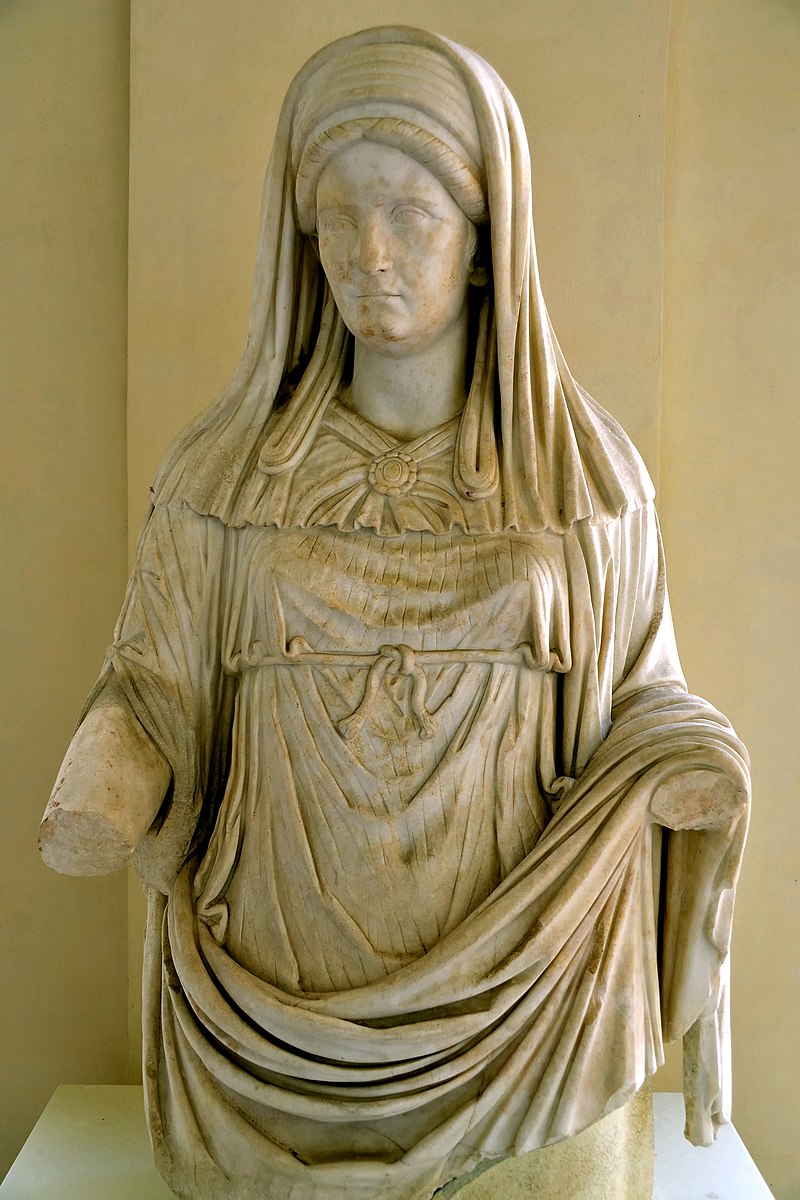
Vestal Virgin
priestesses of goddess Vesta in Ancient Rome

pontifex maximus
the chief high priest of the College of Pontiffs in ancient Rome, open only to patricians until 254 BCE, when a plebeian first occupied this post; gradually became politicized until, beginning with Augustus, it was subsumed into the Imperial office

flamen
A ' (plural, ') was a specific type of priest ("sacerdos") in the ancient Roman religion and one of the oldest classes of the Roman priesthood, with origins likely predating the Republican era. These flamines, of which there were fifteen, were high-ranking members of the College of Pontiffs who administered and oversaw the various cults of the state-sponsored religion, both collectively and individually. The most important of these were the three ("major priests"), who each served one of the gods of the Archaic Triad: Jupiter, Mars, and Quirinus. The remaining twelve ("lesser priests") served
Arval Brethren
ancient Roman priestly body
.gif)
Salii
The Salii, Salians, or Salian priests were the "leaping priests" of Mars in ancient Roman religion, supposed to have been introduced by King Numa Pompilius. They were twelve patrician youths dressed as archaic warriors with an embroidered tunic, a breastplate, a short red cloak (), a sword, and a spiked headdress called an apex. They were charged with the twelve bronze shields called , whichlike those of the Mycenaeansresembled a figure eight. One of the shields was said to have fallen from heaven in the reign of King Numa and eleven copies were made to protect the identity of the sacred shiel
%2C%20III%20sec%2C%20dalla%20necropoli%20di%20porta%20all'isola%20sacra.JPG)
gallus
thumb|200px|Relief of an archigallus making sacrifices to Cybele and Attis, Museo Archeologico Ostiense, [[Ostia Antica]]
rex Sacrorum
ancient Roman religious office
College of Pontiffs
body of the ancient Roman state whose members were the highest-ranking priests of the state religion
fetial
A fetial (; , . ) was a type of priest in ancient Rome. They formed a collegium devoted to Jupiter as the patron of good faith.
Quindecimviri sacris faciundis
Ancient Roman priestly college

epulo
thumb|right|Goddess (Vesta (mythology)|Vesta or Concordia), extending a [[patera, emblem of the Epulones]]
The '''' (Latin for "feasters"; sing. epulo) was a religious organization of Ancient Rome. They arranged feasts and public banquets at festivals and games (ludi). They constituted one of the four great religious corporations (quattuor amplissima collegia'') of ancient Roman priests.
Titii
The Titii (or Titii sodales, later Titienses, Sacerdotes Titiales Flaviales) was a college (sodalitas) of Roman priests.
Rex Nemorensis
Mythological character
Flamen Dialis
high priest of Jupiter in ancient Rome
Flamen Martialis
High priest of Mars in ancient Rome
Sacerdos Cereris
priestess for the goddess Ceres
bidental
thumb|upright|A Dionysus|Bacchic Roman [[puteal ("wellhead") of the Neo-Attic style, inspired by Hellenistic art. Relief shows figures a Bacchic procession: a drunk Hercules (in centre) wears the skin of the Nemean lion and carries his olivewood club.]]
thumb|right|Bidental Drawing From: The Illustrated Companion to the Latin Dictionary and Greek Lexicon
In ancient Roman religion, a bidental was a sacred shrine erected on the spot where lightning had struck.