Category
page 1Ancient suicides

Cleopatra
Cleopatra VII Thea Philopator (; 70/69 BC10 or 12 August 30 BC) was Queen of the Ptolemaic Kingdom of Egypt from 51 to 30 BC, and the last active Hellenistic pharaoh. A member of the Ptolemaic dynasty, she was a descendant of its founder Ptolemy I Soter, a Macedonian Greek general and companion of Alexander the Great. Her first language was Koine Greek, and she is the only Ptolemaic ruler known to have learned the Egyptian language, among several others. After her death, Egypt became a province of the Roman Empire, marking the end of the Hellenistic period in the Mediterranean,

Hannibal
Hannibal (; ; 247 – between 183 and 181 BC) was a Carthaginian general and statesman who commanded the forces of Carthage in their battle against the Roman Republic during the Second Punic War. Hannibal lived during a period of great tension in the Mediterranean Basin, triggered by the emergence of the Roman Republic as a great power with its defeat of Carthage in the First Punic War. Revanchism prevailed in Carthage, symbolized by the pledge that Hannibal made to his father to "never be a friend of Rome".

Judas Iscariot
notable as betrayer of Jesus, one of Jesus's original twelve disciples

Samson
Samson (; ) was the last of the judges of the ancient Israelites mentioned in the Book of Judges (chapters 13 to 16) and one of the last leaders who "judged" the twelve tribes of Israel before the institution of the monarchy. He is sometimes regarded as an Israelite version of the popular Near Eastern folk hero archetype also embodied by the Sumerian Gilgamesh and Enkidu, as well as the Greek Heracles. Samson was given superhuman powers by God in the form of extreme strength.

Saul
thumb|The Kingdom of Saul, according to the biblical account
thumb|300px|David and Saul, by Julius Kronberg, 1885
thumb|upright=1.13|David Plays the Harp for Saul, by Rembrandt|Rembrandt van Rijn, c. 1650
thumb|upright=1.3|Saul threatening David, by José Leonardo, c. 1640s
Saul (; , ; ; , ) was a monarch of ancient Israel and Judah and, according to the Hebrew Bible and Old Testament, the first king of the United Monarchy, a polity of uncertain historicity. His reign, traditionally placed in the late eleventh century BC, marked the transition of the Israelites from a scattered tribal society r

Decebalus
Decebalus (; ), sometimes referred to as Diurpaneus, was the last Dacian king. He is known for fighting three wars, with varying success, against the Roman Empire under two emperors. After raiding south across the Danube, he defeated a Roman invasion in the reign of Domitian, securing a period of independence during which Decebalus consolidated his rule.
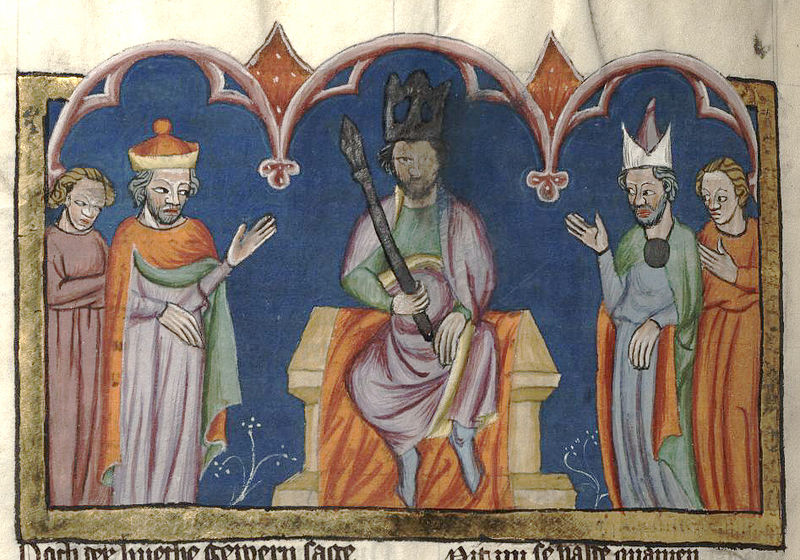
Zimri
king of Israel, with a reign of seven days; chariot commander who murdered king Elah, and succeeded him, but was overthrown by the army

Ermanaric
right|250px|thumb|The orange area signifies the Chernyakhov Culture, identified with Ermanaric's kingdom, in the early fourth century.
right|250px|thumb|Ermanaric's kingdom at the end of the fourth century (a map from 1899).
Ermanaric (died 376) was a Greuthungian king who before the Hunnic invasion evidently ruled a sizable portion of Oium, the part of Scythia inhabited by the Goths at the time. He is mentioned in two Roman sources: the contemporary writings of Ammianus Marcellinus, and in Getica by the sixth-century historian Jordanes. He also appears in a fictionalized form in later Germani
King Zhou of Shang
last king of Chinese Shang dynasty (r. 1075 BBCE-1046 BCE)
Rusa I
King of Urartu

Shamash-shum-ukin
Šamaš-šuma-ukin ( or , meaning "Shamash has established the name"), was king of Babylon as a vassal of the Neo-Assyrian Empire from 668 BC to his death in 648. Born into the Assyrian royal family, Šamaš-šuma-ukin was the son of the Neo-Assyrian king Esarhaddon and the elder brother of Esarhaddon's successor Ashurbanipal.

Sophonisba
thumb|300px|The Death of Sophonisba (Pittoni)|The Death of Sophonisba, by [[Giambattista Pittoni ( 1718)]]
Ptolemy of Cyprus
king of Cyprus

Sardanapalus
thumb|right|300px|Eugène Delacroix. [[The Death of Sardanapalus. Oil on canvas. 12 ft 1 in x 16 ft 3 in. Louvre.]]
thumbnail|Lantern slide given the title "Sardanapalus" by [[William Henry Goodyear. Brooklyn Museum Archives, Goodyear Archival Collection]]
According to the Greek writer Ctesias, Sardanapalus ( ; ), sometimes spelled Sardanapallus (), was the last king of Assyria, although in fact Aššur-uballiṭ II (612–605 BC) holds that distinction.

Ahitophel
Ahitophel, Achitofel, or Ahithophel (), according to the Hebrew Bible, was a counselor of King David and a man greatly renowned for his wisdom. During Absalom's attempt to usurp the throne, he deserted David and supported Absalom, whom he then turned to as an advisor. To counteract Ahitophel's counsel, the fleeing David sent his friend Hushai back to Absalom. Seeing that his advice against David had not been followed due to Hushai's influence, Ahithophel surmised that the revolt would fail, returned to his hometown of Giloh, and hanged himself. He was buried in "the sepulcher of his fathers".

Pentawer
Pentawer (also Pentawere and Pentaweret) was an ancient Egyptian prince of the 20th Dynasty, a son of Pharaoh Ramesses III and his secondary wife, Tiye. He was involved in the so-called "harem conspiracy", a plot to kill his father and place him on the throne. The details of his trial are recorded in the Judicial Papyrus of Turin; he was compelled to commit suicide following his trial. A candidate for his body is a mummy known as "Unknown Man E", discovered in the Deir el-Bahari cache in 1881. This mummy is unusual as it was found wrapped in a sheep or goat skin and was improperly mummified, b
Calanus
Kalanos, also spelled Calanus () ( – 323 BCE), was an ancient Indian gymnosophist, a Brahmin sage , and philosopher from Taxila who accompanied Alexander the Great and was his teacher. He accompanied Alexander the Great to Persis and, after falling ill, immolated himself by entering a pyre in front of Alexander's army. Diodorus Siculus called him Caranus ().
death of Cleopatra
a significant event marking the death of the penultimate Ptolemaic ruler of Egypt in 30 BC

Molon
thumb|Coinage of Antiochos III, [[Susa mint, during his first reign at Susa (223-222 BC), before the revolt of Molon]]
thumb|Coinage of Antiochos III, [[Susa mint, during his second reign at Susa (220-187 BC), after the revolt of Molon.]]
Molon ( or ) or Molo (; ; died 220 BC) was a general and satrap of the Seleucid king Antiochus the Great (223–187 BC). He held the satrapy of Media at the accession of that monarch (223 BC); in addition to which, Antiochus conferred upon him and his brother Alexander the government of all the upper provinces of his empire. But their hatred of Hermeias,
Phasael
Phasael (died 40 BCE; ,; ; from ), was a prince from the Herodian Dynasty of Judea.
Himilco
Magonid Carthaginian general (died 396 BC)
Bruriah
Beruriah (also Bruriah; or ) is one of several women quoted as one of the Chazal (Talmudic sages). She was the wife of the tanna Rabbi Meir and the daughter of Haninah ben Teradion.
list of suicides
Wikimedia list article
Li Qi
Cheng Han emperor (314-338)
Yujiulü Anagui
Khan of the Rouran
Alexander
satrap and brother of Molon
Amsicora
Hampsicora (died 215 BC) was a Sardo-Punic political leader and landowner of Sardinia, and the leader of the major anti-Roman revolt () in the province of 215 BC.
thumb|Map of the revolt
The sources describe Hampsicora as the richest among the landowners of Sardinia, which at that time appeared to be split into two entities: the Carthaginian-dominated Southern and Western agricultural coastline, including the vast Campidano plain, and the more inland areas that maintained their independence and, while being eventually tolerant of the Carthaginians after many skirmishes, were nonetheless hostil
Charmion
servant to Cleopatra
Prince Kinashi no Karu
crown Prince of Japan
Empress Yifu
Northern Wei empress
Prince Hodong of Goguryeo
son of the 1st century King Daemusin of Goguryeo
Harmonia
daughter of Gelo
Zarmanochegas
Zarmanochegas (; according to Strabo) or Zarmarus (according to Dio Cassius) was a gymnosophist (naked philosopher), a monk of the Sramana tradition (possibly, but not necessarily a Buddhist) who, according to ancient historians such as Strabo and Dio Cassius, met Nicholas of Damascus in Antioch in the first years of Augustus' rule over the Roman Empire, and shortly thereafter proceeded to Athens where he burnt himself to death. He is estimated to have died in 19 BC.