Category
page 1Animal anatomy
.jpg)
brain
The brain is an organ that serves as the center of the nervous system in all vertebrate and most invertebrate animals. It consists of nervous tissue and is typically located in the head (cephalization), usually near organs for special senses such as vision, hearing, and olfaction. Being the most specialized organ, it is responsible for receiving information from the sensory nervous system, processing that information (thought, cognition, and intelligence) and the coordination of motor control (muscle activity and endocrine system).

mouth
A mouth, also referred to as the oral, is the body orifice through which many animals ingest food and vocalize. The body cavity immediately behind the mouth opening, known as the oral cavity (or ''' in Latin), is also the first part of the alimentary canal, which leads to the pharynx and the gullet. In tetrapod vertebrates, the mouth is bounded on the outside by the lips and cheeks — thus the oral cavity is also known as the buccal cavity (from Latin ', meaning "cheek") — and contains the tongue on the inside. Except for some groups like birds and lissamphibians, vertebrates usually have teeth
.jpg)
skin
Skin is the layer of usually soft, flexible outer tissue covering the body of a vertebrate animal, with three main functions: protection, regulation, and sensation.

tooth
A tooth (: teeth) is a hard, calcified structure found in the jaws (or mouths) of many vertebrates and used to break down food. Some animals, particularly carnivores and omnivores, also use teeth to help with capturing or wounding prey, tearing food, for defensive purposes, to intimidate other animals often including their own, or to carry prey or their young. The roots of teeth are covered by gums. Teeth are not made of bone, but rather of multiple tissues of varying density and hardness that originate from the outermost embryonic germ layer, the ectoderm.

skeleton
A skeleton is the structural frame that supports the body of most animals. There are several types of skeletons, including the exoskeleton, which is a rigid outer shell that holds up an organism's shape; the endoskeleton, a rigid internal frame to which the organs and soft tissues attach; and the hydroskeleton, a flexible internal structure supported by the hydrostatic pressure of body fluids.

leg
A leg is a weight-bearing and locomotive anatomical structure, usually having a columnar shape. During locomotion, legs function as "extensible struts". The combination of movements at all joints can be modeled as a single, linear element capable of changing length and rotating about an omnidirectional "hip" joint.

abdomen
An abdomen (also belly or stomach in vertebrates, or metasoma in arthropods) is the front part of the torso between the thorax (chest) and pelvis in humans and in other vertebrates. The area occupied by the abdomen is called the abdominal cavity. In arthropods, it is the posterior tagma of the body; it follows the thorax or cephalothorax.

thorax
The thorax (: thoraces or thoraxes) or chest is a part of the anatomy of mammals and other tetrapod animals located between the neck and the abdomen.

tail
thumb|A white-tailed deer's tail
The tail is the elongated section at the rear end of a bilaterian animal's body; in general, the term refers to a distinct, flexible appendage extending backwards from the midline of the torso. In vertebrate animals that evolved to lose their tails (e.g. frogs and hominid primates), the coccyx is the homologous vestigial of the tail. While tails are primarily considered a feature of vertebrates, some invertebrates such as scorpions and springtails, as well as snails and slugs, have tail-like appendages that are also referred to as tails.

gallbladder
In vertebrates, the gallbladder, also known as the cholecyst, is a small hollow organ where bile is stored and concentrated before it is released into the small intestine. In humans, the pear-shaped gallbladder lies beneath the liver, although the structure and position of the gallbladder can vary significantly among animal species. It receives bile, produced by the liver, via the common hepatic duct, and stores it. The bile is then released via the common bile duct into the duodenum, where the bile helps in the digestion of fats.

pharynx
The pharynx (: pharynges) is the part of the throat behind the mouth and nasal cavity, and above the esophagus and trachea (the tubes going down to the stomach and the lungs respectively). It is found in vertebrates and invertebrates, though its structure varies across species. The pharynx carries food to the esophagus and air to the larynx. The flap of cartilage called the epiglottis stops food from entering the larynx.
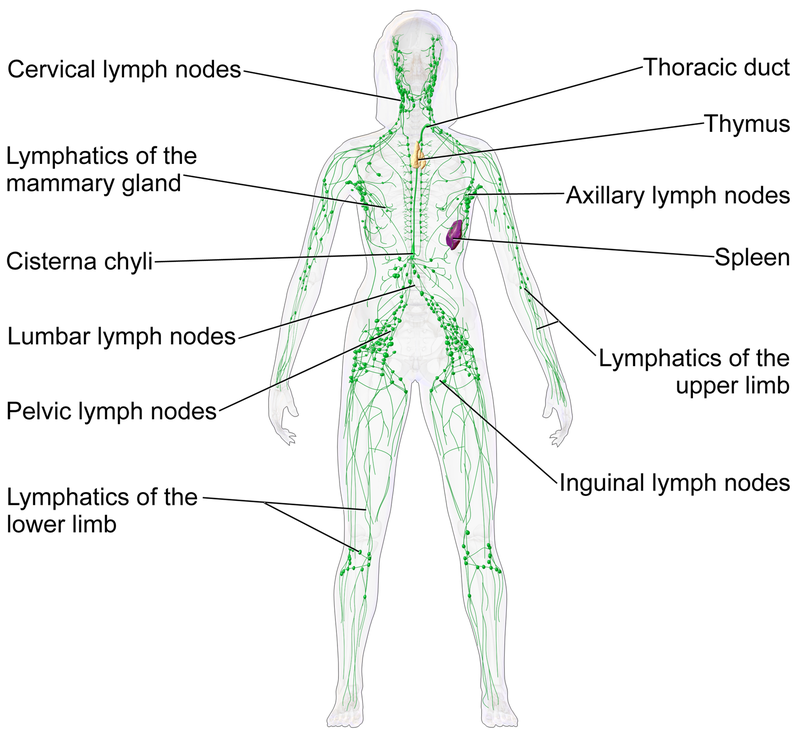
lymphatic system
a part of the defense system (immune system) of vertebrate animals against pathogens

gill
thumb|right|The red gills of this common carp are visibly exposed as a result of a gill flap [[birth defect.]]
A gill () is a specialized respiratory organ that many aquatic animals use for aquatic gas exchange, i.e. to extract dissolved oxygen from water and to excrete carbon dioxide. Branchia (: branchiae, from Ancient Greek ) is the zoologists' academic name for gills.
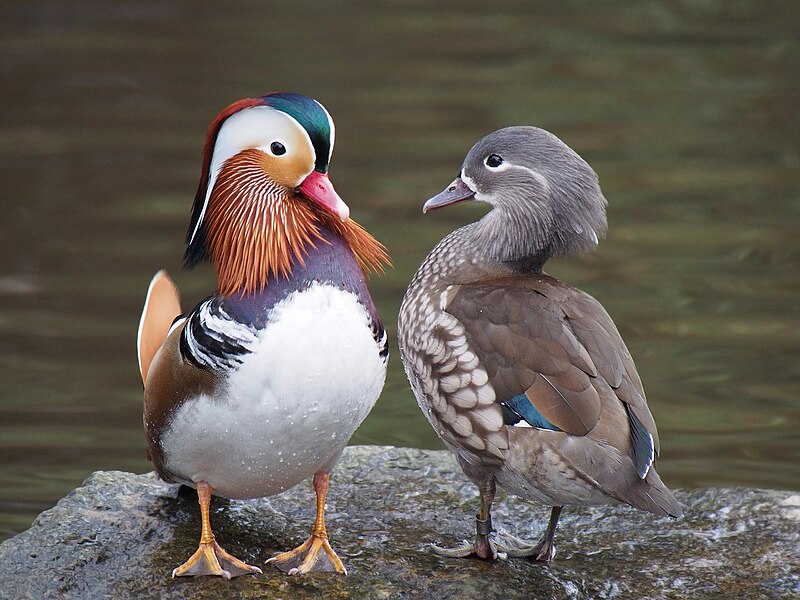
sexual dimorphism
condition where the two sexes of the same species exhibit different characteristics beyond the differences in their sexual organs

metamorphosis
thumb|A dragonfly undergoing the final moult of its metamorphosis; in this process it transforms from its nymphal form to its adult stage

scale
small rigid plate that grows out of an animal's skin

cloaca
thumb|Cloaca of a red-tailed hawk

exoskeleton
thumb|Discarded exoskeleton (exuviae) of [[dragonfly nymph]]
thumb|Exoskeleton of cicada attached to a [[Tridax procumbens (colloquially known as the tridax daisy)]]

claw
thumb|A domestic cat's retractable claw in protracted position
alt=An orange cat stretches his front legs towards the camera. His claws are caught on a screen, which causes the paws to be spread, showing the pads and fur in between them.|thumb|An orange cat stretches his front legs showing off his feet and claws.
A claw is a curved, pointed appendage found at the end of a toe or finger in most amniotes (mammals, reptiles, birds). Some invertebrates such as beetles and spiders have somewhat similar fine, hooked structures at the end of the leg or tarsus for gripping a surface as they walk. The

tentacle
thumb|upright|Cuttlefish with two tentacles and eight arms

horn
weapon of some animals, hornlike growths excluding antlers and ossicones

fistula
In anatomy, a fistula (: fistulas or fistulae ; from Latin fistula, "tube, pipe") is an abnormal connection (i.e. tube) joining two hollow spaces (technically, two epithelialized surfaces), such as blood vessels, intestines, or other hollow organs to each other, often resulting in an abnormal flow of fluid from one space to the other.

cuticle
A cuticle (), or cuticula, is any of a variety of tough but flexible, non-mineral outer coverings of an organism, or parts of an organism, that provide protection. Various types of "cuticle" are non-homologous, differing in their origin, structure, function, and chemical composition.
%20male%20running%20composite.jpg)
bipedalism
thumb|upright=1.2|An ostrich, the co-fastest extant biped at

gizzard
thumb|250x250px|Gizzard of a chicken

proboscis
thumb|A Hoverfly|syrphid fly using its proboscis to reach the nectar of a flower

stinger
right|thumb|Wasp stinger, with droplet of venom

autotomy
thumb|A white-headed dwarf gecko with tail lost due to autotomy
Autotomy ('self-amputation', from the Ancient Greek auto-, "self-" and tome, "severing") is the behaviour whereby an animal sheds or discards an appendage, usually as a self-preservation mechanism to elude a predator's grasp or to distract the predator and thereby allow escape. Some animals are able to regenerate the lost body part later. Autotomy is thought to have evolved independently at least nine times. The term was coined in 1883 by Léon Fredericq.

coelom
The coelom (or celom) is the main body cavity in many animals and is positioned inside the body to surround and contain the digestive tract and other organs. In some animals, it is lined with mesothelium. In other animals, such as molluscs, it remains undifferentiated. In the past, and for practical purposes, coelom characteristics have been used to classify bilaterian animal phyla into informal groups.

carapace
thumb|200px|Diagram of a prawn, with the carapace highlighted in red
A carapace is a dorsal (upper) section of the exoskeleton or shell in a number of animal groups, including arthropods, such as crustaceans and arachnids, as well as vertebrates, such as turtles and tortoises. In turtles and tortoises, the underside is called the plastron.

withers
thumbnail|300px|right|The location of the withers on a horse
thumb|Diagram of a cow; the withers are the region numbered 4.
thumb|Chart illustrating the height of racehorses in hands, measured at the withers.

endoskeleton
thumb|upright=1.2|Endoskeleton of a swordfish
symmetry in biology
geometric symmetry in living beings
enteric nervous system
biological system
body cavity
internal space within a multicellular organism
egg tooth
small, sharp, cranial protuberance used by offspring to break through the egg's surface during hatching
Alveolus
Alveolus ( , ; , ; ) is a general anatomical term for a concave cavity or pit.
eyespot
color mark that looks somewhat like an eye
body plan
set of morphological features common to members of a clade of animals
rostrum
pointed anatomical feature
gular skin
area of skin in vertebrates connecting the lower jaw and throat
flipper
forelimb evolved for movement through water

spermatheca
thumb|Spermatheca of Acanthoscurria geniculata (Brazilian Giant White Knee Tarantula)
thumb|Variety of the structure of spermathecae in Phlebotominae (Diptera, Psychodidae)
thumb|Female tarantula molt
countercurrent exchange
mechanism occurring in nature and mimicked in industry and engineering

fin
thumb|300px|
osteosclerosis
Osteosclerosis is a disorder characterized by abnormal hardening of bone and an elevation in bone density. It may predominantly affect the medullary portion and/or cortex of bone. Plain radiographs are a valuable tool for detecting and classifying osteosclerotic disorders. It can manifest in localized or generalized osteosclerosis. Localized osteosclerosis can be caused by Legg–Calvé–Perthes disease, sickle-cell disease and osteoarthritis among others. Osteosclerosis can be classified in accordance with the causative factor into acquired and hereditary.
bony plate
anatomical feature
spur
anatomical term for an outgrowth of bone covered in a sheath of horn
.png)
prehensility
thumb|A prehensile tail
Prehensility is the quality of an appendage or organ that has adapted for grasping or holding. The word is derived from the Latin term prehendere, meaning "to grasp". The ability to grasp is likely derived from a number of different origins. The most common are tree-climbing and the need to manipulate food.

tubercle
right|250px|thumb|This view of the cactus Mammillaria marksiana shows its pattern of prominent tubercles, with the spines emanating from each tubercle's tip.

appendage
thumb|A beetle leg
An appendage (or outgrowth) is an external body part or natural prolongation that protrudes from an organism's body such as an arm or a leg. Hair, scales, and feathers are cutaneous appendages.
cirrus
long, thin structures in both vertebrate and invertebrate animals
brain-to-body mass ratio
foramen
In anatomy and osteology, a foramen (; : foramina, or foramens ; ) is an opening or enclosed gap within the dense connective tissue (bones and deep fasciae) of extant and extinct amniote animals, typically to allow passage of nerves, arteries, veins or other soft tissue structures (e.g. muscle tendon) from one body compartment to another.
eyestalk
thumb|Pulmonata|Pulmonate [[land snails usually have two sets of tentacles on their head: the upper pair have an eye at the end; the lower pair are for olfaction.]]

theca
thumb|right|Strawberry anther with parallel thecae
In biology, a theca (: thecae) is a sheath or a covering.

lamella
anatomical structure
integument
In biology, an integument is the tissue surrounding an organism's body or an organ within, such as skin, a husk, shell, germ or rind.
isthmus of the fauces
part of the oropharynx directly behind the mouth cavity, bounded superiorly by the soft palate, laterally by the palatoglossal arches, and inferiorly by the tongue
scute
thumb|right|Scutes on an alligator foot
A scute () or scutum (Latin: scutum; plural: scuta "shield") is a bony external plate or scale overlaid with horn, as on the shell of a turtle, the skin of crocodilians, and the feet of birds. The term is also used to describe the anterior portion of the mesothorax in insects as well as some arachnids (e.g., the family Ixodidae, the scale ticks).