Category
page 1Animism

Shinto
The torii gateway to the [[Itsukushima Shrine in Hiroshima Prefecture, Japan, one of the most famous examples in the country. Torii mark the entrance to Shinto shrines and are recognizable symbols of the religion.|right|thumb|upright=1.1]]
, also called Shintoism, is the native religion and former ethnic cult of Japan. Classified as an East Asian religion by scholars of religion, it is often regarded by its practitioners as Japan's indigenous religion and as a nature religion. Scholars sometimes call its practitioners Shintoists, although adherents rarely use that term themselves. With no cent

animism
Animism (from meaning 'breath, spirit, life') is the belief that places, objects, and creatures all possess a distinct spiritual essence. Animism perceives all things—animals, plants, rocks, rivers, weather systems, human handiwork, and in some cases words—as being animated, having agency and free will. Animism is used in anthropology of religion as a term for the belief system of many indigenous peoples in contrast to the relatively more recent development of organized religions. Animism is a metaphysical belief which focuses on the supernatural universe: specifically, on the concept of the i
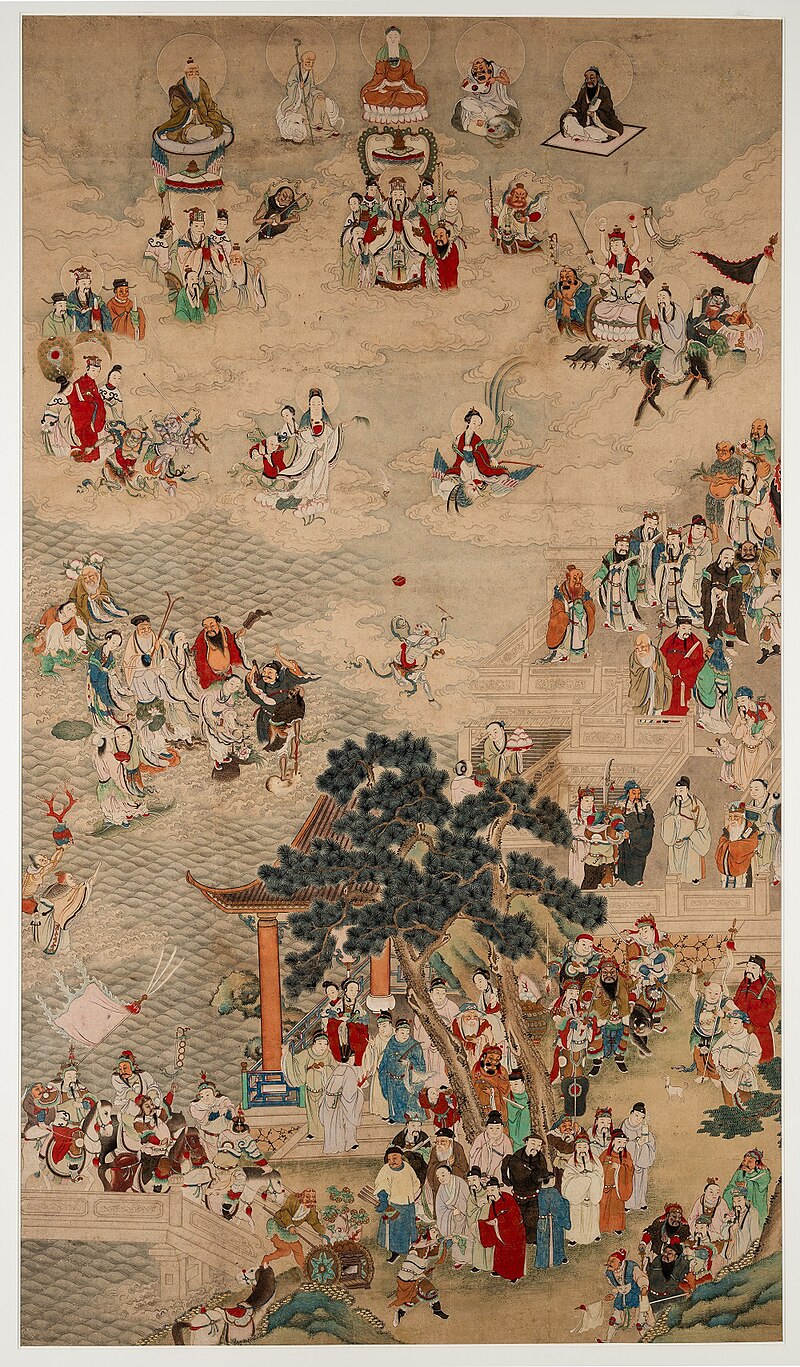
Chinese folk religion
traditional Han Chinese religious belief systems
Lhoba people
ethnic group of Tibet

Huaca
thumb|300px|Coricancha museum marker graphically explaining the Inca Wakas and Seqes system
thumb|300px|Coricancha museum marker describing the Inca Wakas and Seqes system
In the Quechuan languages of South America, a huaca or '''wak'a' is an object that represents something revered, typically a monument of some kind. The term huaca can refer to natural locations, such as immense rocks. Some huacas have been associated with veneration and ritual. The Quechua people traditionally believed every object has a physical presence and two camaquen'' (spirits), one to create it and another to animate
Hawaiian religion
polytheistic, animistic Hawaiian religious beliefs

Sanamahism
Sanamahism , also known as Meiteism , or Lainingthouism is an ethnic religion of the Meitei people of Manipur, in Northeast India. It is a polytheistic religion and is named after Lainingthou Sanamahi, one of the most important deities of the Meitei faith. Sanamahi is the eldest son of the supreme god Sidaba Mapu and the supreme goddess Leimarel Sidabi. Traditionally every Meitei household, irrespective of the religion, worships Sanamahi and Leimarel Sidabi. Sanamahism does not have a religious head but has a body, the Maru Loishang, that oversees the main religious activities and governs all

Nkisi
thumb|Power Figure: Male (Nkisi). Created circa 1800-1950, DRC, The Metropolitan Museum of Art, New York, The Michael C. Rockefeller Memorial Collection, Bequest of Nelson A. Rockefeller, 1979
' or ' (plural varies: , , , or ) are spirits or an object that a spirit inhabits. It is frequently applied to a variety of objects used throughout the Congo Basin in Central Africa, especially in the Territory of Cabinda that are believed to contain spiritual powers or spirits. The term and its concept have passed with the Atlantic slave trade to the Americas.
nkondi
Nkondi (plural varies minkondi, zinkondi, or ninkondi) are mystical statuettes made by the Kongo people of the Congo region. Nkondi are a subclass of minkisi that are considered aggressive.
iwakura
Shinto sacred rock
Ainu mythology and religion
Väki
Väki is a supernatural power in Finnish mythology. It was believed by Baltic Finns that väki resided in natural sites, objects, and animals. Väki has been compared to mana. However, according to Laura Stark, väki is about an impersonal power rather than a universal force. Väki has also been compared to orenda.
Iriadamant
thumb|right|Members of the Iriadamant community in Kittilä, October 1992.
The Iriadamant were a community, also described as a cult, that lived in northern Finland from 1991–1993. The residents of the community were mainly French and Belgian but dressed in Native American costumes. The group arrived in Finland with the support of Professor Erkki Pulliainen of the University of Oulu with the intention of "studying living in nature" and learning self-sufficiency. In the fall of 1991, the group founded a camp near Kittilä. Although of European descent, they were referred to as "Kittilä's Indians"
kamunabi
thumb|300x300px|Ōmiwa Shrine|Omiwa Shrine has [[Mount Miwa as its Shintai and does not have a honden.]]
, also kaminabi or kamunabi, refers to a region in Shinto that is a shintai (repositories in which kami reside) itself, or hosts a kami. They are generally either mountains or forests. Nachi Falls is considered a kannabi, as is Mount Miwa.