Category
page 1Antelopes

antelope
thumb|A bull sable antelope among the trees in the African [[savanna]]
An antelope is an extant or recently extinct species of the ruminant artiodactyl family Bovidae, which are indigenous to most of Africa, India, the Middle East, Central Asia, and a small area of Russia. Antelopes do not form a monophyletic group, as some antelopes are more closely related to other bovid groups, such as bovines, goats, and sheep, than to other antelopes.

duiker
A duiker is a small to medium-sized brown antelope native to sub-Saharan Africa, found in heavily wooded areas. The 22 extant species, including three sometimes considered to be subspecies of the other species, form a clade or natural grouping, either considered to be the subfamily Cephalophinae or the tribe Cephalophini.
%20male.jpg)
Boselaphini
Boselaphini is a tribe of bovines. It contains only two extant genera, each with a single extant species.
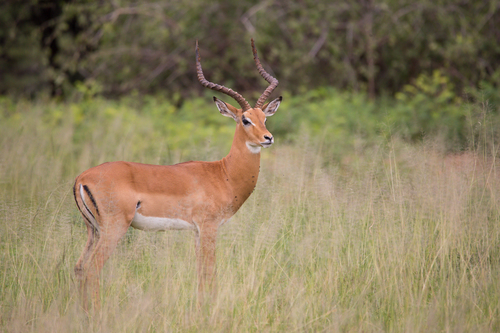
Aepyceros
Aepyceros is a genus of African antelope that contains a single living species, the impala (Aepyceros melampus). It is the only known member of the tribe Aepycerotini.
Aepyceros datoadeni
extinct species of antelopes
Tragelaphini
The tribe Tragelaphini (referred to by some authors as "Strepsicerotini"), or the spiral-horned antelopes, are bovines that are endemic to sub-Saharan Africa. These include the bushbucks, kudus, and the elands. The scientific name is in reference to the mythical creature the tragelaph, a Chimera with the body of a stag and the head of a goat. They are medium-to-large, tall, long-legged antelopes characterized by their twisted horns and striking pelage coloration patterns (most common is the distinctive white, vertical barring).
Dubois santeng
species of mammal (fossil)