Category
page 1Arabian mythology

One Thousand and One Nights
collection of Middle Eastern folk stories
.png)
Bab-el-Mandeb
The Bab-el-Mandeb (, ) is a strait and a major global chokepoint between Yemen on the Arabian Peninsula and Djibouti and Eritrea in the Horn of Africa, connecting the Red Sea to the Gulf of Aden and by extension the Indian Ocean.

Scheherazade
Sheherazade ( also spelled Scheherazade, Shahrazad, or Šahrzād) is the legendary narrator and central framing character of One Thousand and One Nights (), a collection of Middle Eastern, South Asian, and North African folktales compiled in Arabic between roughly the 8th and 14th centuries. Sheherazade is the wife of King Shahryar and saves herself, and ultimately the women of the kingdom, from execution by recounting a continuous sequence of interlinked stories over the course of 1,001 nights.
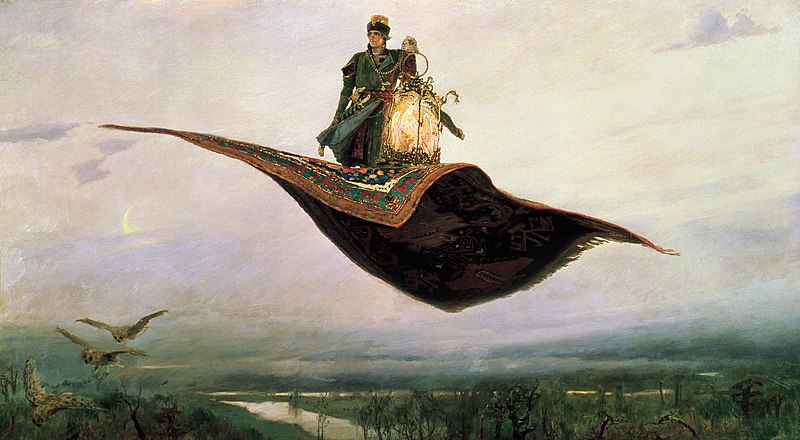
magic carpet
legendary carpet used for transportation
Iram of the Pillars
lost city, region or tribe mentioned in the Quran

ʿĀd
ʿĀd (, '''') was an ancient tribe in pre-Islamic Arabia. The banū ʿĀd (people of ʿĀd) are best known for being mentioned two dozen times in the Quran, often in conjunction with Thamud. In 2025 it was shown that 'Ad was a tribe that existed two millennia ago in the Wadi Rum region of the southern Jordan.

Picatrix
thumb|Title of a 1612 Ghayat al-Hakim manuscript (Istanbul, Hagia Sophia 2443).
Picatrix () is a 400-page Arabic book of magic and astrology, which most scholars assume was originally written in the middle of the 11th century, though an argument for composition in the first half of the 10th century has been made. The work was translated into Spanish and then into Latin during the 13th century, at which time it got the Latin title Picatrix. The title Picatrix is also sometimes used to refer to the book's author.
religion in pre-Islamic Arabia
religions practiced by Arabs before Islam
Karkadann
The Karkadann (Arabic كركدن karkadann or karkaddan from Kargadan, Persian: كرگدن) is a mythical creature said to have lived on the grassy plains of India and Iran.
Mount Qaf
legendary mountain
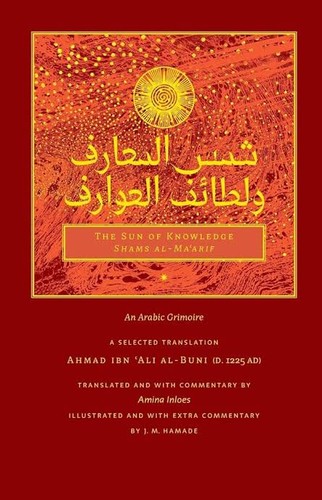
Shams al-Ma'arif
13th-century book by houari smail
mellified man
legendary medicinal substance, found in Chinese sources, stating that old Arabian men voluntarily start bathing in—and eating only—honey; after death, the body is put in a honey-filled coffin; after a century, the contents could heal broken limbs
Book of Idols
book by Hisham Ibn Al-Kalbi
Qareen
A qareen () is a spiritual double of a human, either part of the human themself or a complementary creature in a parallel realm.

Waq-Waq
.JPG)
Aspidochelone
thumb|An Aspidochelone from a French manuscript, c. 1270. J. Paul Getty Museum
According to the tradition of the Physiologus and medieval bestiaries, the aspidochelone is a fabled sea creature, variously described as a large whale or vast sea turtle, and a giant sea monster with huge spines on the ridge of its back. No matter what form it is, it is always described as being so huge that it is often mistaken for a rocky island covered with sand dunes and vegetation. The name aspidochelone appears to be a compound word
combining Greek aspis (which means either "asp" or "shield"), and chelone, t

Ilah
thumb|Gilded statuette of El (deity)|El from [[Ugarit, Father of the gods; explains the origin of the word Ilah.]]
Shaddad
Shaddād (), also known as Shaddād bin ʽĀd (), was the legendary tyrannical king in Arabian folklore. The lost Arabian city of Iram of the Pillars, which is mentioned in Sura 89 of the Qur'an, it typically attributed to being his realm. Various sources suggest Shaddad was the son of 'Ad al-Miltat ibn Saksak ibn Wa'il ibn Himyar.
Kujata
thumb|The cosmic bull Kuyūthāʾ bears the [[Flat Earth, which is rimmed by Mount Qaf and stands on Bahamut. Ottoman Turkish version of The Wonders of Creation by Zakariya al-Qazwini, c.1553.]]
Kuyūthāʾ (), more rarely Kiyūbān () or Kibūthān (), is the cosmic bull in medieval Muslim cosmography. It is said to carry on its back the angel who shoulders the world, and the rock platform upon which this angel stands. The Kuyūthāʾ is said to stand on the back of Bahamut, a giant fish or whale.
Zarqa al Yamama
legendary figure of pre-Islamic Arabia
Atlantis of the Sands
The lost land in the Arabian desert
Al-Mi'raj
thumb|right|300px|A "yellow-colored beast which resembled a rabbit with a black horn".
Zaratan
thumb|Illustration of a similar creature in the Alexander Romance, Armenian manuscript, 1538–1544.
The saratan (from the Arabic سرطان, saraṭān, "crab"), sometimes spelled zaratan, is a giant sea creature from Arabic literature and folklore.
Nabataean religion
religion of the Nabateans
Mahd al-Aadiyya
Arabic poet c. 4000 BCE
Les Mille et Une Nuits
1704 French and first European translation