Category
page 1Arabic words and phrases
.jpg)
Shahada
The Shahada ( ; , 'the testimony'), also transliterated as Shahadah, is an Islamic oath and creed, and one of the Five Pillars of Islam and part of the adhan. It reads: "I bear witness that there is no god but God, and I bear witness that Muhammad is the Messenger of God." The Shahada declares belief in the oneness () of God and the acceptance of Muhammad as God's messenger. Some Shia Muslims also include a statement of belief in the of Ali, but they do not consider it as an obligatory part for converting to Islam.

jihad
Jihad (; ) is an Arabic word that means , , or , particularly with a praiseworthy aim. In an Islamic context, it encompasses almost any effort to make personal and social life conform with God's guidance, such as an internal struggle against evil in oneself, efforts to build a good Muslim community (ummah), and struggle to defend Islam. For its literal translation 'struggle', the term is frequently associated with warfare.

zakāt
thumb|313x313px|Zakat spending as per the Quran on 8 categories of people
Zakat (or Zakāh) is one of the Five Pillars of Islam. Zakat is the Arabic word for "giving to charity" or "giving to the needy". Zakat is a form of almsgiving, often collected by the Muslim Ummah. It is considered in Islam a religious obligation, and by Quranic ranking, is next after prayer (salah) in importance. Eight heads of zakat are mentioned in the Quran.

madrasa
alt=|thumb|upright=1.25|The three madrasas at the Registan of [[Samarkand, built during the Timurid Renaissance]]

Qibla
thumb|Muslims surrounding and facing the [[Kaaba for prayer]]
The qibla () is the direction towards the Kaaba in the Sacred Mosque in Mecca, which is used by Muslims in various religious contexts, particularly the direction of prayer for the salah. According to Islamic tradition, the Kaaba is believed to be a sacred site built by prophets Abraham and Ishmael, and that its use as the qibla was ordained by God in several verses of the Quran revealed to Muhammad in the second Hijri year. Prior to this revelation, Muhammad and his followers in Medina faced Jerusalem for prayers. Most mosques conta

Rigel
Rigel is a blue supergiant star in the equatorial constellation of Orion. It has the Bayer designation β Orionis, which is Latinized to Beta Orionis and abbreviated Beta Ori or β Ori. Rigel is the brightest and most massive componentand the eponymof a star system of at least four stars that appear as a single blue-white point of light to the naked eye. This system is located at a distance of approximately .

Amir
thumb|The court of the Durrani Empire|Durrani Emirate of [[Afghanistan (James Rattray, 1839)]]
Emir (; ' (), also transliterated as amir, is a word of Arabic origin that can refer to a male monarch, aristocrat, holder of high-ranking military or political office, or other person possessing actual or ceremonial authority. The title has a history of use in West Asia, East Africa, West Africa, Central Asia, and South Asia. In the modern era, when used as a formal monarchical title, it is roughly synonymous with "prince", applicable both to a son of a hereditary monarch, and to a reigning monarch

Basmala

as-salamu alaykum
Arabic greeting meaning "Peace be upon you"

Fomalhaut
Fomalhaut (, ) is the brightest star in the southern constellation of Piscis Austrinus, the Southern Fish, and one of the brightest stars in the night sky. It has the Bayer designation Alpha Piscis Austrini, which is an alternative form of α Piscis Austrini, and is abbreviated Alpha PsA or α PsA. This is a class A star on the main sequence approximately from the Sun as measured by the Hipparcos astrometry satellite. Since 1943, the spectrum of this star has served as one of the stable anchor points by which other stars are classified.

mujahid
Mujahideen or mujahidin (), is the plural form of mujahid (), an Arabic term that broadly refers to people who engage in jihad (), interpreted in a jurisprudence of Islam as the fight on behalf of God, religion or the community (ummah).

Deneb
Deneb () is a blue supergiant star in the constellation of Cygnus. It is the brightest star in the constellation and the 19th brightest in the night sky, with an apparent magnitude slightly varying between +1.21 and +1.29. Deneb is one of the vertices of the asterism known as the Summer Triangle and the "head" of the Northern Cross. Its Bayer designation is α Cygni, which is Latinised to Alpha Cygni, abbreviated to Alpha Cyg or α Cyg.

Ahl al-Bayt
family of Muhammad

wadi
thumb|Wadi Ghuweir Trail to Feynan, Jordan

Nakba
The Nakba () is the ethnic cleansing of Palestinian Arabs by Israel through their violent displacement and dispossession of land, property, and belongings, along with the destruction of their society and the suppression of their culture, identity, political rights, and national aspirations. The term is used to describe the events of the 1948 Palestine war in Mandatory Palestine as well as Israel's ongoing persecution and displacement of Palestinians. As a whole, it covers the fracturing of Palestinian society and the longstanding rejection of the right of return for Palestinian refugees and th

Umrah
thumb|Pilgrims circumambulating the [[Kaaba in Mecca]]
.png)
wilaya
A wilaya or wilayah (, plural ; ; ; ) is an administrative division, usually translated as "state", "province" or occasionally as "governorate". The word comes from the Arabic root "w-l-y", "to govern": a wāli—"governor"—governs a wilāya, "that which is governed". Under the Caliphate, the term referred to any constituent near-sovereign state.

Ilm al-Kalam
Ilm al-kalam or ilm al-lahut, often shortened to kalam, is the scholastic, speculative, or rational study of Islamic theology (aqida). It can also be defined as the science that studies the fundamental doctrines of Islamic faith (usul al-din), proving their validity, or refuting doubts regarding them rationally via logic. Kalām was born out of the need to establish and defend the tenets of Islam against philosophical doubters and non-Muslims, and also to defend against heretical and religious innovations (bidʿah). A scholar of kalam is referred to as a mutakallim (plural mutakallimun), a role

Sayyid
Sayyid is an honorific title of Hasanid and Husaynid lineage, recognized as descendants of the Islamic prophet Muhammad through his daughter Fatima and Ali's sons Hasan and Husayn. The title may also refer to the descendants of the family of the Bani Hashim through Muhammad's great-grandfather Hashim, and others including Hamza, Abbas, Abu Talib, and Asad ibn Hashim.
%20%E2%80%93%20Eug%C3%A8ne%20Baugnies%20(1841%E2%80%931891).jpg)
dhikr
thumb|right|The Dhikr, Eugène Baugnies (1841–1891)
'''' (; ; ) is a form of Islamic worship in which phrases or prayers are repeatedly recited for the purpose of remembering God. It plays a central role in Sufism, and each Sufi order typically adopts a specific dhikr, accompanied by specific posture, breathing, and movement. In Sufism, dhikr refers to both the act of this remembrance as well as the prayers used in these acts of remembrance. Dhikr'' usually includes the names of God or supplication from the Quran or hadith. It may be counted with either one's fingers or prayer beads, and may be

khutbah
A khutbah (, khuṭba; , khotbeh; ) serves as the primary formal occasion for public preaching in the Islamic tradition. Someone who gives the khutbah is referred to as a khatib.
intifada
Intifada () is an Arabic word for a rebellion or uprising, or a resistance movement. It can also be used to refer to a civilian uprising against oppression. In Arabic-language usage, any uprising can be referred to as an intifada, including the 1916 Easter Rising, the 1943 Warsaw Ghetto Uprising, and the 1949 Jeju uprising. When used in English outside of the Arab World, the word has primarily referred to the two Palestinian uprisings against Israeli occupation.
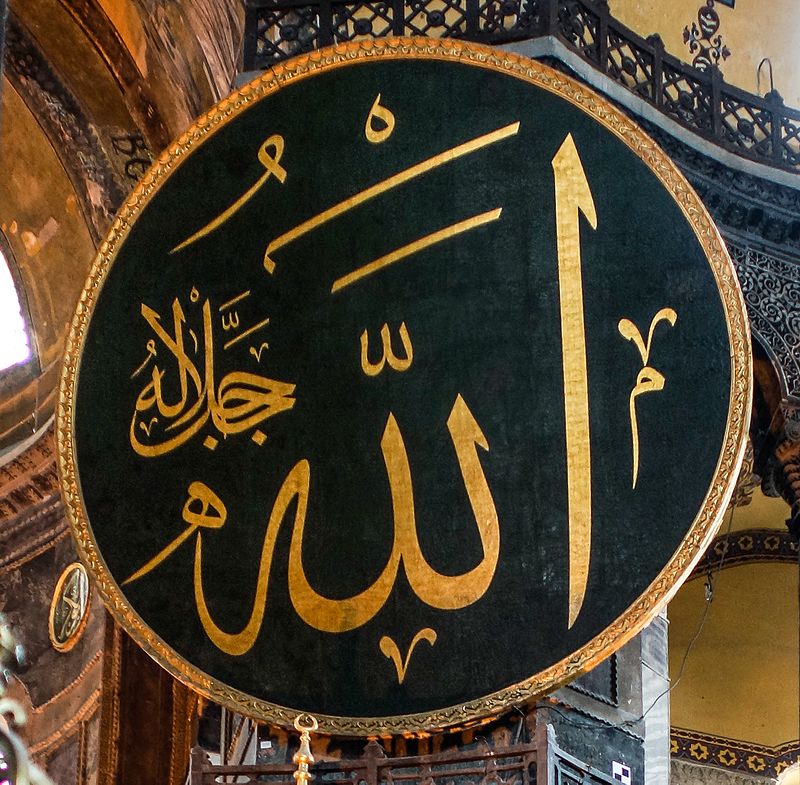
Inshallah
Inshallah, usually called the , is an Arabic-language expression meaning or . It is mentioned in the Quran, surah Al-Kahf (23-24), which requires its use when mentioning intended actions. It signifies that nothing, neither action nor thought, happens without God's permission.

Muhajirun
The Muhajirun (, singular , ) were the converts to Islam and the Islamic prophet Muhammad's advisors and relatives, who emigrated from Mecca to Medina; the event is known in Islam as the Hijra. The early Muslims from Medina are called the Ansar ("helpers").
Jahiliyyah
In Islamic salvation history, the Jāhiliyyah (Age of Ignorance) is an Arabic expression for an era of pre-Islamic Arabia as a whole or only of the Hejaz leading up to the lifetime of Muhammad.

wali
administrative title that was used during the Caliphate and Ottoman Empire to designate governors of administrative divisions

shahid
Shahid, also spelled shaheed, is an Islamic term of Arabic-origin meaning "martyr", used by Muslims for mujahideen who die while fighting in the way of Allah. The word is used frequently in the Quran in the generic sense of "witness" but only once in the sense of "martyr" (i.e. one who dies for his faith); the latter sense acquires wider usage in the hadith. The term is also used in some non-Muslim communities whose cultures were influenced by Islamic persianate empires, such as amongst Hindus and Sikhs in India.

sujud
Sujud (, ), or sajdah (, ), also known as sijda, sejda or shejda, in Islam is the act of low bowing or prostration to God facing the qiblah (direction of the Kaaba at Mecca). It is usually done in standardized prayers (salah). The position involves kneeling and bowing till one touches the ground with seven bones (points): the forehead and nose, two hands, two knees and two sets of toes. In accordance with the Sunnah (the Way) of Muhammad, one's elbows should be far from one's body, unless it causes discomfort to other worshippers, but not resting on the ground. Some scholars hold the position

taqiyya
In Islam, taqiyya () is a concept that refers to a Muslim concealing their faith or religious identity to protect themselves from danger. Although the term stems mainly from discrimination against the minority Shiite tradition, it is also considered a legitimate practice under certain conditions in Sunni sources. The practice of concealing one's beliefs has existed since the early days of Islam; early Muslims did so to avoid persecution or violence by non-Muslim governments or individuals.

dhow
thumb|A dhow in the Indian Ocean, near the islands of [[Zanzibar on the Swahili coast]]
thumb|Fishermen's dhows moored at Dubai in 2014
Sharif
Sharīf or Sherif (, 'noble', 'highborn'), also spelled shareef, feminine sharīfa (), plural ashrāf (), shurafāʾ (), or (in the Maghreb) shurfāʾ, is a title used to designate a person descended, or claiming to be descended, from the family of the Islamic prophet Muhammad ( ). It may be used in three senses:

Saluki
The Saluki or Arabian hound or Persian hound (Persian:سگ تازی، Arabic: سلوقي) is a standardised breed developed from sighthounds – dogs that hunt primarily by sight rather than strong scent – that was once used by nomadic tribes to run down game animals. The dog was originally bred in the Fertile Crescent. The modern breed is typically deep-chested and long-legged, and similar dogs appear in medieval and ancient art. The breed is most closely related to the Afghan hound, a basal breed that predates the emergence of modern breeds in the 19th century, and the Saluki has been purebred both in the
millet
legal court

Alhamdulillah
Alhamdulillah (, '') is an Arabic phrase meaning "praise be to God", sometimes translated as "thank God" or "thanks be to the Lord". This phrase is called Tahmid (). A longer variant of the phrase is al-ḥamdu l-illāhi rabbi l-ʿālamīn'' (), meaning "all praise is due to God, Lord of all the universes", the first verse of Surah Al-Fatiha, the opening chapter of the Quran.

khamsin
Khamsin, chamsin or hamsin ( , meaning "fifty"), more commonly known in Egypt, Israel and Palestine as khamaseen ( , ), is a dry, hot, sandy local wind affecting Egypt and the Levant; similar winds, blowing in other parts of North Africa, the Arabian Peninsula and the entire Mediterranean basin, have different local names, such as bad-i-sad-o-bist roz in Iran and Afghanistan, haboob in the Sudan, aajej in southern Morocco, ghibli in Tunis, harmattan in the western Maghreb, africo in Italy, sirocco (derived from the Arabic , "eastern") which blows in winter over much of the Middle East, and sim
Raka'at
A '''Rak'a ( ', lit. "bow"; plural: '''') is a single iteration of prescribed movements and supplications performed by Muslims as part of the prescribed obligatory prayer known as salah. Each of the five daily prayers observed by Muslims consists of a number of raka'at.
nahiyah

hamada
thumb|upright=1.3|Hamada plateau at Tademaït, [[Algeria. Photograph by French explorer Fernand Foureau during his trans-Saharan journey in 1890.]]
thumb|Hamada in the interior of the Cape Verde island of Boa Vista, Cape Verde|Boa Vista.
thumb|Hamada desert near the Hoggar Mountains in [[Algeria.]]
thumb|Cyclists ride over hamada to the Erg Chebbi dunes, [[Morocco.]]

Dhu'l-Qarnayn
figure in the Quran
fitna
Arabic word for strife and conflict
Simoom
Simoom /Saimum( samūm; from the root s-m-m, "to poison") is a strong, hot, dry, dust-laden wind. The word is generally used to describe a local wind that blows in the Sahara, Jordan, Iraq, Syria, and the deserts of Arabian Peninsula. Its temperature may exceed and the relative humidity may fall below 10%.
mahr
In Islam, a mahr (in ; ; Bengali: দেনমোহর; ; ; ; also transliterated mehr, meher, denmohor, mehrieh, or mahriyeh) is the bride wealth obligation, in the form of money, possessions or teaching of verses from the Quran by the groom, to the bride in connection with an Islamic wedding. While the mahr is often money, it can also be anything agreed upon by the bride such as jewellery, home goods, furniture, a dwelling or some land. Mahr is typically specified in the marriage contract signed upon marriage.

majlis
thumb|upright=1.5|Bowl with a scene by a pond, signed by Abu Zayd al-Kashani in 1187, [[Seljuk Empire, Iran.]]
'''''' is an Arabic term meaning 'sitting room'. It is used to describe various types of special gatherings among common interest groups of administrative, social or religious nature in countries with linguistic or cultural connections to the Muslim world. can refer to a legislature as well and is used in the name of legislative councils or assemblies in some states.
nazar
eye-shaped amulet believed to protect against the evil eye

marabout
In the Muslim world, the marabout () is a descendant of Muhammad (Arabic: سـيّد, romanized: sayyid and sidi in the Maghreb) and a Muslim religious leader and teacher who historically had the function of a chaplain serving as a part of an Islamic army, notably in North Africa and the Sahara region, in West Africa, and historically in the Maghreb.
Eid Mubarak
traditional Muslim greeting

maktab
thumb|Interior of a 19th-century kuttab in Cairo, Egypt
A kuttab ( kuttāb, plural: kataatiib, ) or maktab () is a type of elementary school in the Muslim world. Though the kuttab was primarily used for teaching children in reading, writing, grammar, and Islamic studies, such as memorizing and reciting the Qur'an (including ''Qira'at''), other practical and theoretical subjects were also often taught. The kuttāb represents an old-fashioned method of education in Muslim majority countries, in which a sheikh teaches a group of students who sit in front of him on the ground. Until the 20th centur

Mashallah
thumb|Mashallah in Arabic calligraphy
Mashallah or Ma Sha Allah or Masha Allah or Ma Shaa Allah () is an Arabic phrase generally used to positively denote something of greatness or beauty and to express a feeling of awe. It is often used to convey a sense of respect and to protect against the evil eye, suggesting that the speaker is acknowledging something positive without invoking jealousy.
.jpg)
ksar
thumb|Ksar Aït Benhaddou, [[Morocco, a UNESCO World Heritage Site since 1987]]
Ksar or qṣar (), in plural ksour or qsour (), is a type of fortified village in North Africa, usually found in the regions predominantly or traditionally inhabited by Berbers (Amazigh). The equivalent Berber term used is '''' (singular) or (plural).
mu'min
'''''Mu'min or Mumin''''' (; ) is an Arabic name and Islamic term frequently referenced in the Quran, meaning "believer". Al-Mu'minun (, ; 'The Believers') is the 23rd Surah ("chapter") of the Quran.
%2004.jpg)
sadaqah
'''''''' ( , "charity", "benevolence", plural ) in the modern-day Islamic context has come to signify "voluntary charity". Unlike zakat, which is a obligatory form of almsgiving and one of the five pillars of Islam, ṣadaqah'' is a voluntary offering whose amount and nature are determined solely by the benefactor, as emphasized in the Quran.

Ruku'
thumb|wiktionary:en:precant|Precants performing ruku
ras el hanout
food spice
vilayet
thumb|page=271|Law of the vilayets (; 1867), in Volume II of , published by [[Gregory Aristarchis and edited by Demetrius Nicolaides]]

mahalla
Munafiq
marji'
Marja (; plural marājiʿ; ) is a title given to the highest level of Twelver Shia religious cleric, with the authority given by a hawzah (a seminary where Shi'a Muslim scholars are educated) to make legal decisions within the confines of Islamic law for followers and clerics below him in rank. The highest ranking marjiʿ is known as the marja al-mutlaq or marja al-taqlid al-mutlaq. A marji' is usually also a grand ayatollah.

tasbih
thumbnail|Glory to Allah "Subhan Allah" in Arabic, Desouk, Egypt

Mubah
Mubāḥ (Arabic: مباح) is an Arabic word roughly meaning "permitted", which has technical uses in Islamic law. "Mubah" is an Islamic jurisprudential term that refers to an action for which a person has no specific obligation. Consequently, performing or abstaining from it is considered equally permissible, and neither action results in reward or punishment from the perspective of God in Islam.

askari
thumb|An askari with an assegai at [[AFB Waterkloof, Pretoria, South Africa, January 1943.]]
An askari or ascari (from Somali, Swahili, and Arabic , , meaning 'soldier' or 'military', also 'police' in Somali) was a local soldier serving in the armies of the European colonial powers in Africa, particularly in the African Great Lakes, Northeast Africa and Central Africa. The word is used in this sense in English, as well as in German, Italian, Urdu, and Portuguese. In French, the word is used only in reference to native troops outside the French colonial empire. The designation is still in occas