Category
page 1Aral Sea
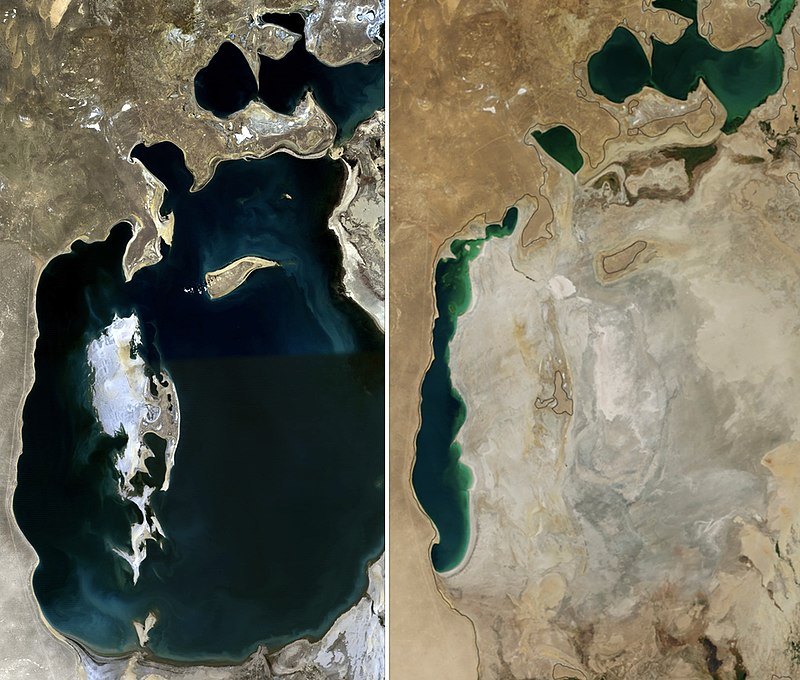
Aral Sea
Formerly a salt lake in Central Asia

Khwarazm
Khwarazm or Chorasmia is a large oasis region on the Amu Darya river delta in western Central Asia, bordered on the north by the (former) Aral Sea, on the east by the Kyzylkum Desert, on the south by the Karakum Desert, and on the west by the Ustyurt Plateau. It was the center of the Iranian Khwarezmian civilization until the 9th century, when Turkic tribes moved into and ruled the lands. A series of kingdoms such as the Afrighid dynasty and the Anushtegin dynasty, whose capitals were (among others) Kath, Gurganj (now Konye-Urgench) andfrom the 16th century onKhiva. Today Khwarazm belongs part

Aralkum
desert on the seabed once occupied by the Aral Sea

Bastard sturgeon
species of fish
North Aral Sea
extant lake
South Aral Sea
former lake
Dike Kokaral
dam in Kazakhstan
Barsa-Kelmes Nature Reserve
protected area
Aral–Caspian Depression
lowland depression around the Aral Sea and Northern Caspian Sea
Zhalanash
thumb|Ships left stranded in the desert in the bay of Zhalanash
Zhalanash (, Jalanaş), is a village in south central Kazakhstan. Previously a fishing village on the Aral Sea, Zhalanash now lies several kilometers from its shores. In recent years, it had become a tourism location for its old harbor, where several ship hulls had been left standing in the desert by the retreating sea. As of 2017, these hulls have been dismantled for scrap metal and only the bottoms remain. The town's economy is focused around camel herding.
Barsakelmes Lake
lake in Kazakhstan, part of former Aral Sea
1971 Aral smallpox incident
smallpox outbreak from a Soviet bioweapon test
public health problems in the Aral Sea region
Akespe
Akespe () is a village in the Aral District, Kyzylorda Region, Kazakhstan. It is part of the Kosaman Rural District (KATO code - 433246200). Population:
International Fund for Saving the Aral Sea
Kerderi mausoleum
Kerderi is a group of abandoned settlements located on the dried seafloor of what was once the Aral Sea, in Kazakhstan. Kerderi is thought to have been inhabited around the fourteenth century, when water levels were low enough to expose dry land. It is not known when Kerderi was abandoned. However, some objects from Kerderi have been carbon-dated to as late as the start of the sixteenth century and historical evidence suggests that the Aral Sea began slowly refilling after 1570, when the Amu Darya river resumed its flow into the Aral. Kerderi was completely flooded; at 1960 water levels, the s