Category
page 1Archostemata
Archostemata
The Archostemata are the smallest suborder of beetles, consisting of 50 living species in five families and over 200 described fossil species. They are an ancient lineage with a number of primitive characteristics. Antennae may be thread-shaped (filiform) or like a string of beads (moniliform). This suborder also contains the only beetles where both sexes are paedogenic, Micromalthus debilis. Modern archostematan beetles are considered rare, but were more diverse during the Mesozoic.

Telephone-pole beetle
species of beetle
Crowsoniellidae
REDIRECT Crowsoniella
Jurodidae
Jurodidae is a family of beetles that was originally described for the extinct genus Jurodes, known from the Middle-Late Jurassic of Asia. In 1996, a living species, Sikhotealinia zhiltzovae, was discovered in the Sikhote-Alin mountains in southeastern Siberia, and assigned to this family. Their placement is uncertain, but are usually considered archostematans. In one study, Sikhotealinia and Jurodes were considered a sister group to all other archostematan beetles. However, other authors have considered their placement within beetles as a whole uncertain, due to their mix characteristics of t
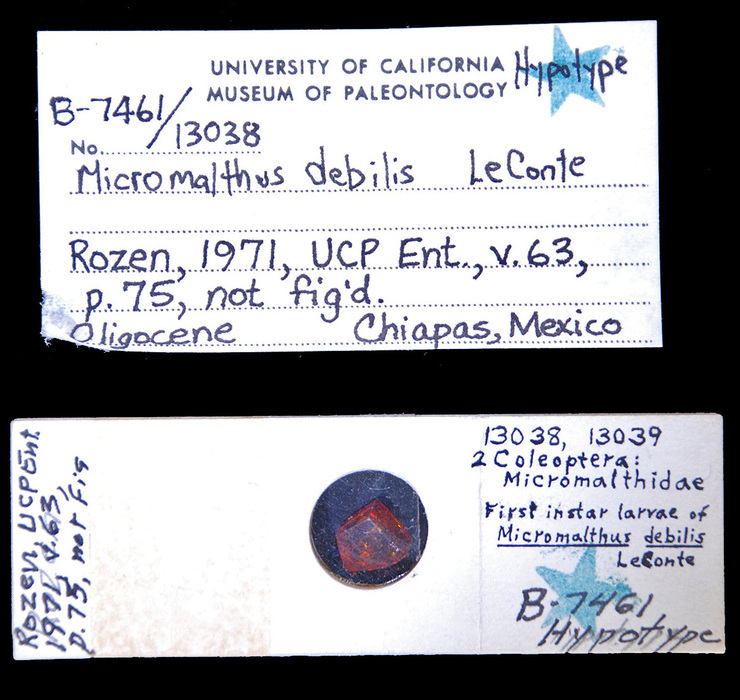
Micromalthidae
Micromalthidae is an ancient family of small beetles belonging to the suborder Archostemata. The only known living representative is the telephone-pole beetle, Micromalthus debilis. A few extinct species have been described, the oldest being the Late Permian Archaeomalthus synoriacos. It is one of the oldest families of beetles still existing today.
Crowsoniella
Crowsoniella is a genus of beetles in the order Archostemata. It contains only a single species, Crowsoniella relicta, and is the only member of the monotypic family Crowsoniellidae. It is known only from three male specimens collected in 1973 in the Lepini mountains of central Italy by Roberto Pace. In a degraded pasture, the beetles were found among the roots of a large hawthorn tree, in deep calcareous soil. No other specimens have been found since.
Magnocoleidae
Magnocoleus is an extinct genus of beetles from the Early Cretaceous of China, between 130.0 and 125.45 Mya. The genus contains a single species, Magnocoleus huangjiapuensis, and is the only member of the family Magnocoleidae in the suborder Archostemata. Magnocoleus was first described by Chinese palaeoentomologist Hong Youchong in 1998, based on fossils of isolated elytra from the Qingshila Formation in Huangjiapu, near the Nantianmen village of Zhangjiakou in Hebei. Recent phylogenetic analyses have suggested that Magnocoleus is closely related to or placed within either Cupedidae or O