Category
page 1Artistic techniques
.svg)
symmetry
thumb|upright=1.25|Symmetry (left) and asymmetry (right)
thumb|upright=0.8|A spherical symmetry group with [[octahedral symmetry. The yellow region shows the fundamental domain.]]
thumb|upright=0.8|A fractal-like shape that has [[reflectional symmetry, rotational symmetry and self-similarity, three forms of symmetry. This shape is obtained by a finite subdivision rule.]]

collaging
thumb|right|300px|Kurt Schwitters, Das Undbild, 1919, [[Staatsgalerie Stuttgart]]
Collage (, from the , "to glue" or "to stick together") is a technique of art creation, primarily used in the visual arts, by which art results from an assembly of different forms, thus creating a new whole. Collage may refer to the technique as a whole, or more specifically to a two-dimensional work, assembled from flat pieces on a flat substrate, whereas assemblage typically refers to a three-dimensional equivalent.

camera obscura
optical device that projects an image of its surroundings on a screen

pointillism
thumb|upright|Detail from Georges Seurat|Seurat's [[Parade de cirque, 1889, showing the contrasting dots of paint which define Pointillism]]
.jpg)
triptych
thumb|330px|Triptych of the The Elevation of the Cross (Rubens)|Raising of the Cross, Rubens, 1610–11, Antwerp Cathedral
A triptych ( ) is a work of art (usually a panel painting) that is divided into three sections, or three carved panels that are hinged together and can be folded shut or displayed open. It is therefore a type of polyptych, the term for all multi-panel works. The middle panel is typically the largest and flanked by two smaller related works, although there are triptychs of equal-sized panels. The form can also be used for pendant jewelry.

engraving process
thumb|Saint Jerome in His Study (Dürer)|St. Jerome in His Study (1514), engraving by [[Northern Renaissance master Albrecht Dürer]]
Engraving is the practice of incising a design on a hard, usually flat surface by cutting grooves into it with a burin. The result may be a decorated object in itself, as when silver, gold, steel, or glass are engraved, or may provide an intaglio printing plate, of copper or another metal, for printing images on paper as prints or illustrations; these images are also called "engravings". Engraving is one of the oldest and most important techniques in printmaking.

chiaroscuro
thumb|right|Giovanni Baglione. Divine Love Conquering Earthly Love (1602–1603), showing dramatic compositional chiaroscuro.
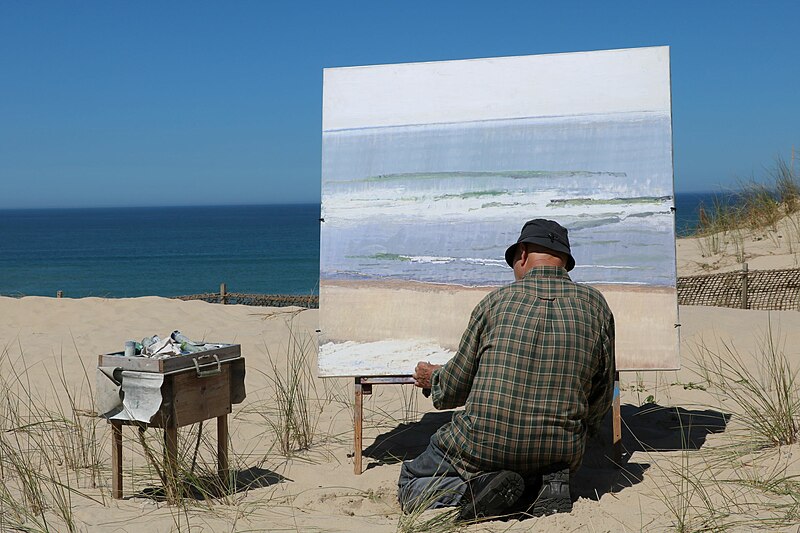
en plein air
act of painting outdoors

trompe-l'œil
upright=1.3|thumb|Ceiling of the Treasure Room of the National Archaeological Museum of Ferrara |Archaeological Museum of Ferrara, [[Italy, painted in 1503–1506]]
composition
placement or arrangement of visual elements or ingredients in a work of art

anamorphosis
thumb|upright=1.35|Example of mirror anamorphosis

mezzotint technique
thumb|Saint Agnes, mezzotint by John Smith (engraver)|John Smith after [[Godfrey Kneller, usually thought to be a portrait of Kneller's daughter, Catherine Voss]]

ceramic glaze
layer or coating of vitreous substance fused to a ceramic object

airbrush
thumb|Paasche Airbrush Company|Paasche F#1 Single-action external mix airbrush
thumb|An Airbrush artist at work
An airbrush is a small, air-operated tool that atomizes and sprays various media, most often paint, but also ink, dye, and make-up. Spray painting developed from the airbrush and is considered to employ a type of airbrush.

grisaille
thumb|270px|Christ and the Woman Taken in Adultery (Bruegel)|Christ and the Woman Taken in Adultery, [[Pieter Bruegel the Elder, 1565, ]]
thumb|270px|Battesimo della gente, one of Andrea del Sarto's gray and brown grisaille [[frescoes in the Chiostro dello Scalzo, Florence (1511-26)]]
Grisaille ( or ; , from gris 'grey') is a painting executed entirely in shades of black and grey or of another neutral greyish colour. It is particularly used in large decorative schemes in imitation of sculpture. Many grisailles include a slightly wider colour range.
complementary colors
pairs of colors which, when combined, cancel each other out

patina
thumb|Copper roof on the Minneapolis City Hall, coated with patina
thumb|upright|The Dresden Frauenkirche. The church was destroyed during the [[bombing of Dresden in 1945 and rebuilt from 1993 to 2005 with new material; the stones with the black patina are the parts that survived the firebombing from the original 18th-century church.]]
thumb|Pre-colonial copper coin formerly used in the Copper Belt ([[Democratic Republic of the Congo and Zambia). The external layer has been weathered by moisture and rain, leading to the oxidation of copper.]]
droste effect
recursive visual effect

gilding
thumb|right|Gilded frame ready for burnishing (metal)|burnishing with an [[agate stone tool]]
thumb|right|Application of gold leaf to a reproduction of a 15th-century panel painting
Gilding is a decorative technique for applying a very thin coating of gold over solid surfaces such as metal (most common), wood, porcelain, or stone. A gilded object is also described as "gilt". Where metal is gilded, the metal below was traditionally silver in the West, to make silver-gilt (or vermeil) objects, but gilt-bronze is commonly used in China, and also called ormolu if it is Western. Methods of gilding

impasto
thumb|right|100000x260px|Still Life: Vase with Pink Roses (1890) is an oil painting by Van Gogh which makes extensive use of the impasto technique.
Impasto is a technique used in painting where paint is laid on an area of the surface thickly, usually thick enough that the brush or painting-knife strokes are visible. Paint can also be mixed right on the canvas. When dry, impasto provides texture; the paint appears to be coming out of the canvas.

cloisonnism
thumb|Paul Gauguin, [[The Yellow Christ (Le Christ jaune)1889, oil on canvasAlbright-Knox Art Gallery, Buffalo, New York]]
Cloisonnism is a style of post-Impressionist painting with bold and flat forms separated by dark contours. The term was coined by critic Édouard Dujardin on the occasion of the Salon des Indépendants, in March 1888. Artists Émile Bernard, Louis Anquetin, Paul Gauguin, Paul Sérusier, and others started painting in this style in the late 19th century. The name evokes the technique of cloisonné, where wires (cloisons or "compartments") are soldered to the body of the piece, f

cloisonné
thumb|Pectoral of Senusret II, from his daughter's grave, using shaped stones rather than enamel. Cloisonné inlays on gold of [[carnelian, feldspar, garnet, turquoise, lapis lazuli, 1880s BC]]
thumb|right|Chinese Ming dynasty|Ming Dynasty cloisonné enamel bowl, using nine colours of enamel
camera lucida
optical device used as a drawing aid by artists
assemblage
art form and technique

tenebrism
thumb|John the Baptist (Caravaggio)|John the Baptist (John in the Wilderness), by [[Caravaggio, 1604, in the Nelson-Atkins Museum of Art, Kansas City ]]

intarsia
thumb|Geometric figure (1537), intarsia by fra Damiano da Bergamo; Museum of the Basilica of Saint Dominic, Bologna, Italy
thumb|Intarsia on the First aid kit of Alexander Karađorđević, Prince of Serbia, [[Historical Museum of Serbia]]
aerial perspective
The optical effect on the visibility of objects seen through air with distance

pyrography
thumb|327x327px|The King Wolf, pyrography on olive wood by Roberto Frangioni Piroritrattista Framàr
Pyrography or pyrogravure is the free handed art of decorating wood or other materials with burn marks resulting from the controlled application of a heated object such as a poker. It is also known as pokerwork or wood burning.

bricolage
thumb|A maker space with potential bricolage material
In the arts, bricolage (French for "DIY" or "do-it-yourself projects"; ) is the construction or creation of a work from a diverse range of things that happen to be available, or a work constructed using mixed media.

damascening
thumb|upright=1.2|Some examples of damascened work in Toledo
thumb|upright=1.2|An array of damascened pistols
site-specific art
artwork created for a certain place
opus sectile
traditional mosaic technique
mise en abyme
artistic technique

stain
thumb|From a copy of "Decorative Patterns of the Ancient world," by Sir Flinders Petrie.
mail art
art movement coined in the 1960s
cropping
to remove unwanted outer parts of an image
Tanbo art
Japanese art form
glitch art
practice of using digital or analog errors for aesthetic purposes
hatching
Hatching () is an artistic technique used to create tonal or shading effects by drawing, painting, or scribing closely spaced parallel lines. When lines are placed at an angle to one another, it is called cross-hatching. Hatching is also sometimes used to encode colours in monochromatic representations of colour images, particularly in heraldry.

écorché
thumb|upright|Écorché by Leonardo da Vinci.
An écorché () is a figure drawn, painted, or sculpted showing the muscles of the body without skin, normally as a figure study for another work or as an exercise for a student artist. The architect and Renaissance man Leon Battista Alberti recommended that when painters intend to depict a nude, they should first arrange the muscles and bones, then depict the overlying skin.thumb|upright|Écorchéchisel (H. 33 cm. L 21.8 cm) realized after Peter Paul Rubens after 1640 by [[Paulus Pontius. - Engraving No. SNR - 3 PONTIUS. Photograph taken during the exhi
creativity techniques
methods devised to encourage creative actions
defamiliarization
Defamiliarization or ostranenie () is the artistic technique of presenting to audiences common or ordinary things in an unfamiliar or strange way so they can gain new perspectives. According to the Russian formalists who coined the term, it is the central concept of art and poetry. The concept has influenced 20th-century art and theory, ranging over movements including Dadaism, postmodernism, epic theatre, science fiction, and philosophy. Additionally, it is used as a tactic by certain recent protest movements such as culture jamming.

maki-e
thumb|
thumb| enlargement
is a Japanese lacquer decoration technique in which pictures, patterns, and letters are drawn with lacquer on the surface of lacquerware, and then metal powder such as gold or silver is sprinkled and fixed on the surface of the lacquerware. The origin of the term maki-e is a compound word of maki meaning "sprinkling" and e meaning "picture" or "design". The term can also be used to refer to lacquerware made with this decorative technique. The term first appeared in the Heian period.
body proportions
size ratio of body parts

champlevé
thumb|300px|High-quality Mosan art|Mosan 12th century armlet, somewhat damaged, so showing the cast recesses for the enamel
Champlevé is an enamelling technique in the decorative arts, or an object made by that process, in which troughs or cells are carved, etched, die struck, or cast into the surface of a metal object, and filled with vitreous enamel. The piece is then fired until the enamel fuses, and when cooled, the surface of the object is polished. The uncarved portions of the original surface remain visible as a frame for the enamel designs; typically, they are gilded in medieval work.
appropriation
Artistic practice of borrowing, quoting, or recontextualizing existing images or objects to generate new meanings through citational commentary

Yōga
thumb|Lake Shore (湖畔), by Kuroda Seiki (1897)
thumb|Reminiscence of the Tempyō Era (天平の面影), by [[Fujishima Takeji (1902)]]
representation
art technique of the use of signs that stand in for and take the place of something else
negative space
space around an object
vytynanky
slavic form of the art of papercutting

Posterization
thumb|Example of a photograph in JPEG format (24-bit color or 16.7 million colors) before posterization, contrasting the result of saving to [[GIF format (256 colors). Posterization occurs across the image, but is most obvious in areas of subtle variation in tone.]]
thumb|Posterized photo of a hibiscus
thumb|Posterized photo
paper craft
making of artistic works entirely or primarily of paper

Screentone
thumb|Three shapes overlaid with different screentone patterns
Venus effect
phenomenon in the psychology of perception
flocking
artistic technique
obverse and reverse
front and back side of coins, medals, orders of merit, and paper bills
décollage
Décollage is an art style that is the opposite of collage; instead of an image being built up of all or parts of existing images, it is created by ripping and tearing away or otherwise removing pieces of an original image. The French word "décollage" translates into English literally as "take-off" or "to become unglued" or "to become unstuck". Examples of décollage include etrécissements and cut-up technique. A similar technique is the lacerated poster, a poster in which one has been placed over another or others, and the top poster or posters have been ripped, revealing to a greater or lesser
texture
perceived surface quality of a work of art
optical feedback
Hierarchical proportion
Art technique in sculpture and painting