Category
page 1Ascaridomorpha
.jpg)
ascariasis

Ascaris lumbricoides
species of worm

Ascarididae
The Ascarididae are a family of the large intestinal roundworms. Members of the family are intestinal parasites, infecting all classes of vertebrates. It includes a number of genera, the most well known of which are:

parasitic helminthiasis infectious disease
Helminthiasis, also known as worm infection, is any macroparasitic disease of humans and other animals in which a part of the body is infected with parasitic worms, known as helminths. There are numerous species of these parasites, which are broadly classified into tapeworms, flukes, and roundworms. They often live in the gastrointestinal tract of their hosts, but they may also burrow into other organs, where they induce physiological damage.

Ascaris
Ascaris is a nematode genus of parasitic worms known as the "small intestinal roundworms". One species, Ascaris lumbricoides, affects humans and causes the disease ascariasis. Another species, Ascaris suum, typically infects pigs. Other ascarid genera infect other animals, such as Parascaris equorum, the equine roundworm, and Toxocara and Toxascaris, which infect dogs and cats.

Toxocara canis
species of worm

Anisakis
Anisakis ( ) is a genus of parasitic nematodes that have life cycles involving fish and marine mammals. They are infective to humans and cause anisakiasis. People who produce immunoglobulin E in response to this parasite may subsequently have an allergic reaction, including anaphylaxis, after eating fish infected with Anisakis species.

Toxocara cati
species of worm
Anisakidae
The Anisakidae are a family of intestinal nematodes (roundworms). The larvae of these worms can cause anisakiasis when ingested by humans, in raw or insufficiently cooked fish.

Ascaris suum
species of worm

Toxascaris leonina
species of worm

Anisakis simplex
species of worm

Dioctophyme renale
species of worm

Toxocaridae
thumb|Toxocara canis adult worms
The Toxocaridae are a zoonotic family of parasitic nematodes that infect canids and felids and which cause toxocariasis in humans (visceral larva migrans and ocular larva migrans). The worms are unable to reproduce in humans.

Ascaridia galli
species of a parasitic roundworm
Baylisascaris procyonis
species of worm
Ophidascaris robertsi
taxon, (Sprent & Mines, 1960) species of ascarididae
Parascaris equorum
species of worm
Heterakidae
Heterakidae is a family of nematodes belonging to the order Ascaridida.
Baylisascaris
Baylisascaris is a genus of roundworms that infect more than fifty animal species.

Cucullanus
thumb|left|Cucullanus cirratus, [[scanning electron microscope photograph of the head (with added colours)]]
Cucullanus is a genus of parasitic nematodes. The genus includes more than 100 species.
Cucullanidae
Cucullanidae is a family of parasitic nematodes, created by Cobbold in 1864.
It includes the following genera:

Hysterothylacium
Hysterothylacium is a genus of parasitic roundworms in the family Raphidascarididae. As of 2020 it consists of over 70 species and is considered one of the largest of the ascaridoid genera parasitising fish.
Dioctophymidae
thumb | right | Dioctophyme renale (Giant Kidney Worm)
Dioctophymidae is a family of nematodes belonging to the order Ascaridida. Much older literature uses the alternative spelling "Dioctophymatidae" but this alternative spelling was suppressed by the ICZN in a 1987 ruling.
Goezia
Goezia is a genus of nematodes belonging to the family Raphidascarididae.
Terranova
genus of worms

Heterakis gallinarum
species of worm
Subuluridae
Subuluridae is a family of spirurian nematodes which, together with the two species of Maupasinidae, make up the superfamily Subuluroidea. Like all nematodes, they have neither a circulatory nor a respiratory system.

Heterakis
Heterakis is a genus of parasitic nematodes. Members of the genus are minute roundworms, hardly 1 cm long, infecting different species of gallinaceous birds, including chickens, turkeys, ducks, geese, grouse, guineafowl, partridges, pheasants, and quail. About 10 species are placed in the genus, but classification is often ambiguous due to their close resemblance, and a number of synonyms have arisen. H. gallinarum Schrank, 1788; H. isolonche von Linstow, 1906; and H. dispar Schrank, 1870 are the best understood species in terms of prevalence, pathogenicity, and biology. They inhabit the
Parascaris
Parascaris is a genus of nematodes in the family Ascarididae. It contains two species, Parascaris equorum and Parascaris univalens, which are morphologically identical, but can be distinguished by chromosome number. Both species parasitize horses.

Porrocaecum
Porrocaecum is a genus of nematodes belonging to the family Ascarididae.

Meteterakis
Meteterakis is a genus of nematodes belonging to the family Heterakidae.
Dioctophyme
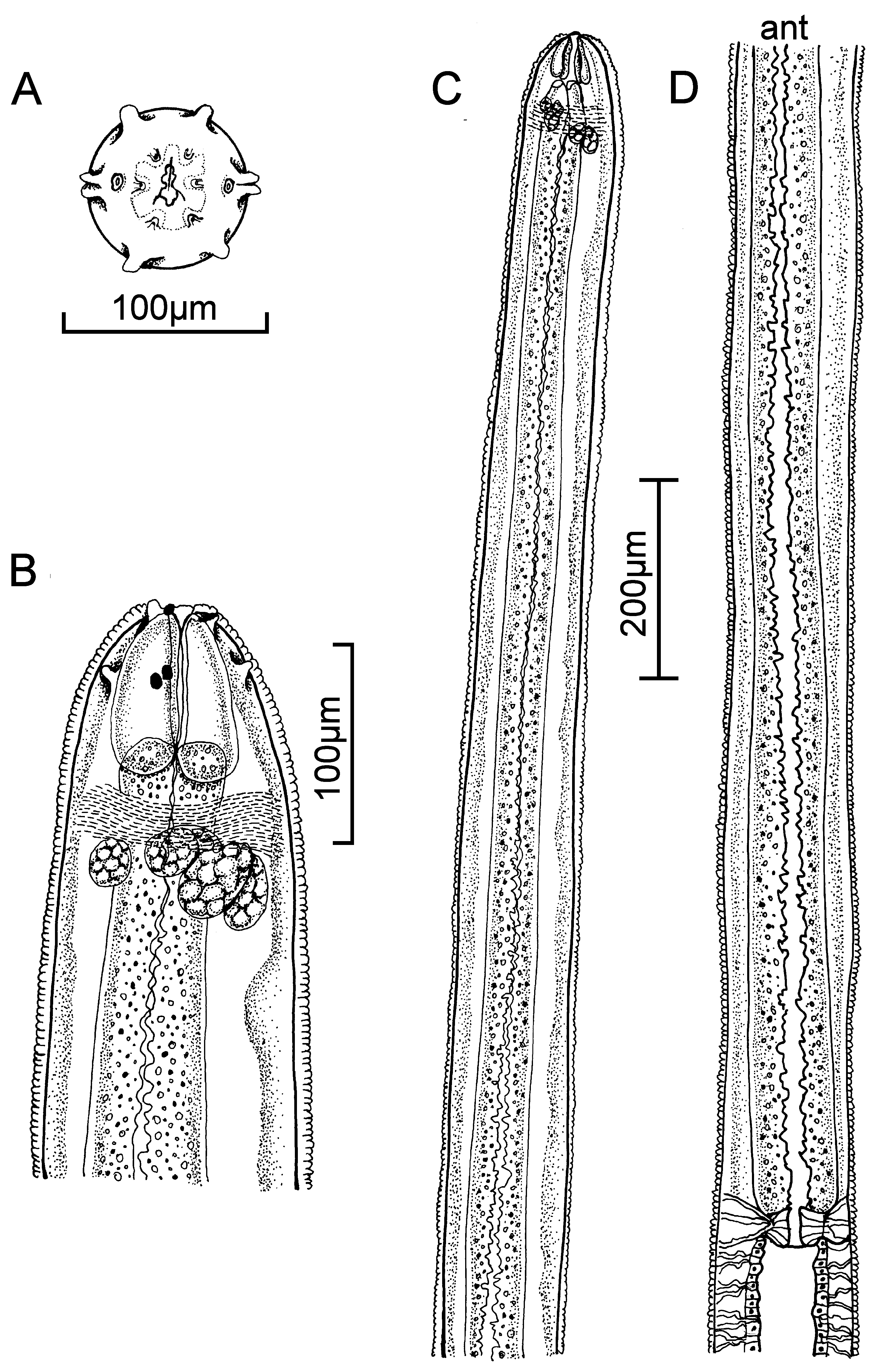
Dioctophyme is a monotypic genus of nematodes belonging to the family Dioctophymidae. The only species is Dioctophyme renale. Much older literature uses the alternative spelling "Dioctophyma" and the family name "Dioctophymatidae" but these alternative spellings were suppressed by the ICZN in a 1987 ruling.
Toxocara vitulorum
species of parasitic roundworm