Category
page 1Asia (Roman province)

Ephesus
Ephesus ( ; ; ; may ultimately derive from ) was an ancient Greek city on the coast of Ionia, in present-day Selçuk in İzmir Province, Turkey. It was built in the 10th century BC on the site of Apasa, a city-state that was also the capital of Arzawa, by Attic and Ionian Greek colonists. During the Classical Greek era, it was one of twelve cities that were members of the Ionian League. The city came under the control of the Roman Republic in 129 BC.

Lydia
Lydia (; ) was an Iron Age kingdom situated in western Anatolia, in modern-day Turkey. Later, it became an important province of the Achaemenid Empire and then the Roman Empire. Its capital was Sardis.
%20-%20Turkey%20-%2010%20(5747249729).jpg)
Pergamon
Pergamon or Pergamum ( or ; ), also referred to by its modern Greek form Pergamos (), was a rich and powerful ancient Greek city in Aeolis. It is located from the modern coastline of the Aegean Sea on a promontory on the north side of the river Caicus (modern-day Bakırçay) and northwest of the modern city of Bergama, Turkey.

Caria
Caria (; from Greek: Καρία, Karia; ) was a region of western Anatolia extending along the coast from mid-Ionia (Mycale) south to Lycia and east to Phrygia. The Carians were described by Herodotus as being Anatolian mainlanders and they called themselves Caria because of the name of their king. He reports the Carians themselves maintained that they were Anatolian mainlanders intensely engaged in seafaring and were akin to the Mysians and the Lydians. The Carians spoke Carian, a native Anatolian language closely related to Luwian. Also closely associated with the Carians were the Leleges, which
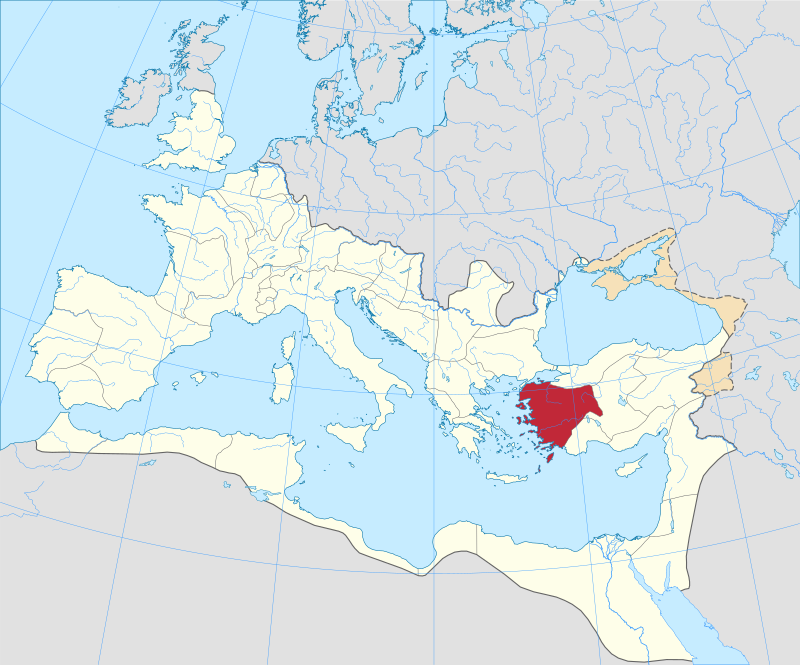
Asia
Roman province

Aeolis
Aeolis (; ), or Aeolia (; ), was an area that comprised the west and northwestern region of Asia Minor (modern-day Turkey), mostly along the coast, and also several offshore islands (particularly Lesbos), where the Aeolian Greek city-states were located. Aeolis incorporated the southern parts of Mysia, and is bounded by it to the north, Ionia to the south, and Lydia to the east.

Pisidia
thumb|300px|Greco-Roman Asia Minor, including Pisidia.
.jpg)
Mysia
Mysia (UK , US or ; ; ; ) was a region in the northwest of ancient Asia Minor (Anatolia, Asian part of modern Turkey). It was located on the south coast of the Sea of Marmara. It was bounded by Bithynia on the east, Phrygia on the southeast, Lydia on the south, Aeolis on the southwest, Troad on the west, and the Propontis on the north. In ancient times it was inhabited by the Mysians, Phrygians, Aeolian Greeks and other groups.
Treaty of Apamea
Hellenistic peace treaty (188 BCE)
Red Basilica
Ancient Roman buildings and structures in Turkey
Caloe
Caloe was a town in the Roman province of Asia. It is mentioned as Kaloe or Keloue in 3rd-century inscriptions; as Kalose in Hierocles's Synecdemos (660); and as Kalloe, Kaloe, and Kolone in Parthey's Notitiæ episcopatuum, in which it figures from the 6th to the 12fth or 13th century.
Attaea
Attaea or Attaia () was a city of Classical Anatolia in the region of the Caicus River or Lycus River. It minted coins inscribed "ΑΤΤΕΑΤΩΝ" from Caracalla's time simultaneously with those who have the legend "ΑΤΤΑΙΤΩΝ." It was also the site of a bishopric and was an important site for early Christianity. Attaea is today a titular see of the Roman Catholic Church in the ecclesiastical province of Ephesus. Its site seems to be at Ajasmat köi on the right bank of Ajasmat chaí, east of the Sunabai shore.
Aristonicus uprising
revolt in Pergamon, between 133 and 129 BC