Category
page 1Asterisms (astronomy)

Orion's Belt
asterism
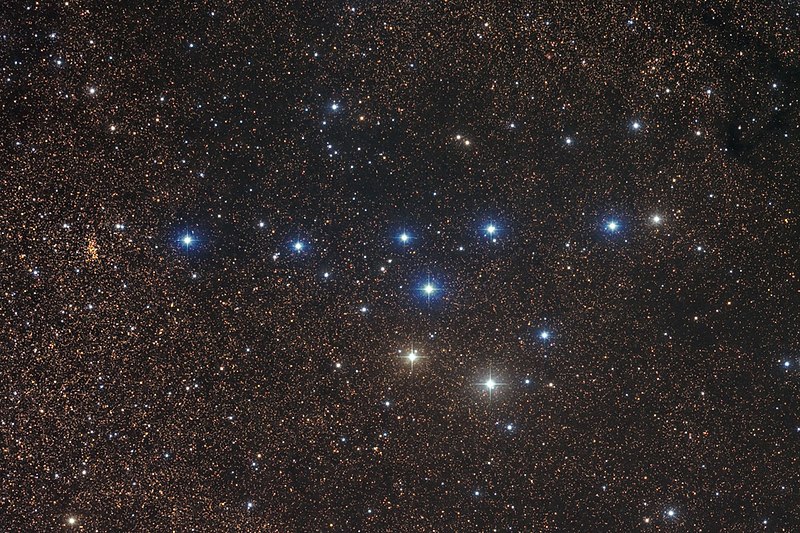
asterism
pattern of stars recognized on Earth's night sky

Big Dipper
pattern of seven bright stars in the constellation Ursa Major

Messier 73
Asterism of four stars in the constellation Aquarius

Summer Triangle
asterism
Winter Hexagon
asterism
NGC 2277
galaxy
Winter Triangle
asterism in the form of an approximately equilateral trangle formed by Sirius, Betelgeuse and Procyon
NGC 1746
asterism in the constellation Taurus
NGC 6169
star cluster
NGC 7055
galaxy
NGC 6863
Asterism in the constellation Aquila
NGC 6738
asterism in the constellation Aquila
NGC 7050
galaxy
Double Cluster
open star cluster
Spring Triangle
asterism
Brocchi's Cluster
Asterism of 10 stars in the constellation Vulpecula
Orion's Sword
asterism in the constellation Orion
Great Diamond
asterism

Kemble's Cascade
asterism in the constellation Camelopardalis
Pi Orionis
group of fairly widely scattered stars in the constellation Orion that constitute the asterism Orion's Shield or Orion's Bow
Northern Cross
astronomical asterism in the northern hemisphere celestial sphere
decans
thumb|upright=1.35|'Diagonal star table' from the late Eleventh Dynasty of Egypt|Eleventh Dynasty coffin lid; found at [[Asyut, Egypt. Roemer- und Pelizaeus-Museum Hildesheim]]
The decans (; ) are 36 groups of stars (small constellations) used in ancient Egyptian astronomy to conveniently divide the 360 degree ecliptic into 36 parts of 10 degrees each, both for theurgical and heliacal chronometrical purposes. The decans each appeared, geocentrically, to rise consecutively on the horizon throughout each daily Earth rotation. The rising of each decan marked the beginning of a new decanal "hour"
Diamond Cross
asterism in the constellation Carina
Mother Camels
asterism in the constellation Draco
Alicante 8
Open Cluster in the constellation Scutum