Category
page 1Astronomical objects discovered in 2000

Themisto
moon of Jupiter

Megaclite
Megaclite , also known as '''''', is one of Jupiter's smallest and outermost natural satellites.

Dia
moon of Jupiter

Praxidike
moon of Jupiter

Harpalyke
moon of Jupiter

Chaldene
Chaldene , also known as ', is a retrograde irregular satellite of Jupiter. It was discovered by a team of astronomers from the University of Hawaiʻi led by Scott S. Sheppard, in 2000, and given the temporary designation '.
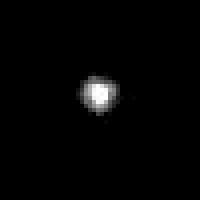
20000 Varuna
Kuiper belt object

Isonoe
moon of Jupiter

Iocaste
moon of Jupiter

Taygete
moon of Jupiter

Erinome
Erinome, also known as '''''', is a retrograde irregular satellite of Jupiter. It was discovered by a team of astronomers from the University of Hawaiʻi led by Scott S. Sheppard in 2000, and given the temporary designation .

Kalyke
Kalyke , also known as '''''', is a little retrograde irregular satellite of Jupiter.
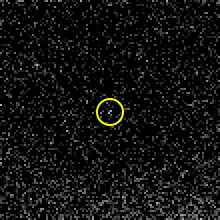
Albiorix
moon of Saturn

Ymir
moon of Saturn

Paaliaq
Paaliaq is a prograde irregular satellite of Saturn. It was discovered by J. J. Kavelaars, Brett J. Gladman, Jean-Marc Petit, Hans Scholl, Matthew J. Holman, Brian G. Marsden, Philip D. Nicholson and Joseph A. Burns in early October 2000, and given the temporary designation S/2000 S 2. It was named in August 2003 after a fictional shaman in the book The Curse of the Shaman, written by Michael Kusugak, who supplied Kavelaars with the names of giants from Inuit mythology that were used for other Saturnian moons.

Kiviuq
moon of Saturn

Ijiraq
moon of Saturn

Skathi
moon of Saturn
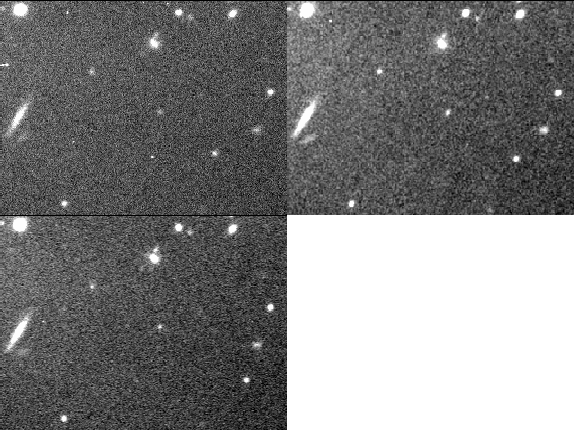
Tarvos
moon of Saturn

Erriapus
Erriapus , also known as Saturn XXVIII, is one of the mid-sized irregular moons of Saturn.

Mundilfari
moon of Saturn

Siarnaq
Siarnaq is the second-largest irregular moon of Saturn. It was discovered on 23 September 2000 by a team of astronomers led by Brett J. Gladman. It was named after the Inuit goddess of the sea, Siarnaq, who is more commonly known as Sedna. Siarnaq is the largest member of Saturn's Inuit group of prograde irregular moons, which orbit far from Saturn in the same direction as the planet's rotation. The moons of the Inuit group are believed to have originated as fragments from the collisional breakup of a larger progenitor moon after it was gravitationally captured into orbit around Saturn several

Tarqeq
Tarqeq, also known as Saturn LII (provisional designation S/2007 S 1) is a natural satellite of Saturn. Its discovery was announced by Scott S. Sheppard, David C. Jewitt, Jan Kleyna, and Brian G. Marsden on 13 April 2007 from observations taken between 5 January 2006 and 22 March 2007. It is named after Tarqeq, the Inuit moon god, and is a member of the Inuit group of irregular satellites. It is about six kilometres in diameter. The Cassini spacecraft observed Tarqeq over 1.5 days on 15–16 January 2014.
Thrymr
moon of Saturn

762 Pulcova
main-belt asteroid
38628 Huya
trans-Neptunian object
60558 Echeclus
active centaur
(87269) 2000 OO67
trans-Neptunian object
(148209) 2000 CR105
minor planet
54598 Bienor
centaur near Uranus
16241 Dvorsky
asteroid
15565 Benjaminsteele
asteroid

16248 Fox
asteroid
15132 Steigmeyer
asteroid
16271 Duanenichols
asteroid

16155 Buddy
asteroid
16239 Dower
asteroid

16165 Licht
asteroid
18125 Brianwilson
asteroid

15155 Ahn
asteroid
16225 Georgebaldo
asteroid
16247 Esner
asteroid
15619 Albertwu
asteroid

16230 Benson
asteroid
20898 Fountainhills
asteroid

16246 Cantor
asteroid
15559 Abigailhines
asteroid

16238 Chappe
asteroid
15567 Giacomelli
asteroid
16222 Donnanderson
asteroid
16251 Barbifrank
asteroid

15594 Castillo
asteroid

18106 Blume
asteroid
15144 Araas
asteroid
15629 Sriner
asteroid
17211 Brianfisher
asteroid
16167 Oertli
asteroid

16219 Venturelli
asteroid
14274 Landstreet
asteroid
16154 Dabramo
asteroid