Category
page 1Astronomical objects discovered in 2016

GN-z11
GN-z11 is a high-redshift galaxy discovered by NASA's Hubble Space Telescope in the constellation Ursa Major. It is among the farthest galaxies from Earth ever found. The 2015 discovery was published in a 2016 paper headed by Pascal Oesch and Gabriel Brammer (Cosmic Dawn Center). Up until the discovery of JADES-GS-z13-0 in 2022 by the James Webb Space Telescope, GN-z11 was the oldest and most distant galaxy yet identified in the observable universe, having a spectroscopic redshift of , which corresponds to a proper distance of approximately . Data published in 2024 established that the galaxy
Valetudo
moon of planet Jupiter
S/2016 J 1
moon of Jupiter
469219 Kamoʻoalewa
near-Earth asteroid and quasi-satellite of Earth
BOSS Great Wall
the largest known galaxy wall
Crater 2 dwarf galaxy
dwarf satellite galaxy of the Milky Way
HD 131399 Ab
red dwarf in the constellation Centaurus
2016 WF9
asteroid
2XMM J160050.7–514245
triple-star system in the constellation Norma; the best known gamma-ray burst progenitor candidate
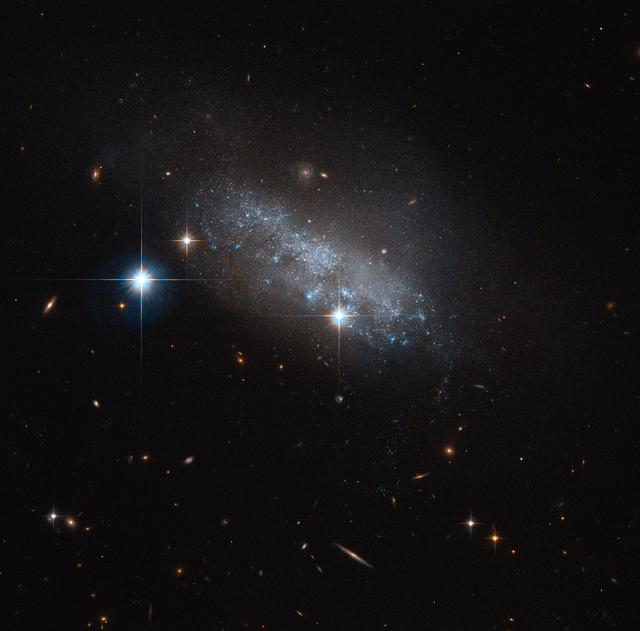
Virgo I
galaxy
C/2016 R2 (PanSTARRS)
comet

Vela Supercluster
Supercluster in the constellation Vela
EPIC 204278916
a young, pre-main-sequence star about 5 million years old, of spectral type M1, located in the Upper Scorpius sub-group of the Scorpius–Centaurus Association
SN2016aps
brightest supernova ever recorded
Donatiello I
dwarf spheroidal galaxy

2016 AZ8
asteroid
PSR J0952–0607
massive millisecond pulsar in the Milky Way
605911 Cecily
Amor asteroid
V407 Lupi
nova
V5856 Sagittarii
nova in the constellation Sagittarius
WISE J080822.18−644357.3
star in the constellation Carina