Category
page 1Atoms

atom
Atoms are the basic particles of the chemical elements and the fundamental building blocks of matter. An atom consists of a nucleus of protons and generally neutrons, surrounded by an electromagnetically bound swarm of electrons. The chemical elements are distinguished from each other by the number of protons that are in their atoms. For example, any atom that contains 11 protons is sodium, and any atom that contains 29 protons is copper. Atoms with the same number of protons but a different number of neutrons are called isotopes of the same element.

atomic number
number of protons found in the nucleus of an atom

atomic nucleus
core of the atom; composed of bound nucleons (protons and neutrons)

atomic mass
rest mass of an atom in its ground state

plum pudding model
scientific model of the atom first proposed by J. J. Thomson in 1904
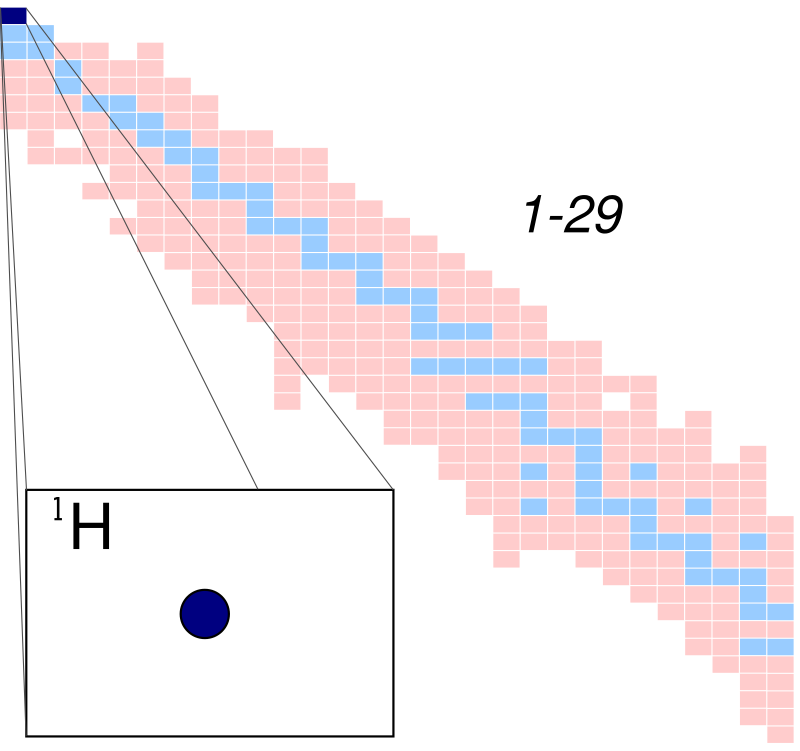
hydrogen atom
atom of element hydrogen
hydrogen-like atom
atomic nucleus with one electron that behaves like hydrogen
Rydberg atom
excited atomic quantum state with high principle quantum number (n)
superatom
In chemistry, a superatom is any cluster of atoms that seem to exhibit some of the properties of elemental atoms. One example of a superatom is the cluster .
Electron configurations of the elements
Wikimedia list article
cubical atom
early atomic model in which electrons were positioned at the eight corners of a cube, accounting for the phenomenon of valency
ultracold atom
atom maintained at temperatures close to 0 kelvins, usually in an atomic physics laboratory

helium atom
mathematical modeling of a helium atom
oscillator strength
Dimensionless quantity in spectroscopy

Two-electron atom
helium-like quantum systems that have a nucleus and two electrons
atomic fountain
cloud of atoms that is tossed upwards by lasers in the Earth's gravitational field
Nuclear density
density of the nucleus of an atom