Category
page 1August 1945 in Asia

Atomic bombings of Hiroshima and Nagasaki
On 6 and 9 August 1945, the United States detonated two atomic bombs over the Japanese cities of Hiroshima and Nagasaki, respectively, during the final days of World War II. The aerial bombings killed 150,000 to 246,000 people, most of whom were civilians, and remain the first and only uses of nuclear weapons in an armed conflict.
In the final year of World War II, the Allies prepared for a costly invasion of the Japanese mainland. This undertaking was preceded by a conventional bombing and firebombing campaign that devastated 64 Japanese cities, including an operation on Tokyo. The war in Europe concluded when Germany surrendered on 8 May 1945, and the Allies turned their full attention to the Pacific War. By July 1945, the Allies' Manhattan Project had produced two types of atomic bombs: "Little Boy", an enriched uranium gun-type fission weapon, and "Fat Man", a plutonium implosion-type nuclear weapon. The 509th Composite Group of the U.S. Army Air Forces was trained and equipped with the specialized Silverplate version of the Boeing B-29 Superfortress, and deployed to Tinian in the Mariana Islands. The Allies called for the unconditional surrender of the Imperial Japanese Armed Forces in the Potsdam Declaration on 26 July 1945, the alternative being "prompt and utter destruction". The Japanese government ignored the ultimatum. Japan announced its surrender to the Allies on 15 August, six days after the bombing of Nagasaki and the Soviet Union's declaration of war against Japan and invasion of Manchuria. The Japanese government signed an instrument of surrender on 2 September, ending the war.
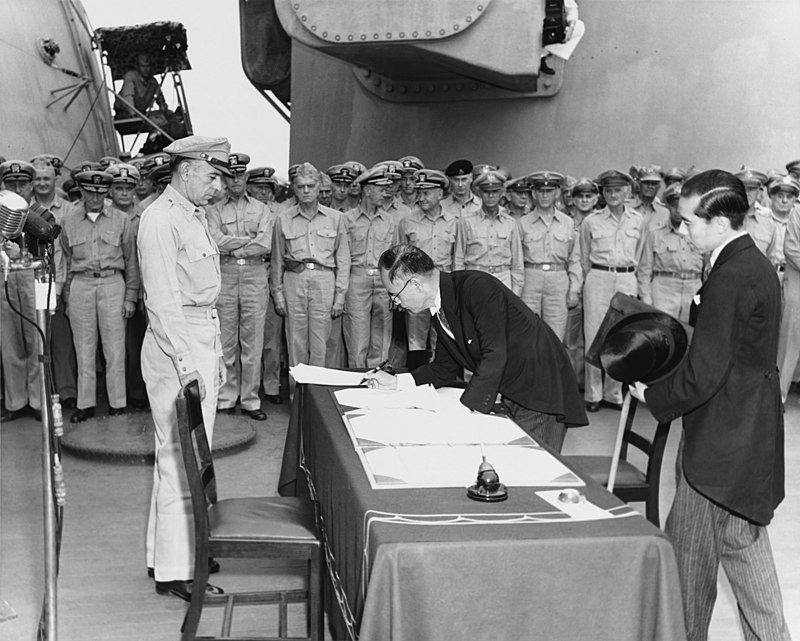
surrender of Japan
end of World War II, 2 September 1945
Soviet invasion of Manchuria
1945 invasion; part of the Soviet–Japanese War of World War II
Soviet–Japanese War
invasion of the Japanese puppet state of Manchukuo by the Soviet Union near the end of WWII
Hirohito surrender broadcast
radio broadcast in which Emperor Hirohito announced the Japanese surrender in World War II
August Revolution
1945 uprising led by Viet Minh
Borneo campaign
1945 last major Allied campaign in the South West Pacific Area during World War II
Proclamation of Indonesian Independence
1945 document declaring Indonesian independence from the Netherlands
Kuril Islands landing operation
part of the 1945 Soviet–Japanese War
Kyūjō Incident
coup d'état
Battle of Mindanao
1945 World War II battle
Soviet invasion of South Sakhalin
1945 Soviet invasion of the Japanese portion of Sakhalin Island
Battle of Shumshu
1945 Russian-Japanese WWII battle
Battle of North Borneo
1945 battle during the Second World War between Allied and Japanese forces
Allied naval bombardments of Japan during World War II
1945 Simultaneous bombings of Japan by the Allies during World War II
Matsue Incident
coup d'état attempt in Japan
death of Subhas Chandra Bose
death of and subsequent theories about Subhas Chandra Bose
proposed Soviet invasion of Hokkaido
plans made to invade Hokkaido in August 1945
Second Guangxi campaign
1945 Chinese counter offensive
Battle of the Sittang Bend
part of Burma Campaign during World War 2
abdication of Bảo Đại
The formal end of the Nguyễn Dynasty's reign.
Harbin–Kirin Operation
Soviet military operation
Seishin Operation
1945 amphibious assault in northern Korea
Battle of Mutanchiang
1945 Soviet-Japanese battle in Manchuria
Bombing of Akita in World War II
1945 last bombing mission in World War II
Liberation of Hong Kong
British resumes sovereignty over Hong Kong in 1945