Category
page 1Auriga

Auriga
Auriga is a constellation in the northern celestial hemisphere. It is one of the 88 modern constellations; it was among the 48 constellations listed by the 2nd-century astronomer Ptolemy. Its name is Latin for '(the) charioteer', associating it with various mythological beings, including Erichthonius and Myrtilus. Auriga is most prominent during winter evenings in the northern Hemisphere, as are five other constellations that have stars in the Winter Hexagon asterism. Because of its northern declination, Auriga is only visible in its entirety as far south as −34°; for observers farther south i

Capella
Capella is the brightest star in the northern constellation of Auriga. It has the Bayer designation α Aurigae, which is Latinised to Alpha Aurigae and abbreviated Alpha Aur or α Aur. Capella is the sixth-brightest star in the night sky, and the third-brightest in the northern celestial hemisphere after Arcturus and Vega. A prominent object in the northern sky, it is circumpolar to observers north of 44°N. Its name meaning "little goat" in Latin, Capella depicted the goat Amalthea that suckled Zeus in classical mythology. Capella is relatively close, at . It is one of the brightest X-ray source

Messier 37
open cluster in the constellation Auriga

Messier 38
open cluster in the constellation Auriga

Messier 36
open cluster in the constellation Auriga

Beta Tauri
star in the constellation Taurus
Beta Aurigae
binary star system in the northern constellation of Auriga
NGC 1931
nebula and open cluster in the constellation Auriga
Q583418
open cluster in the constellation Auriga
Q921254
open cluster in the constellation Auriga
4-H cluster
open cluster in the constellation Auriga
IC 405
emission nebula in the constellation Auriga

WASP-12b
WASP-12b is a hot Jupiter (a class of extrasolar planets) orbiting the star WASP-12, discovered in April of 2008, by the SuperWASP planetary transit survey. The planet takes only a little over one Earth day to orbit its star, in contrast to about 365.25 days for the Earth to orbit the Sun. Its distance from the star (approximately ) is only \textstyle\frac{1}{43} the Earth's distance from the Sun, with an eccentricity the same as Jupiter's. Consequently, it has one of the lowest densities for exoplanets ("inflated" by the flux of energy from the star). On December 3, 2013, scientists working w
NGC 2387
galaxy
Epsilon Aurigae
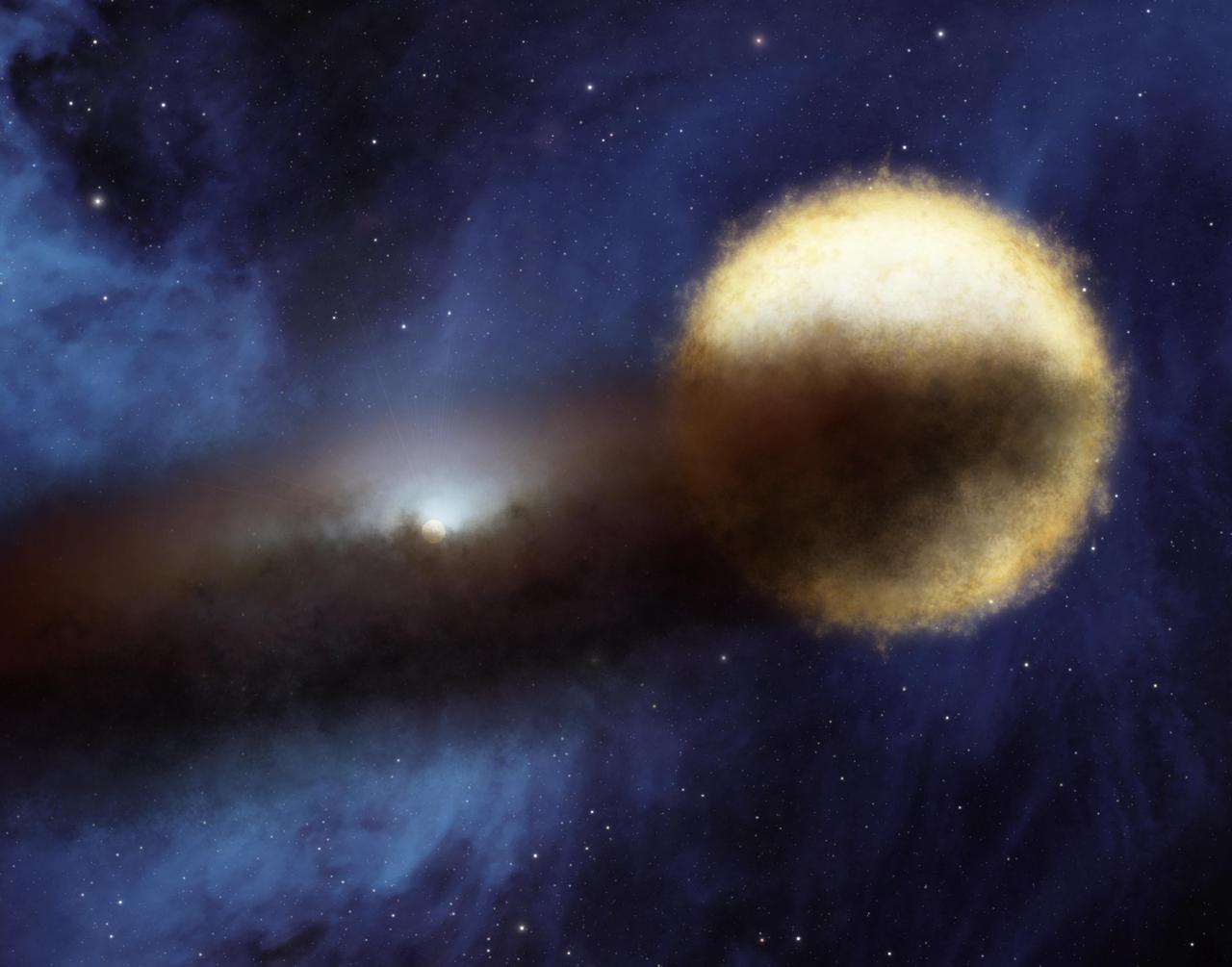
star in the northern constellation of Auriga
Q958905
star cluster
NGC 2240
star cluster
NGC 1985
bright nebula in Auriga
NGC 2242
planetary nebula
Iota Aurigae
star in the constellation Auriga
Theta Aurigae
binary star in the constellation Auriga

WASP-12
WASP-12 is a magnitude 11 yellow dwarf star located approximately 1347 light-years away in the constellation Auriga. WASP-12 has a mass and radius similar to the Sun and is known for being orbited by a planet that is extremely hot and has a retrograde orbit around WASP-12. WASP-12 forms a triple star system with two red dwarf companions. Both of them have spectral types of M3V and are only 38% and 37% as massive as the Sun, respectively.
Zeta Aurigae
binary star in the constellation Auriga
AE Aurigae
star in the constellation Auriga
list of stars in Auriga
Wikimedia list article
Delta Aurigae
star in the constellation Auriga
Eta Aurigae
star in the constellation Auriga
Q1511210
planetary nebula in the constellation Auriga
Lambda Aurigae
star in the constellation Auriga
AB Aurigae
star in the constellation Auriga
Nu Aurigae
star in the constellation Auriga
Nervia
solar-type star in the constellation Auriga
Tau Aurigae
star in the constellation Auriga
IC 417
Bright nebula in Auriga
Pi Aurigae
star in the constellation Auriga
Upsilon Aurigae
star in the constellation Auriga

HAT-P-9 b
HAT-P-9b, formally named Alef, is an exoplanet approximately 1500 light years away in the constellation Auriga. This planet was found by the transit method on June 26, 2008. It has a mass 78% that of Jupiter and a radius 140% that of Jupiter. As with most transiting planets, this planet is a hot Jupiter, meaning this Jupiter-like planet orbits extremely close to its parent star, taking only 3.92 days to orbit.
14 Aurigae
star system in the constellation Auriga
Omega Aurigae
binary star system in the constellation Auriga
Omicron Aurigae
star in the constellation Auriga
Mu Aurigae
star in the constellation Auriga
Psi1 Aurigae
star in the constellation Auriga
MWC 480
star in the constellation Auriga
Palomar 2
globular cluster
Galactic anticenter
direction in space directly opposite to the Galactic Center, as viewed from Earth
Westbrook Nebula
aspherical protoplanetary nebula which is located in the constellation Auriga
Q1334571
variable star in the constellation Auriga
MACS J0717.5+3745
Galaxy cluster in the constellation Auriga
HD 45350
star in the constellation Auriga

IQ Aurigae
variable star in the constellation Auriga
WW Aurigae
binary star in the constellation Auriga
V538 Aurigae
star in the constellation Auriga
Chi Aurigae
binary star system in the constellation Auriga
Sigma Aurigae
star in the constellation Auriga
Psi8 Aurigae
star in the constellation Auriga
NO Aurigae
star in the constellation Auriga
9 Aurigae
star system in the constellation Auriga
RT Aurigae
star in the constellation Auriga
AR Aurigae
binary star system in the constellation Auriga
Q2779066
star in the constellation Auriga