Category
page 1Bartonian first appearances
.jpg)
Canidae
Canidae (; from Latin, canis, "dog") is a biological family of caniform carnivorans, constituting a clade. A member of this family is a canid (, rarely ), colloquially referred to as dogs. The family includes three subfamilies: the Caninae, and the extinct Borophaginae and Hesperocyoninae. The Caninae are the canines, and include domestic dogs, wolves, coyotes, raccoon dogs, foxes, jackals and other species.

triggerfish
Triggerfish are about 40 species of often brightly colored, marine, ray-finned fishes belonging to the family Balistidae. Often marked by lines and spots, they inhabit tropical and subtropical oceans throughout the world, with the greatest species richness in the Indo-Pacific. Most are found in relatively shallow, coastal habitats, especially at coral reefs, but a few, such as the oceanic triggerfish (Canthidermis maculata), are pelagic. While several species from this family are popular in the marine aquarium trade, they are often notoriously ill-tempered.

Pauropoda
Pauropoda is a class of small, pale, millipede-like arthropods in the subphylum Myriapoda. More than 900 species in twelve families are found worldwide, living in soil and leaf mold. Pauropods look like centipedes or millipedes and may be a sister group of the latter, but a close relationship with Symphyla has also been posited. The name Pauropoda derives from the Greek pauros (meaning "small" or "few") and pous, genitive podos (meaning "foot"), because most species in this class have only nine pairs of legs as adults, a smaller number than those found among adults in any other class of myriap

Molidae
The Molidae comprise the family of the molas or ocean sunfishes, unusual fish whose bodies come to an end just behind the dorsal and anal fins, giving them a "half-fish" appearance. They are also the largest of the extant ray-finned bony fish, with the southern sunfish, Mola alexandrini, recorded at in length and in weight.
.jpg)
Nimravidae
Nimravidae is an extinct family of carnivorans, sometimes known as false saber-toothed cats, whose fossils are found in North America, Africa, and Eurasia. Not considered to belong to the true cats (family Felidae), the nimravids are generally considered closely related and classified as a distinct family in the suborder Feliformia. The family consisted of three subfamilies hoplophonines, nimravines, and barbourofelines. Barboroufelines were initially classified as a subfamily of the Nimravidae since 1991, however in 2004, they were reassigned to their own distinct family. Since 2020, the majo
Bartonian
The Bartonian is, in the International Commission on Stratigraphy's (ICS) geologic time scale, a stage or age in the middle of the Eocene Epoch or Series. The Bartonian Age spans the time between . It is preceded by the Lutetian and is followed by the Priabonian Age.
Negaprion
Negaprion is a genus of requiem sharks in the family Carcharhinidae. It contains the two extant species of lemon sharks: the lemon shark (N. brevirostris) of the Americas, and the sicklefin lemon shark (N. acutidens) of the Indo-Pacific. Both species are large, slow-moving, bulky sharks inhabiting shallow coastal waters, and can be identified by their short, blunt snouts, two dorsal fins of nearly equal size, and uniform yellowish brown or gray coloration.
Peripatidae
Peripatidae or Equatorial Velvet Worms is a family of velvet worms. This family includes more than 90 described species distributed among 13 genera, but some authorities deem only 80 of these species to be valid. The oldest putative representatives of the family herald from Burmese amber dated to the mid-Cretaceous, around 100 million years ago, with representatives from Dominican and Baltic amber attesting to a broader distribution in the Palaeogene / Neogene; molecular variability suggests that the family's crown group may have arisen in the early Mesozoic.

Atlanta
genus of molluscs
Hoplolatilus
Hoplolatilus is a genus of tilefishes native to the Indian Ocean and the western Pacific Ocean. The chameleon tilefish (Hoplolatilus chlupatyi), also known as the flashing tilefish, is well known in particular in the aquarium hobby due to its unique ability to change colors in an instant with the help of specialized proteins in its skin that can reflect light in different wavelengths, allowing it to cycle between primary and secondary colors on the light spectrum.
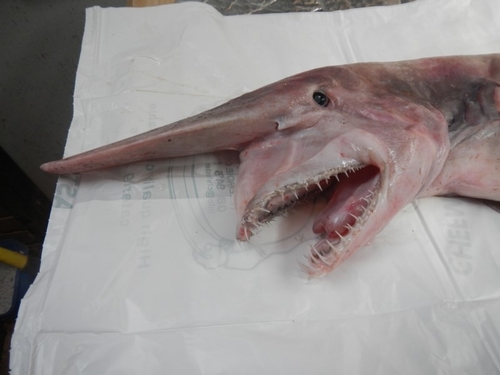
Mitsukurina
Mitsukurina is a genus of mackerel shark in the family Mitsukurinidae. It contains one extant species, the goblin shark (M. owstoni) and more extinct species. The genus was described by American ichthyologist David Starr Jordan in 1898 and named in honour of Kakichi Mitsukuri.
Nimravinae
right|thumb|250px|Nimravidae cladogram