Category
page 1Bat families
%20Slovakia.jpg)
Vespertilionidae
thumb|Parti-coloured batVespertilio murinus, Slovakia
Vespertilionidae is a family of microbats, of the order Chiroptera, flying, insect-eating mammals variously described as the common, vesper, or simple nosed bats. The vespertilionid family is the most diverse and widely distributed of bat families, specialised in many forms to occupy a range of habitats and ecological circumstances, and it is frequently observed or the subject of research. The facial features of the species are often simple, as they mainly rely on vocally emitted echolocation. The tails of the species are enclosed by the lo

Emballonuridae
Emballonuridae is a family of microbats, many of which are referred to as sac-winged or sheath-tailed bats. They are widely distributed in tropical and subtropical regions around the world. The earliest fossil records are from the Eocene.

Megadermatidae
Megadermatidae, or false vampire bats, are a family of bats found from central Africa, eastwards through southern Asia, and into Australia. They are relatively large bats, ranging from 6.5 cm to 14 cm in head-body length. They have large eyes, very large ears and a prominent nose-leaf. They have a wide membrane between the hind legs, or uropatagium, but no tail. Many species are a drab brown, but some are white, bluish-grey or even olive-green, helping to camouflage them against their preferred roosting environments.

Hipposideridae
The Hipposideridae are a family of bats commonly known as the Old World leaf-nosed bats. While it has often been seen as a subfamily, Hipposiderinae, of the family Rhinolophidae, it is now more generally classified as its own family. Nevertheless, it is most closely related to Rhinolophidae within the suborder Yinpterochiroptera.
Furipteridae
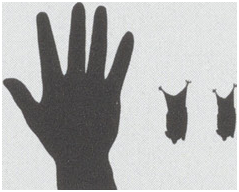
Furipteridae is family of bats, allying two genera of single species, Amorphochilus schnablii (smoky bat) and the type Furipterus horrens (thumbless bat). They are found in Central and South America and are closely related to the bats in the families Natalidae and Thyropteridae. The species are distinguished by their reduced or functionless thumbs, enclosed by the wing membranes, and their broad, funnel-shaped ears. They are insectivorous and can live in many different kinds of environments. They have greyish fur, and a small nose-leaf. Like many bats, they roost in caves.
Mormoopidae
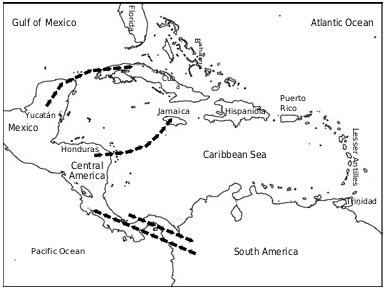
The family Mormoopidae contains bats known generally as mustached bats, ghost-faced bats, and naked-backed bats. They are found in the Americas from the Southwestern United States to Southeastern Brazil.
Natalidae
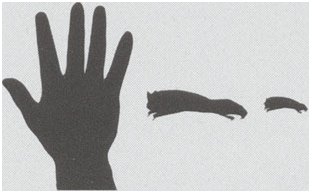
The family Natalidae, or funnel-eared bats, are found from Mexico to Brazil and the Caribbean islands. The family has three genera, Chilonatalus, Natalus and Nyctiellus. They are slender bats with unusually long tails and, as their name suggests, funnel-shaped ears. They are small, at only in length, with brown, grey, or reddish fur. Like many other bats, they are insectivorous, and roost in caves.

Mystacinidae
__NOTOC__
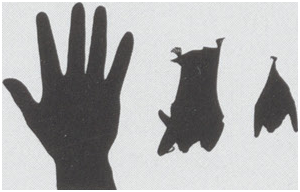
Mystacinidae is a family of unusual bats, the New Zealand short-tailed bats. There is one living genus, Mystacina, with two species, one of which could have possibly become extinct in the 1960s. They are medium-sized bats, about in length, with grey, velvety fur.
Nycteridae
REDIRECT Nycteris
Rhinonycteridae
Rhinonycteridae is a family of bats, within the suborder Yinpterochiroptera. The type species, the orange nose-leafed species group Rhinonicteris aurantia, is found across the north of Australia.

Cistugidae
REDIRECT Cistugo
Philisidae
Philisidae is an extinct family of bats of the suborder Microchiroptera that lived between the Eocene to the Late Miocene in the continent of Africa.
Palaeochiropterygidae
Palaeochiropterygidae is a family of extinct bats. It was originally erected by the Swiss naturalist Pierre Revilliod in 1917 after discoveries of Palaeochiropteryx fossils from the Messel Pit of Germany. Palaeochiropterygidae was merged into Archaeonycteridae by Kurten and Anderson in 1980, but modern authorities specializing in bat fossils maintain the distinction between the two. It was classified to the unranked clade Microchiropteramorpha by Smith et al. in 2007.
Onychonycteridae
Onychonycteridae is an extinct family of bats known only from the early Eocene of Europe and North America. The type species, Onychonycteris finneyi, was described in 2008 from two nearly complete skeletons found in the Green River Formation of southwestern Wyoming. Since that time a number of previously described fossil bat species have been assigned to Onychonycteridae, as well as two more recently discovered species.