Category
page 1Bees

bee
Bees are winged insects that form a monophyletic clade Anthophila within the superfamily Apoidea of the order Hymenoptera, with over 20,000 known species in seven recognized families. Some species – including honey bees, bumblebees, and stingless bees – are social insects living in highly hierarchical colonies, while over 90% of bee species – including mason bees, carpenter bees, leafcutter bees, and sweat bees – are solitary. Members of the most well-known bee genus, Apis (i.e. honey bees), are known to construct hexagonally celled waxy nests called hives.

Apis
genus of insects

honeycomb
A honeycomb is a mass of hexagonal prismatic cells built from beeswax by honey bees in their nests to contain their brood (eggs, larvae, and pupae) and stores of honey and pollen.

drone
male bee, wasp or hornet

queen bee
dominant reproductive female bee in a colony
Worker bee
female bee with blocked reproductive capacity
Meliponini
stingless bees (stunted stinger) tribe of insects from honey bees family

melittology
thumb|A honeybee drinking water
pollen basket
part of the tibia on the hind legs of certain species of bees
fear of bees
phobia of bees
Stenotritidae
The Stenotritidae is the smallest of all formally recognised bee families, with only 22 species in two genera, all of them restricted to Australia. Historically, they were generally considered to belong in the family Colletidae, but the stenotritids are presently considered their sister taxon, and deserving of family status. Of prime importance is that the stenotritids have unmodified mouthparts, whereas colletids are separated from all other bees by having bilobed glossae.
scopa
modified hairs on Apoidea body
Laying worker bee
beekeeping term

buzz pollination
form of pollination
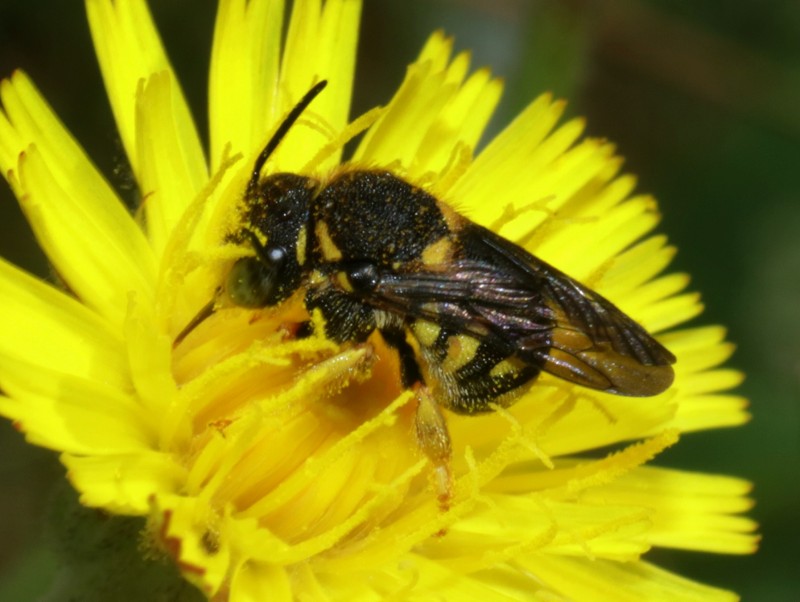
Anthidiellum strigatum
species of insect
cuckoo bee
type of parasitic bee
Colletes abeillei
species of insect
bee learning and communication
cognitive and sensory processes in bees
Meliponiculture
link=https://pt.wikipedia.org/wiki/Ficheiro:Meliponario_individual.png|thumb|Meliponary with individual posts in the Pau Brasil village, in the Tupiniquim Indigenous Land, Aracruz, [[Espírito Santo]]Meliponiculture is the rational farming of stingless bees, or meliponines (Meliponini tribe), which is different from apiculture (the breeding of bees of the Apis mellifera species; western honey bee or European honey bee; Apini tribe). In meliponiculture, the hives can be organized in meliponary, places with suitable conditions of temperature, solar orientation, humidity, and food supply (flowers
Nasanov's gland