Category
page 1Black holes

Black hole
A black hole is an astronomical body so compact that its gravity prevents anything, including light, from escaping. Albert Einstein's theory of general relativity, which describes gravitation as the curvature of spacetime, predicts that any sufficiently compact mass will form a black hole. The boundary of no escape is called the event horizon. In general relativity, crossing a black hole's event horizon traps an object inside but produces no locally detectable change. General relativity also predicts that every black hole should have a central singularity, where the curvature of spacetime is infinite.

gravitational wave
propagating spacetime ripple

wormhole
thumb|upright=1.3|A wormhole visualized as a two-dimensional surface. Route (a) is the shortest path through normal space between points 1 and 2; route (b) is a shorter path through a wormhole.
event horizon
boundary of a region of spacetime from which one cannot escape once entered
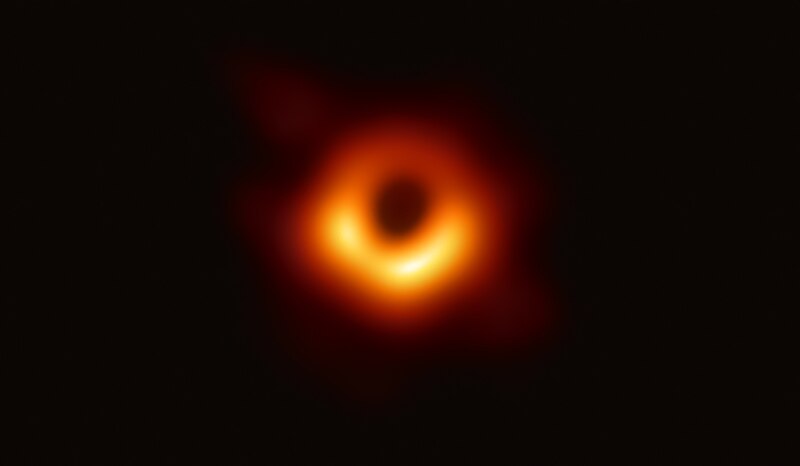
supermassive black hole
black hole with mass above 10⁵ solar masses, usually found at the centers of galaxies
Hawking radiation
radiation with a blackbody spectrum radiated from an event horizon
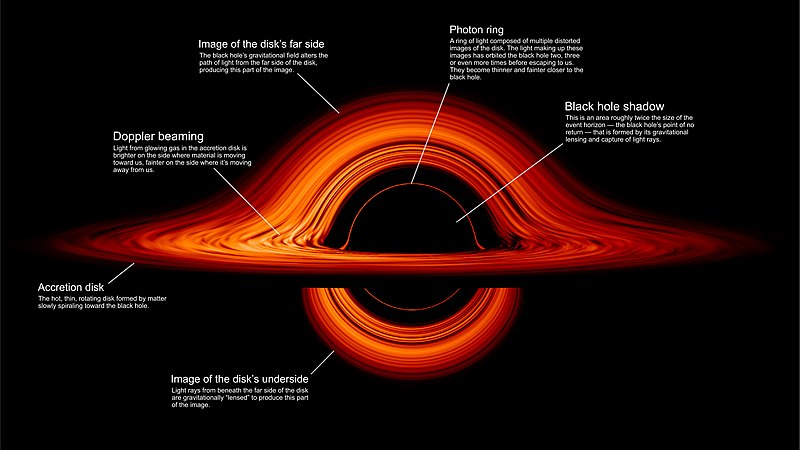
accretion disc
structure formed by diffuse material in orbital motion around a massive central body

Schwarzschild radius
distance from a massive body where the escape velocity equals the speed of light

gravitational collapse
contraction of an astronomical object due to the influence of its own gravity
stellar black hole
black hole formed by a collapsed star
Schwarzschild metric
spherically symmetric static vacuum solution of Einstein’s field equations with zero cosmological constant
astrophysical jet
beam of ionized matter flowing along the axis of a rotating astronomical object
holographic principle
physical principle in which physics inside a bounded region is fully captured by physics at the boundary of the region
naked singularity
a hypothetical gravitational singularity without an event horizon
micro black hole
black hole on a quantum level or with quantum effects
.png)
spaghettification
alt=|thumb|Astronaut falling into a black hole (schematic illustration of the spaghettification effect)
thumb|upright=1.3|Tidal forces acting on a spherical body in a non-homogeneous [[gravitational field. In this diagram, the gravitational force originates from a source to the right. It shows both the tidal field (thick red arrows) and the gravity field (thin blue arrows) exerted on the body's surface and center (label O) by a source (label S).]]
black hole information paradox
scientific question of whether information can disappear in a black hole
primordial black hole
hypothetical type of black hole that formed soon after the Big Bang
Tolman–Oppenheimer–Volkoff limit
upper bound to the mass of cold, nonrotating neutron stars

quasi-star
thumb|alt=|upright=1.3|An artist’s impression of a quasi-star, showing a black hole core residing in the massive photospheric envelope of the object

ergosphere
thumb|right|300px|At the ergospheres (shown here in violet for the outer and red for the inner one), the temporal metric coefficient gtt becomes negative, i.e., acts like a purely spatial metric component. Consequently, timelike or lightlike worldlines within this region must co-rotate with the inner mass. Kerr–Newman metric#Alternative .28Kerr.E2.80.93Schild.29 formulation|Cartesian projection, equatorial perspective.
Kerr metric
exact solution for the Einstein field equations
surface gravity
standard surface gravity
black hole thermodynamics
area of physical study that seeks to reconcile the laws of thermodynamics with the existence of black hole event horizons
intermediate-mass black hole
black hole with a mass range of 100 to 100000 solar masses
Planck particle
hypothetical object whose Schwarzschild radius is approximately the same as its Compton wavelength
dark star
hypothetical astronomical object heated by dark-matter annihilation
Reissner–Nordström metric
spherically symmetric metric with electric charge
rotating black hole
black hole with angular momentum

gravastar
thumb|A diagram comparing the structure of a classical black hole with a gravastar.
Penrose process
theorical process wherein energy can be extracted from a rotating black hole
no-hair theorem
theorem
binary black hole
system consisting of two black holes orbiting each other
cosmic censorship hypothesis
conjecture that, in general relativity, there is no naked singularity (i.e. one visible from future null infinity) generically
orbital decay
process that leads to gradual decrease of the distance between two orbiting bodies
Bekenstein bound
Upper limit on entropy that can be contained within a given finite region of space which has a finite amount of energy, in physics.
.jpg)
blanet
thumb |Artist's impression of the view of the sky from a planet orbiting inside the dust disk around the supermassive black hole in the center of the galaxy NGC 4261.
Feryal Özel
Turkish-American astronomer (born 1975)
photon sphere
spherical area or region of space where gravity is strong enough that massless particles are forced to travel in orbits
kugelblitz
theorized concentration of light so intense that it forms an event horizon and becomes self-trapped
Geon
nonsingular electromagnetic or gravitational wave held together in a confined region by the gravitational attraction of its own field energy
tidal disruption event
pulling apart of a star by tidal forces when it gets too close to a supermassive black hole
brightest cluster galaxy
brightest galaxy within a galaxy cluster
Cauchy horizon
light-like boundary of the domain of validity of a Cauchy problem in general relativity
black star
gravitational object composed of matter
black hole cosmology
cosmological model in which the observable universe is the interior of a black hole
extremal black hole
black hole with maximal charge or angular momentum allowed for a given mass
Virtual black hole
black holes appearing from quantum spacetime fluctuations
BKL singularity
general relativity model near the beginning of the universe
firewall
hypothetical phenomenon where an observer falling into a black hole encounters high-energy quanta at the event horizon
Planck star
hypothetical astronomical object, theorized as a compact, exotic star, that exists within a black hole's event horizon, created when the energy density of a collapsing star reaches the Planck energy density
Little Red Dot
class of small, red galaxies
dark-energy star
object composed of dark energy that outwardly resembles a black hole
ring singularity
Ring-shaped gravitational singularity of a rotating blackhole
list of black holes
Wikimedia list article
ER=EPR
conjencture unifying entanglement and wormholes
magnetospheric eternally collapsing object
compact object with an intrinsic magnetic field that collapses continuously without forming an event horizon
blitzar
In astronomy, blitzars are a hypothetical type of neutron star, specifically pulsars that can rapidly collapse into black holes if their spinning slows down. Heino Falcke and Luciano Rezzolla proposed these stars in 2013 as an explanation for fast radio bursts.
Extreme mass ratio inspiral
sonic black hole
acoustic analogue of a black hole where phonons cannot escape an analogue event horizon