Category
page 2Boletales genera
Harrya
Harrya is a fungal genus in the family Boletaceae. It was circumscribed in 2012 to contain the species Harrya atriceps and the type Harrya chromapes.
Austropaxillus
Austropaxillus is a genus of fungi in the family Serpulaceae, containing nine species found in Australia, New Zealand and South America.
Tubosaeta
Tubosaeta is a genus of fungi in the family Boletaceae. The genus was circumscribed by mycologist Egon Horak in 1967.
Sutorius
Sutorius is a genus of fungi in the family Boletaceae. Its type species is the widely distributed Sutorius eximius (formerly referred to the genera Boletus, Ceriomyces, Leccinum, and Tylopilus). The Asian Boletus obscureumbrinus, found in Japan and China, was described by Japanese mycologist Tsuguo Hongo in 1968, moved to genus Sutorius in 2016, but then reclassified into genus Neoboletus in 2019. The Australian Sutorius australiensis and the southern Chinese Sutorius subrufus also belong to the genus.
Rossbeevera
Rossbeevera is a genus of sequestrate (truffle-like) fungi in the family Boletaceae. It was first published in 2012 under the erroneous name Rosbeeva, but was corrected to Rossbeevera in the same issue. The genus was created to contain species formerly placed in Chamonixia, but characterized by having ellipsoid to spindle-shaped spores with 3–5 longitudinal ridges, bluish-green to deep blue fruit body staining reaction, and a thin whitish peridium. The Chinese species R. yunnanensis is the earliest diverging lineage within the genus, and has a close phylogenetic relationship with the bole
Baorangia
Baorangia is a fungal genus in the family Boletaceae. It was circumscribed by Chinese mycologists Gang Wu and Zhu L. Yang in 2015 with B. pseudocalopus (formerly classified in Boletus) as the type species. Baorangia emilei and B. bicolor were transferred to the genus from Boletus that same year. The erection of Baorangia follows recent molecular studies that outlined a new phylogenetic framework for the Boletaceae. The generic name—derived from the Chinese words bao ("thin") and rang ("hymenium")—refers to the characteristically thin hymenophore, which distinguishes it fr
Rheubarbariboletus
Rheubarbariboletus is a fungal genus in the family Boletaceae. Circumscribed in 2014, it contains two species found in Europe: Rheubarbariboletus persicolor, and the type, R. armeniacus. The generic name is derived from the Latin rheubarbarum, meaning "rhubarb", referring to the color of the flesh at the base of the stipe. The genus is closely related to Xerocomellus, but differs by having smooth spores, the unchanging yellowish to orange-rhubarb coloring of the stipe base, and the distinctive dark-green to black color reaction with iron sulphate on both the surface of the cap and on the
Phlebopus
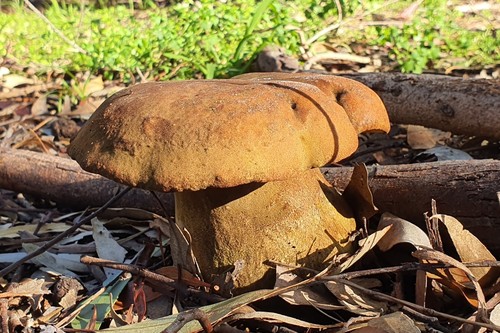
Phlebopus is a genus of fungi in the family Boletinellaceae (suborder Sclerodermatineae of the Boletales order). The genus has a widespread distribution in subtropical and pantropical regions, and contains 12 species. The species are saprobic, with some possibly able to form mycorrhizae with exotic trees in certain conditions. It contains the gigantic Phlebopus marginatus, the cap of which can reach in diameter.
Exsudoporus
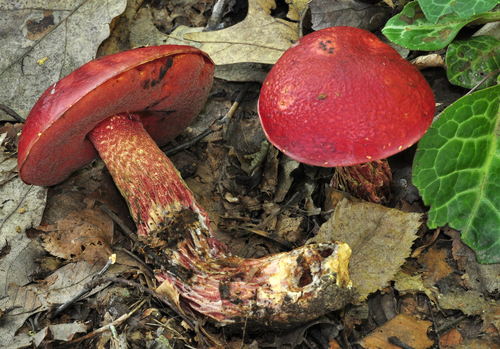
Exsudoporus is a genus of fungi in the family Boletaceae. It was circumscribed in 2014 by Alfredo Vizzini and colleagues, following a number of molecular studies that outlined a new phylogenetic framework for Boletaceae and revealed the genus Boletus in its traditional circumscription to be polyphyletic. However, due to lack of sufficient sequences, Wu and colleagues (2016) were reluctant to accept the newly proposed genus and considered it a synonym of Butyriboletus. Following additional phylogenetic sequencing and morphological analyses, Exsudoporus was clearly resolved as a monophyletic, ho
Gyrodontium
Gyrodontium is a genus of fungi in the family Boletaceae. There are three species in the genus, which have a widespread distribution.
Wakefieldia
Wakefieldia is a genus of two species of fungi, generally thought to belong in the family Boletaceae, but a recent molecular study has shown that Wakefieldia macrospora is in fact not related to Boletales and belongs to family Hymenogastraceae.
Austrogaster
Austrogaster is a genus of fungi in the family Paxillaceae. The genus contains three species found in temperate South America, and New Zealand. The genus was circumscribed by Rolf Singer in 1962.
Truncocolumella
Truncocolumella is a genus of fungi in the family Suillaceae, of the order Boletales. It was circumscribed by American mycologist Sanford Myron Zeller in 1939.
Gymnopaxillus
Gymnopaxillus is a genus of fungi in the family Serpulaceae. According to the Dictionary of the Fungi (10th edition, 2008), the family contains four species found in temperate South America and Australia. Gymnopaxillus was circumscribed by mycologist Egon Horak in 1966 with G. morchelliformis as the type species. G. crubensis, described from Argentina, was added in 1989, while the Australasian species G. nudus and
G. vestitus were added to the genus in 2001.
Mycoamaranthus
Mycoamaranthus is a genus of fungi in the family Boletaceae. The genus contains three species, found in Australasia, Africa, and Southeast Asia.
Meiorganum
Meiorganum is a genus of fungi in the family Paxillaceae. The genus contains two species, distributed in Malaysia and New Caledonia.
Rugiboletus
Rugiboletus is a genus of fungi in the family Boletaceae. It was circumscribed by Chinese mycologists Gang Wu and Zhu L. Yang in 2015 with the alpine species Rugiboletus extremiorientalis (previously Krombholzia extremiorientalis) from eastern Asia as the type species. Rugiboletus brunneiporus of southern China and India was also described that same year. The erection of Rugiboletus follows recent molecular studies that outlined a new phylogenetic framework for the Boletaceae. The generic name—derived from the Latin stem rugi- ("wrinkled") and Boletus as the mushroom caps are wrinkled an
Alessioporus
Alessioporus is a fungal genus in the family Boletaceae. It was circumscribed in 2014 to contain the species formerly known as Xerocomus ichnusanus. Alessioporus ichnusanus is found in southern Europe, where it grows in association with oak species and less often Cistus species. It grows even less frequently with Castanea sativa and possibly with Eucalyptus camaldulensis and Pteridium aquilinum.
Pulchroboletus
Pulchroboletus is a fungal genus in the family Boletaceae. It was circumscribed in 2014 to contain the species formerly known as Xerocomus roseoalbidus, a rare bolete fungus originally described from Sardinia, Italy. Pulchroboletus roseoalbidus is found in Mediterranean Europe, where it grows in association with oak species and less often Cistus species. In 2017, the species Boletus rubricitrinus was moved to Pulchroboletus. Pulchroboletus rubricitrinus can be found under Quercus in lawns in Florida and Texas.
Royoungia
Royoungia is a fungal genus in the family Boletaceae. This genus is represented by the type species Royoungia boletoides, which was found in Australia. In 2016, 5 more species were found in China.
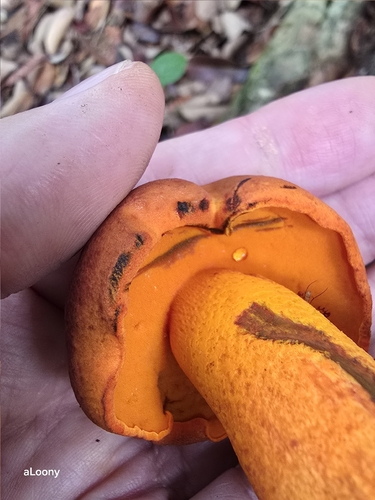
Crocinoboletus
Crocinoboletus is a fungal genus in the family Boletaceae. Circumscribed in 2014, it contains two species: Crocinoboletus laetissimus, and the type, C. rufoaureus. This latter bolete was originally described by George Edward Massee in 1909 from collections made in Singapore. The genus is readily characterized by bright orange fruitbodies that readily stain blue-olive when injured, and smooth spores. The cap cuticle is made of a trichoderm (a cellular arrangement wherein the outermost hyphae emerge roughly parallel, like hairs, perpendicular to the cap surface) in the middle part of the ca
Rhodactina
Rhodactina is a genus of secotioid fungi in the family Boletaceae. The genus was circumscribed in 1989 based on the type species Rhodactina himalayensis, found in India and northern Thailand. The genus was originally classified in the family Gauteriaceae because of similarities in spore ornamentation to the genera Gautieria and Austrogautieria. A second species, Rhodactina incarnata, was added to the genus in 2006. It is found in Dipterocarpaceae-dominated forests in Chiang Mai (northern Thailand). Molecular phylogenetics analysis shows that Rhodactina is aligned with the Boletaceae.
Zangia
genus of fungi
Favillea
Favillea is a genus of fungi within the Sclerodermataceae family.