Category
page 1Bones of the vertebral column

vertebral column
bony structure found in vertebrates

spinal cord
long, thin, tubular structure made up of nervous tissue

scoliosis
Scoliosis (: scolioses) is a medical condition in which the spine has an irregular curve in the coronal plane. The curve is usually S- or C-shaped over three dimensions. In some, the degree of curve is stable, while in others, it increases over time. Mild scoliosis does not typically cause problems, but more severe cases can affect breathing and movement. Pain is usually present in adults, and can worsen with age. As the condition progresses, it may alter a person's life, and hence can also be considered a disability. It can be compared to kyphosis and lordosis, other abnormal curvatures of th

sacrum
The sacrum (: sacra or sacrums), in human anatomy, is a triangular bone at the base of the spine that forms by the fusing of the sacral vertebrae (S1S5) between ages 18 and 30.

coccyx
The coccyx (: coccyges or coccyxes), commonly referred to as the tailbone, is the final segment of the vertebral column in all apes, and analogous structures in certain other mammals such as horses. In tailless primates (e.g. humans and other great apes) since Nacholapithecus (a Miocene hominoid), the coccyx is the remnant of a vestigial tail. In animals with bony tails, it is known as tailhead or dock, in bird anatomy as tailfan. It comprises three to five separate or fused coccygeal vertebrae below the sacrum, attached to the sacrum by a fibrocartilaginous joint, the sacrococcygeal symphysis

atlas
first cervical vertebra of the spine
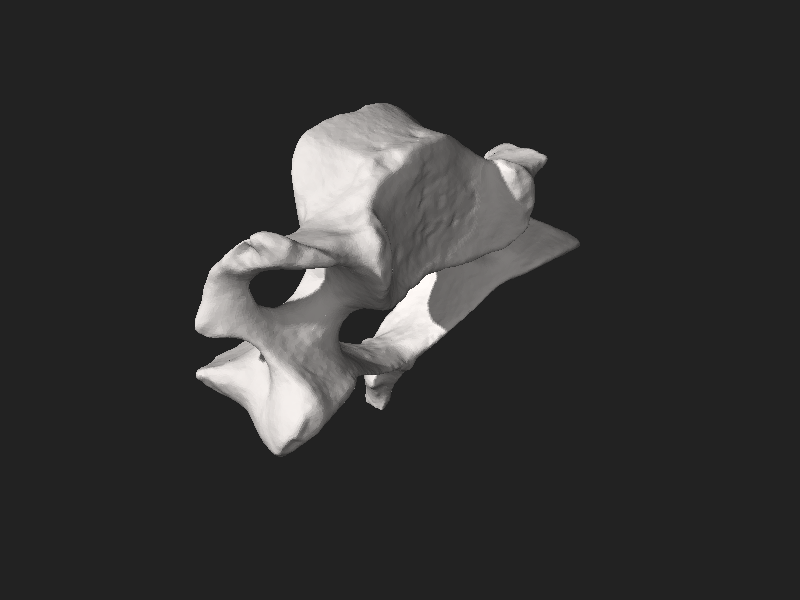
cervical vertebra
vertebra of the human neck
back pain
type of pain felt in the back
intervertebral disc
cartilage of spine
lumbar vertebrae
vertebrae in the region of the lower back, below the thoracic vertebrae and above the sacral vertebrae
thoracic vertebra
one of the vertebra between the cervical vertebrae and the lumbar vertebrae
spinal canal
space in the vertebral column formed by the vertebrae through which the spinal cord passes; it is a process of the dorsal body cavity; this canal is enclosed within the vertebral foramen of the vertebrae
Scheuermann's disease
osteochondrosis that results in abnormal bone growth and curvature located in thoracic vertebral column
cauda equina
lower part of the spinal cord, consisting of the lumbar, sacral, and coccygeal nerve roots

coccydynia
Coccydynia is a medical term meaning pain in the coccyx or tailbone area, often brought on by a fall onto the coccyx or by persistent irritation usually from sitting.
intervertebral foramen
foramen between spinal vertebrae
Schmorl's nodes
medical condition
percutaneous vertebroplasty
type of spinal procedure
atlanto-axial joint
articulation between the cervical atlas and the axis
anterior longitudinal ligament
ligament running down the front of the vertebral column
posterior longitudinal ligament
Bones of the vertebral column, and ligaments of the head and neck and torso
ligamenta flava
ligaments connecting the laminae of adjacent vertebrae
lumbar spinal stenosis
medical condition of the spine
zygapophysial joint
joint between two adjacent vertebrae

subluxation
A subluxation is an incomplete or partial dislocation of a joint or organ. According to the World Health Organization, a subluxation is a "significant structural displacement" and is therefore visible on static imaging studies, such as X-rays. Unlike real subluxations, the pseudoscientific concept of a chiropractic "vertebral subluxation" may or may not be visible on x-rays.
lumbosacral symphysis
joint between the last lumbar vertebra and the first sacral vertebra
nuchal ligament
ligament at the back of the neck
alar ligament
ligaments connecting the skull to the second vertebra to regulate head movement
disc protrusion
vertebrates disease
transverse ligament of atlas
ligament connecting the first and second cervical vertebrae
degenerative disc disease
bone deterioration disease that has material basis in gradual dehydration and tears located in intervertebral disc
supraspinous ligament
Ligament of the spine
sacrococcygeal symphysis
joint in the pelvis
cruciate ligament of atlas
ligament forming part of theatlanto-axial joint
Interspinal ligament
Ligament of the spine
functional spinal unit
the smallest physiological motion unit of the spine to exhibit biomechanical characteristics similar to those of the entire spine
rhizotomy
neurosurgical procedure performed on the spinal cord