Category
page 1Boolean algebra

George Boole
English mathematician, philosopher and logician (1815–1864)

Boolean algebra
branch of algebra abstracting logical operations
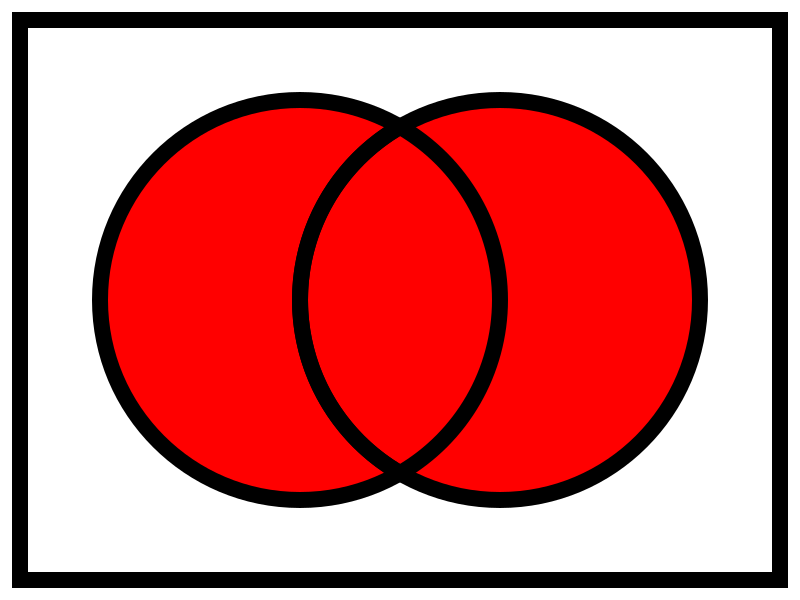
union
operation denoted by symbol “∪” applied on two sets; the set of all distinct elements in the collection

propositional calculus
branch of logic concerned with the study of propositions (whether they are true or false) that are formed by other propositions with the use of logical connectives, and how their value depends on the truth value of their components

De Morgan's laws
pair of transformation rules that are both valid rules of inference

truth table
Mathematical table used in logic

AND gate
logic gate that outputs if both inputs are on

Boolean data type
basic computing representation of truth and falsehood
sigma-algebra
In mathematical analysis and in probability theory, a σ-algebra ("sigma algebra") is part of the formalism for defining sets that can be measured. In calculus and analysis, for example, σ-algebras are used to define the concept of sets with area or volume. In probability theory, they are used to define events for which a probability can be defined. In this way, σ-algebras help to formalize the notion of size.

OR gate
Digital logic gate type
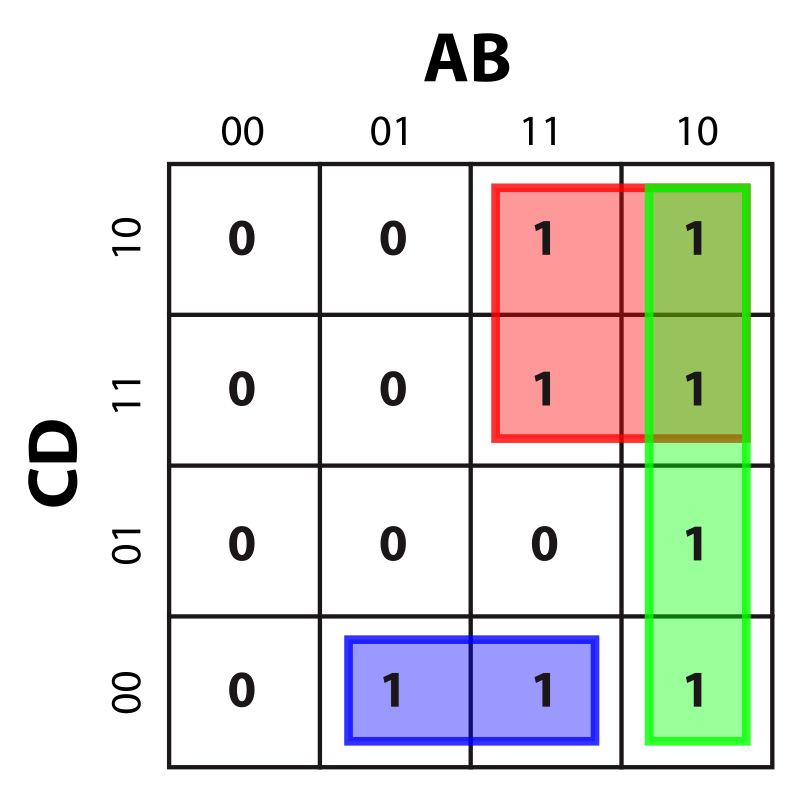
Karnaugh map
method to simplify boolean algebra expressions; refinement of Edward Veitch's 1952 Veitch diagram
bitwise operation
computer operation that operates on values at the level of their individual bits
XOR gate
logic gate
boolean satisfiability problem
problem of determining if a Boolean formula could be made true
Boolean function
any mathematical function with Boolean arguments and result
logical matrix
matrix with entries from the Boolean domain B = {0, 1}
Boolean algebra
lattice that models the classical propositional logic
binary decision diagram
data structure
Quine–McCluskey algorithm
algorithm
field of sets
mathematical structure of sets in an abstract space
Boolean ring
mathematical concept
Boolean domain
set consisting of exactly two elements, interpretable as false and true
Stone's representation theorem for Boolean algebras
theorem
canonical normal form
concept in Boolean algebra
propositional formula
type of logical formula in propositional logic
Boolean expression
expression in a computer program that produces either "true" or "false" when evaluated

Davis–Putnam algorithm
algorithm for check the validity of a logic formula

absorption law
theorem
Implicant
In Boolean logic, the term implicant has either a generic or a particular use. In the generic use, it refers to the hypothesis of an implication (implicant). In the particular use, a product term (i.e., a conjunction of literals) P is an implicant of a Boolean function F, denoted P \le F, if P implies F (i.e., whenever P takes the value 1 so does F).
For instance, implicants of the function
f(x,y,z,w)=xy+yz+w
include the terms xy, xyz, xyzw, w,
as well as some others.
functional completeness
property of a set of logical connectives which can express all possible truth tables by combining members of the set
consensus theorem
theorem
true quantified Boolean formula
problem of deciding the satisfiability of a true quantified Boolean formula
algebraic normal form
algebraic normal form, closely related to Zhegalkin polynomial
Majority function
boolean function
Boolean prime ideal theorem
theorem
Shannon's expansion
theorem in Boolean algebra
Parity function
Boolean function whose value is 1 if the input vector has an odd number of ones
Stone space
type of space in topology (branch of mathematics)

Laws of Form
1969 non-fiction book by G. Spencer-Brown
two-element Boolean algebra
boolean algebra
Petrick's method
minimization algorithm for Boolean algebra
Boolean-valued function
function with two-element codomain
Symmetric Boolean function
Logic optimization
process in digital electronics and integrated circuit design
Boolean differential calculus
subject field of Boolean algebra discussing changes of Boolean variables and functions