Category
page 1Bosons

photon
A photon () is an elementary particle that is a quantum of the electromagnetic field, including electromagnetic radiation such as light and radio waves, and the force carrier for the electromagnetic force. Photons are massless particles that can only move at one speed, the speed of light measured in a vacuum. The photon belongs to the class of boson particles.

Higgs boson
elementary particle transmitting the Higgs field giving particles mass

boson
thumb|upright=1.6|The class of Bosons is one of the two fundamental classes of subatomic particle, the other being [[fermions. All subatomic particles must be one or the other. A composite particle (hadron) may fall into either class depending on its composition.]]

gluon

meson
In particle physics, a meson () is a type of hadronic subatomic particle composed of an equal number of quarks and antiquarks, usually one of each, bound together by the strong interaction. Because mesons are composed of quark subparticles, they have a meaningful physical size, a diameter of roughly one femtometre (10 m), which is about 0.6 times the size of a proton or neutron. All mesons are unstable, with the longest-lived lasting for only a few tenths of a nanosecond. Heavier mesons decay to lighter mesons and ultimately to stable electrons, neutrinos and photons.

graviton
In theories of quantum gravity, the graviton is the hypothetical elementary particle that mediates the force of gravitational interaction. It is a quantum of gravitational wave energy. There is no complete quantum field theory of gravitons due to the unsolved mathematical problem of renormalization in general relativity. This problem is avoided in string theory, which has the graviton as a massless state of a fundamental string, but that theory has not made sufficient progress.

gauge boson
force carrier, a bosonic particle that carries any of the fundamental interactions of nature, commonly called forces

phonon
A phonon is a quasiparticle, collective excitation in a periodic, elastic arrangement of atoms or molecules in condensed matter, specifically in solids and some liquids. In the context of optically trapped objects, the quantized vibration mode can be defined as phonons as long as the modal wavelength of the oscillation is smaller than the size of the object. A type of quasiparticle in physics, a phonon is an excited state in the quantum mechanical quantization of the modes of vibrations for elastic structures of interacting particles. Phonons can be thought of as quantized sound waves, similar
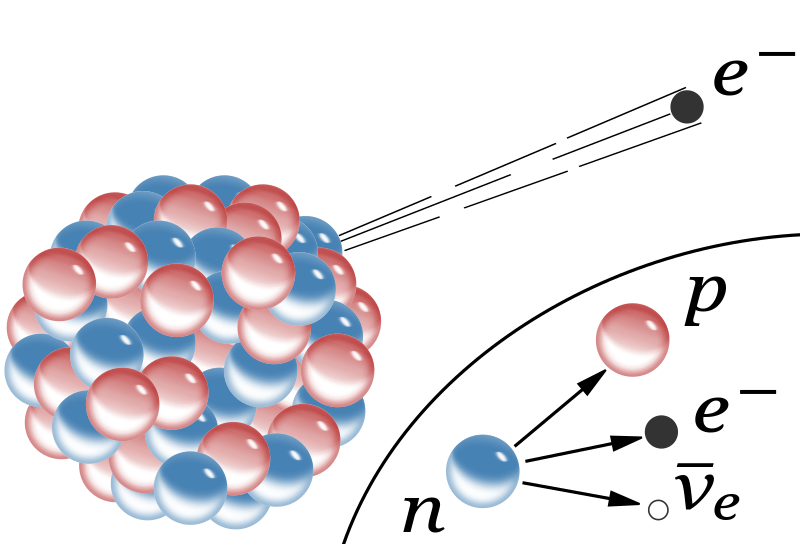
W or Z boson
massive gauge bosons that mediate the weak nuclear interaction

exciton
thumbnail|Frenkel exciton, bound electron-hole pair where the hole is localized at a position in the crystal represented by black dots
thumbnail|Wannier–Mott exciton, bound electron-hole pair that is not localized at a crystal position. This figure schematically shows diffusion of the exciton across the lattice.
axion
An axion () is a hypothetical elementary particle originally theorized in 1978 independently by Frank Wilczek and Steven Weinberg as the Goldstone boson of Peccei–Quinn theory, which had been proposed in 1977 to solve the strong CP problem in quantum chromodynamics (QCD). If axions exist and have low mass within a specific range, they are of interest as a possible component of cold dark matter.
scalar boson
boson with spin equal to zero
sfermion
In supersymmetric extension to the Standard Model (SM) of physics, a sfermion is a hypothetical spin-0 superpartner particle (sparticle) of its associated fermion. Each particle has a superpartner with spin that differs by . Fermions in the SM have spin- and, therefore, sfermions have spin 0.
Goldstone boson
massless boson that must be present in a quantum system with spontaneously broken symmetry
vector boson
boson with the spin equal to 1
dark photon
theoretical elementary particle
X17 particle
hypothetical subatomic particle as the cause of anomalous measurement results near 17 MeV
majoron
In particle physics, majorons (named after Ettore Majorana) are a hypothetical type of Goldstone boson that are conjectured to mediate the neutrino mass violation of lepton number or B − L in certain high energy collisions such as
graviphoton
In theoretical physics and quantum physics, a graviphoton or gravivector is a hypothetical particle which emerges as an excitation of the metric tensor (i.e. gravitational field) in spacetime dimensions higher than four, as described in Kaluza–Klein theory.
chameleon
hypothetical scalar particle
scalar meson
meson with total spin 0 and even parity
Odderon
In particle physics, the odderon corresponds to an elusive family of odd-gluon states, dominated by a three-gluon state. When protons collide elastically with other protons or with anti-protons at high energies, gluons are exchanged. Exchanging an even number of gluons is a crossing-even part of elastic proton–proton and proton–antiproton scattering, while odderon exchange (i.e. exchange of odd number of gluons) corresponds to a crossing-odd term in the elastic scattering amplitude. In turn, the odderon's crossing-odd counterpart is the pomeron.