Category
page 1Bothriospilini

Chlorida festiva
species of beetle

Chlorida costata
Species of beetle
Chlorida
Chlorida is a genus of beetles in the family Cerambycidae, containing the following species:

Chlorida denticulata
species of beetle
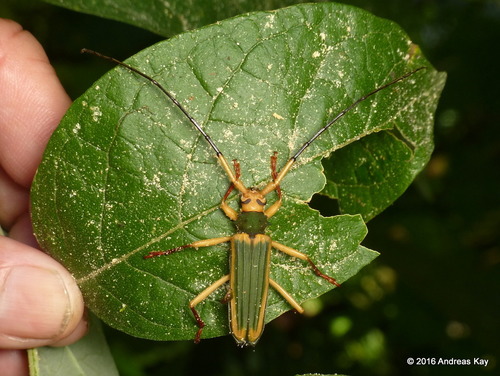
Chlorida cincta
species of beetle

Chlorida curta
species of beetle

Chlorida obliqua
species of beetle

Chlorida transversalis
species of beetle

Chlorida spinosa
species of beetle

Chlorida fasciata
species of beetle
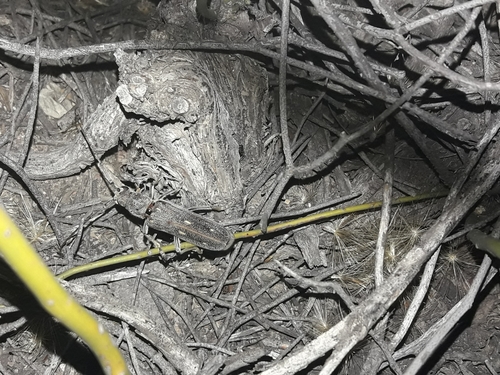
Ranqueles
genus of insects
Ranqueles mus
species of beetle
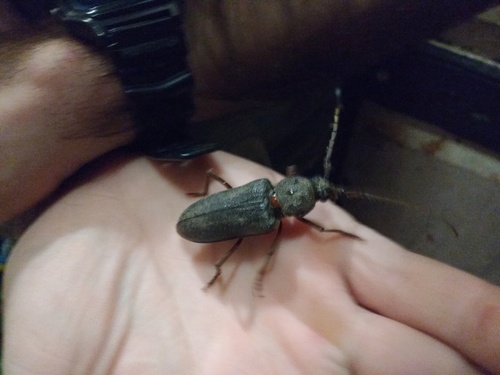
Ranqueles steparius
species of beetle
Ranqueles gounellei
species of beetle
Bothriospilini
Bothriospilini is a tribe of beetles in the subfamily Cerambycinae, containing 11 genera which have a primarily neotropical distribution.
The tribe was proposed in 1950 by Brazilian entomologist Frederico Lane as a member of the new subfamily Bothriospilinae, and with Bothriospila assigned as the type genus. The tribe is morphologically close to the tribe Torneutini, with which it has in common the same shape of the last abdominal segment, which is wide and largely braided in the female, as well as the anterior thigh cavities that are open from behind and the laterally open medial cavity.
Knulliana
Knulliana is a genus of longhorn beetles. It is monotypic, being represented by the single species Knulliana cincta, commonly known as the banded hickory borer. The species may be found throughout the eastern half of North America, including Mexico and the Bahamas, with one subspecies extending to the Sonoran Desert.
Gnaphalodes
Gnaphalodes trachyderoides is a species of beetle in the family Cerambycidae, the only species in the genus Gnaphalodes. It is found in the southern United States, Mexico, and Central America.
Chrotoma
Chrotoma is a genus of long-horned beetles in the family Cerambycidae. There is a single species in Chrotoma, C. dunniana, found in the southwest United States and northern Mexico.
Bothriospila
Bothriospila is a genus of beetles in the family Cerambycidae, and the type genus of the tribe Bothriospilini. It contains two species: the type, Bothriospila elegans, found in Brazil and Paraguay, and Bothriospila pulcherrima, found in Brazil. The latter was described as a new species from Brazil in 2012. Bothriospila was circumscribed in 1923 by Swedish entomologist Per Olof Christopher Aurivillius.
Taygayba
Taygayba venezuelensis is a species of beetle in the family Cerambycidae, the only species in the genus Taygayba. Both the genus and species were described in 1998 by Brazilian entomologists Ubirajara Ribeiro Martins and Maria Helena Mainieri Galileo. As its species epithet suggests, the beetle is found in Venezuela.
Delemodacrys
Delemodacrys mourei is a species of beetle in the family Cerambycidae, the only species in the genus Delemodacrys.
Chlorida inexpectata
species of beetle
Timbaraba
Timbaraba dispar is a species of beetle in the tribe Bothriospilini (family Cerambycidae), and the only species in the genus Timbaraba. Both the genus and its species were described in 2004 by Brazilian entomologists Marcela Laura Monné and Dilma Solange Napp. Timbaraba dispar occurs in Venezuela. It has filiform (threadlike) antennae with 11 segments, and a trapezoidal mentum. The genus name Timbaraba – an indigenous word that means "sprinkles of white" – refers to the eburneous (resembling ivory) callosities that occur on the elytra.
Scapanopygus
Scapanopygus cinereus is a species of beetle in the family Cerambycidae, the only species in the genus Scapanopygus. Both the genus and species were described in 1913 by French entomologist Pierre-Émile Gounelle. The type specimen was collected from Averías, a municipality in Argentina, on the banks of the Salado River.