Category
page 1Brain
.jpg)
brain
The brain is an organ that serves as the center of the nervous system in all vertebrate and most invertebrate animals. It consists of nervous tissue and is typically located in the head (cephalization), usually near organs for special senses such as vision, hearing, and olfaction. Being the most specialized organ, it is responsible for receiving information from the sensory nervous system, processing that information (thought, cognition, and intelligence) and the coordination of motor control (muscle activity and endocrine system).

mind
thumb|alt=Diagram of a head with symbols for different mental capacities inside it|The mind is responsible for phenomena like perception, [[thought, feeling, and action.]]

human brain
main organ of the human nervous system

brain death
permanent, irreversible, total cessation of brain function

blood–brain barrier
semipermable membrane that separates blood and the brain

pons
The pons (from Latin ) is the part of the brainstem that, in humans and other mammals, lies inferior to the midbrain, superior to the medulla oblongata, and anterior to the cerebellum.
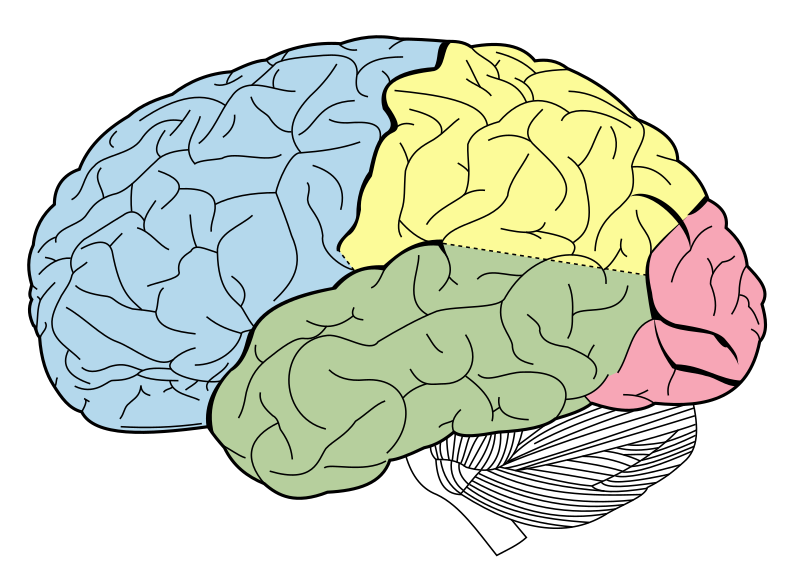
frontal lobe
part of the brain that, because of how large it is, it's responsible for many functions, such as motor control, executive functions, language production, emotional regulation, working memory, and personality

cerebral hemisphere
half of the cerebrum
temporal lobe
part of the brain responsible for processing auditory information and encoding of memory. The temporal lobe also plays a role in processing affect/emotions, language, and certain aspects of visual perception.
ten percent of brain myth
urban legend
motor cortex
region of the cerebral cortex
cerebral lobe
part of the cerebral cortex
lateralization of brain function
tendency for cognitive processes to be specialized to one side of the brain or the other
grid neuron
type of neuron
artificial brain
software and hardware with cognitive abilities similar to those of the animal or human brain
gut–brain axis
biochemical signaling that takes place between the gastrointestinal tract (GI tract) and the central nervous system
brain size
topic of study within the fields of anatomy, biological anthropology, animal science, and evolution

split-brain procedure
Split-brain or callosal syndrome is a type of disconnection syndrome when the corpus callosum connecting the two hemispheres of the brain is severed to some degree. It is an association of symptoms produced by disruption of, or interference with, the connection between the hemispheres of the brain. The surgical operation to produce this condition (corpus callosotomy) involves transection of the corpus callosum, and is usually a last resort to treat refractory epilepsy. Initially, partial callosotomies are performed; if this operation does not succeed, a complete callosotomy is performed to mit
brain-to-body mass ratio
posterior commissure
brain landmark commonly used in biomedical image processing
isolated brain
brain kept alive in vitro outside of a body
large-scale brain network
collection of widespread brain regions showing functional connectivity by statistical analysis of the fMRI BOLD signal or other signal fluctuations
Brain simulation
creation of a computer model of all or part of a brain
The Institutes for the Achievement of Human Potential
organization
list of regions in the human brain
Wikimedia list article

How to Create a Mind
book by Raymond Kurzweil
Dorsal attention network
Areas in the human brain that respond with activation increases to attention-demanding tasks
Corpora amylacea
name for a variety of small anatomical masses
holonomic brain theory
quantum interpretation of neuroscience
aging brain
degradation of functioning of the brain
subarachnoidal lymphatic-like membrane
Proposed fourth meningeal layer
INAH 3
third interstitial nucleus of the anterior hypothalamus
Yakovlevian torque
type of physical brain asymmetry
artery of Percheron
rare anatomic variation in the brain vascularization
Talairach coordinates
3-D coordinate system of the human brain
Functional specialization
theory that regions of the brain are specialized for functions
brainwave entrainment
hypothetical neural stimulation for altering states of consciousness
frontoparietal network
large scale brain network involved in sustained attention
Parental brain
brain changes from parental experience and hormones
salience network
Large scale brain network of the human brain, composed of the anterior insula and dorsal anterior cingulate cortex, which is involved in detecting and filtering salient stimuli, as well as in recruiting relevant functional networks