Category
page 1Bronze Age Asia

Indus Valley Civilization
Bronze Age civilisation in South Asia

Phoenicia
Phoenicians were an ancient Semitic people who inhabited city-states in Canaan along the Levantine coast of the eastern Mediterranean, primarily in present-day Lebanon and parts of coastal Syria. Their maritime civilization expanded and contracted over time, with its cultural core stretching from Arwad to Mount Carmel. Through trade and colonization, the Phoenicians extended their influence across the Mediterranean, from Cyprus to the Iberian Peninsula, leaving behind thousands of inscriptions.

Mohenjo-daro
Mohenjo-daro (; ; ) is an archaeological site in Larkana District, Sindh, Pakistan. Built , it was one of the largest settlements of the ancient Indus Valley Civilisation, and one of the world's earliest major cities, contemporaneous with the civilisations of ancient Egypt, Mesopotamia, Minoa, and Norte Chico.

Urartu
Urartu was an Iron Age kingdom centered around the Armenian highlands between Lake Van, Lake Urmia, and Lake Sevan. The territory of the ancient kingdom of Urartu extended over the modern frontiers of Turkey, Iran, Iraq, Armenia, the southern regions of Georgia, and western regions of Azerbaijan. Its kings left behind cuneiform inscriptions in the Urartian language, a member of the Hurro-Urartian language family.
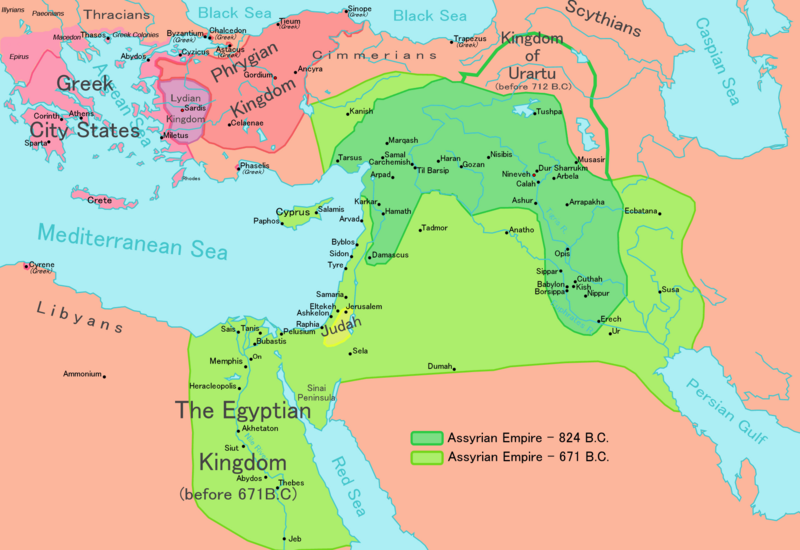
Neo-Assyrian Empire
historical state in Mesopotamia

Kassites
The Kassites (; Neo-Assyrian: 𒂵𒅆𒄿, ka₃-ši-i, kašši) were a people of the ancient Near East, originating from the Zagros Mountains. They controlled Babylonia under the Kassite Dynasty after the fall of the Old Babylonian Empire from until (short chronology).

Proto-Indo-Europeans
The Proto-Indo-Europeans are a postulated prehistoric ethnolinguistic group of Eurasia who spoke Proto-Indo-European (PIE), the reconstructed common ancestor of the Indo-European language family.
Bronze Age collapse
collapse of several civilizations at the end of the bronze age
Ban Chiang
archaeological site in north-east Thailand

Arkaim
Arkaim () is a fortified archaeological site, dated to 2150-1650 BCE, belonging to the Sintashta culture, situated in the steppe of the Southern Urals, north-northwest of the village of Amursky and east-southeast of the village of Alexandrovsky in the Chelyabinsk Oblast of Russia, just north of the border with Kazakhstan. It was discovered in 1987 by a team of archaeologists which later came under the leadership of Gennady Zdanovich. The realization of its importance unprecedentedly forestalled the planned flooding of the area for a reservoir. The construction of Arkaim is attributed to the ea
%20Magan%20Meluha%20with%20transcription.jpg)
Meluhha
' or ' ( ) is the Sumerian name of a prominent trading partner of Sumer during the Middle Bronze Age. Its identification remains an open question, but most scholars associate it with the Indus Valley Civilisation.
Tirzah
ancient Samarian town
Ochre Coloured Pottery culture
Bronze Age culture of the Indo-Gangetic Plain
Co Loa Citadel
Archaeological site in Vietnam
Okunev culture
Bronze Age archaeological culture
Kingdom of Ḫana
Bronze age country in the middle Euphrates
Indonesian ceremonial bronze axes
Bronze Age objects of the Indonesian archipelago
Đông Sơn drum
type of bronze drum from Vietnam
Ingala Valley
archaeological site in Isetsky District, Russia
bronze drum
instrument among Tai-Kadai peoples
Bronze Age India
historical and archeological period of civilization in the Indian subcontinent during the Bronze Age
Gamigaya Petroglyphs
monument
Numeira
thumb|Overview of Numeira, looking west thumb|Early Bronze III destruction level at Numeira, inside the east gate
Numeira (also an-Numayra) is an archaeological site in Jordan near the southern Dead Sea. The site has substantial Early Bronze Age remains.
Beshamoun
Bechamoun (), is a town near Beirut in the Mount Lebanon Governorate of Lebanon. It has an area about 6.6 square kilometres and elevation between 60 and 580 metres above sea level. It lies 8 kilometres from Beirut’s airport and central Beirut. The town has a population of greater than 80000.
Jhukar Phase
Tulamba
Tulamba (also Tulambah) () is a small town in Punjab, Pakistan. Tulamba is situated on the eastern bank of the Ravi River, between the cities of Abdul Hakeem and Mian Channu. Prior to 1985, Tulamba was administered as part of the district of Multan, but in 1985 it was included in Mian Channu Tehsil of the newly formed Khanewal District. Tulamba's population is nearly 50,000. The spoken language is Rachnavi Punjabi. A native of Tulamba is referred to as a Tulmabvi.
Early Assyrian period
history of Assyrian civilization of Mesopotamia between 2500 BCE and 2025 BCE
II Kultepe
Kultepe-2 (also known as II Kultepe) is an ancient settlement in Nakhchivan. It is located about 1.5 km north of the related ancient site of Kultepe-1, or about 10 km north of Nakhchivan (city) on the west bank of Nakhchivanchay (Nakhchivan river; :de:Naxçıvançay) river between the villages of Kültepe and Didivar. In ancient times, the site reached nearly 10 ha in size, but the river erosion reduced this now to about 3 ha. Chehrichay (Chehri river) connects in this area with Nakhchivan river.
Garakepektepe
Garakopaktapa () is an ancient multilayer settlement of the Middle Bronze Age epoch, located in a basin of the Guruchay and Kondalanchay Rivers, near Fuzuli Rayon, Azerbaijan.
history of metallurgy in the Indian subcontinent
aspect of history
Pejeng drum
Type of ancient bronze kettledrum
Tall Zira'a
archaeological site in Jordan